
Protecting Your Community’s “Naturally Occurring Affordable Housing”
September 18, 2024
by
Steve Butler
Category:
Housing
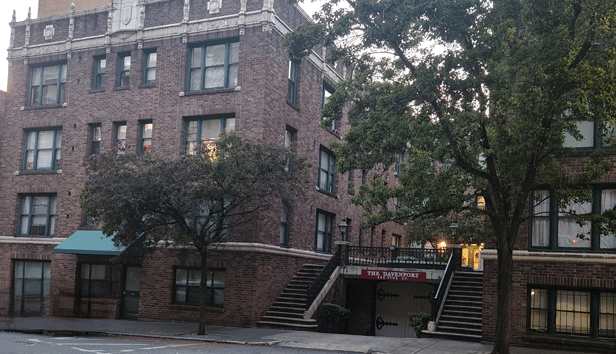
Photo provided courtesy of the author
Rising rental rates and home prices have made affordable housing an increasingly challenging issue for many Washington households. While much attention has been focused on ways to encourage new affordable housing units, it is important to recognize the role of naturally occurring affordable housing (NOAH), which currently exist in almost every community in our state and throughout the U.S. The need to preserve this type of existing affordable housing is being recognized and acknowledged by an increasing number of Washington cities, towns, and counties.
This blog will describe the importance of NOAH in more detail and identify the growing number of local governments that are seriously studying policies and actions to use NOAH as another way of maintaining its affordable housing supply.
What Is Defined as NOAH?
There is no official definition in Washington State, but NOAH generally refers to residential properties that are “affordable” but not subsidized by any federal or state programs, with rents and purchase prices that are relatively low compared to the regional housing market. These properties usually include older apartment complexes, older single-family homes, and housing in manufactured housing communities, all of which typically have lower rent or purchase prices than newer developments.
Why Is NOAH Important?
Naturally occurring affordable housing helps individuals and families that might otherwise be priced out of local housing, especially in a hot market. NOAH often serves lower-income families, seniors, and working-class individuals who are crucial to a community’s fabric but not typically the target audience for new, market-rate residential developments.
Maintaining and renovating existing affordable housing will almost always be more financially feasible than building new residential units. The 2015-2022 Washington statewide average cost to build one unit of new multi-family housing was $307,407, much higher than the average cost of preserving an existing apartment unit (even if renovations are needed).
A major difficulty for developers and builders of new affordable housing is finding land parcels available for development (both physically and financially) that will not generate a lot of local community/neighborhood opposition to a proposed housing project. Accordingly, another benefit of longstanding NOAH is that the housing units have been in existence for several years and are presumably accepted by the community.
A major challenge to preserving NOAH is that, as property values rise in an active real estate market, there is often pressure for owners of NOAH to either upgrade these older properties so they may command higher rents or sell them to a developer who will likely demolish the existing units and build new, market-rate housing. Such cases usually lead to increased housing costs and the strong potential for current residents to be displaced.
In addition, NOAH properties sometimes suffer from underinvestment by their owners, which can lead to deteriorating conditions for current residents and/or an increased likelihood of redevelopment.
What Can Local Governments Do to Protect NOAH?
There are several types of actions can be taken by local governments and other public agencies to maintain NOAH in their communities, including:
- Policy Support: Local leaders can adopt policies and create programs to protect NOAH from being redeveloped into high-end housing. Measures like tenant protection laws can help maintain the affordability of these crucial properties.
- Preservation Initiatives: Local governments and housing organizations can implement preservation strategies such as providing incentives for property owners to maintain and improve their buildings without significantly raising rents. Programs like Tacoma’s Historic Preservation Program and the Regional Equitable Development Initiative (REDI) Fund exemplify this approach.
- Community Land Trusts: Nonprofit community land trusts (CLTs) can protect NOAH properties by purchasing and managing them, thereby preventing market pressures from driving up rents and ensuring long-term affordability. For example, the Homestead CLT works to both preserve existing and build new affordable housing units in King County.
Local Policy Examples
Many existing comprehensive plans and housing actions plans already address NOAH. The Washington State Department of Commerce’s Guidance for Updating Your Housing Element (Book 2) includes a lot of very useful information about NOAH, including many policy examples in Appendix C, such as:
- Encouraging and supporting efforts to maintain opportunities for lower-cost housing where relatively affordable housing exists through preservation or other efforts and particularly in centers where most redevelopment pressure will occur (see Housing Policy HO-41 from the Redmond Comprehensive Plan, 2011).
- Encouraging property owners to take advantage of existing maintenance and preservation programs, services, and resources, including the Historic Preservation Tax Credit (See Housing Element – Maintenance & Preservation: Policy 3 from the Wenatchee Urban Area Comprehensive Plan, Updated 2023).
- Favoring the rehabilitation, relocation, and reuse of existing housing over its demolition (see Housing Chapter Policy H-34 from the Bellingham Comprehensive Plan, 2016).
It is also encouraging to see that more comprehensive plans will include specific NOAH policies and strategies. For example, the Bellevue's draft Comprehensive Plan Update contains the following draft policy:
HO-38. Monitor the city’s stock of both subsidized and naturally occurring affordable housing and work to preserve it as permanent income-restricted housing.
Burien’s draft Comprehensive Plan Update includes draft goal 4.1 to “(p)lace a high priority on conserving and improving the Burien’s existing housing stock,” which includes a recommended strategy about “(p)rotecting naturally occurring affordable housing and housing with long term affordability covenants.”
The town of Steilacoom’s draft Comprehensive Plan Update (draft policy H 3.1) states:
The Town recognizes the fact that the existing housing stock is an important source of affordable housing units. The housing element will establish provisions to preserve the existing housing stock through repair, maintenance, and rehabilitation.
Conclusion and Resources
Addressing affordable housing will continue to be a challenging issue in our state and in many other parts of the U.S. It is important for all interested parties, including local governments, to understand and evaluate the mechanisms that are available to effectively address our housing problem and use as many as determined to be locally feasible. Preserving and protecting naturally occurring affordable housing in your community deserves serious consideration.
For more information on NOAH, see the resources below:
- American Planning Association: Can Zoning Save Naturally Occurring Affordable Housing (NOAH)? (2023) – Free summary provided; $10 fee to download the full report with no cost to Zoning Practice subscribers.
- Mecklenburg County: Housing & Homelessness Myths Busted - Naturally Occurring Affordable Housing
- National League of Cities: What is Affordable Housing? (2024)
The author would like to thank Laura Hodgson and Courtney Williams (Washington State Department of Commerce) and Inonge Mubita (MRSC Public Policy Intern) for their assistance with this blog.
MRSC is a private nonprofit organization serving local governments in Washington State. Eligible government agencies in Washington State may use our free, one-on-one Ask MRSC service to get answers to legal, policy, or financial questions.


