
Levy Lid Lifts
This page provides an overview of property tax levy lid lifts for local governments in Washington State, including rate-based and multi-year options plus examples of local resolutions.
For a more comprehensive discussion of the intricacies of the property tax in Washington State, refer to MRSC's City Revenue Guide and County Revenue Guide, or the Department of Revenue's Property Tax Levies Operations Manual.
Levy lid lifts are a complicated issue and if you are considering such a ballot measure it is important to seek guidance from legal counsel.
New legislation: Effective July 1, 2026, Sec. 501 of HB 2442 made the following changes to levy lid lifts:
- Rate-based ("single-year") levy lid lifts can optionally set a levy rate for two consecutive years.
- The maximum length of multi-year levy lid lifts—the number of years the jurisdiction can use exceed the 101% limit—has been extended from six years to 10 years.
For more information, see our blog post Significant Changes Coming to Levy Lid Lifts in 2026. We have updated this webpage to reflect the new legislation.
Overview
The passage of Initiative 747 in 2001 established a “101% levy limit” limiting the amount that any taxing district can increase its regular property tax levy (the total amount of revenue collected) from current assessed valuation (excluding new construction) without voter approval. The state Supreme Court struck down the initiative in 2007, but the legislature reinstated it.
The levy limit is as follows:
- Taxing districts under 10,000 population may not increase the total levy amount collected from current assessed valuation by more than 1% annually (the “levy lid”).
- Taxing districts with a population of 10,000 or more may not increase the total levy amount collected from current assessed valuation by more than 1% annually or the rate of inflation, whichever is lower. However, if the inflation rate is below 1%, these jurisdictions may adopt resolutions of “substantial need” to increase the levy up to 1 percent. For more on the inflation rate and resolutions of substantial need, see our Implicit Price Deflator webpage.
Note: These tax limits apply only to current assessed valuation and do not affect property tax levies from new construction or increases in state-assessed utility valuation.
The 101% limit obviously restricts revenue growth, especially for jurisdictions that are heavily dependent on property taxes and whose costs are increasing more than 1% per year due to inflation, salary and benefit costs, and other factors. (To see property tax vs. sales tax reliance for all cities and towns in Washington, see our Tax Reliance Map.)
If property values are increasing more than 1% per year within a jurisdiction, the 1% levy limit also puts downward pressure on the maximum allowable levy rates (the tax rate per $1,000 assessed value), forcing the jurisdiction to collect a lower rate than it used to.
Example of How the 101% Limit Affects Property Tax Rates
| Year | Current Assessed Valuation (excluding new construction), assumes 2% annual increase | Maximum Allowable Levy (1% annual increase) | Maximum Allowable Levy Rate/$1,000 AV |
|---|---|---|---|
| 1 | $100,000,000 | $150,000 | $1.50 |
| 2 | $102,000,000 | $151,500 | $1.49 |
| 3 | $104,040,000 | $153,015 | $1.47 |
| 4 | $106,120,800 | $154,545 | $1.46 |
| 5 | $108,243,216 | $156,091 | $1.44 |
However, there are two ways for a jurisdiction to increase its regular levy above the 1% limit:
- Banked capacity: A jurisdiction may take less than the maximum increase in any given year and “bank” the remaining capacity to use in the future. For more information on banked capacity, see our page Property Tax Basics. If you do not know whether your jurisdiction has banked capacity that it can use, ask your county assessor.
- Levy lid lift: A taxing district may seek voter approval to increase its levy more than 1%, up to the statutory maximum rate, for a specified amount of time.
Most jurisdictions may also submit a special, or excess, levy to their voters to temporarily increase their taxes above the statutory maximums (RCW 84.52.052 for most agencies and RCW 84.52.130 for fire protection districts). However, this is separate from the regular levy, expires after one year for all agencies except fire protection districts, and requires a 60% majority.
What is a Levy Lid Lift?
A levy lid lift allows a local government to increase its property tax revenues above the 101% levy limit discussed earlier.
A taxing district can ask a voters to “lift” the total levy amount collected from current assessed valuation by more than 1%. However, the new levy rate per $1,000 assessed valuation cannot exceed the jurisdiction's maximum statutory levy rate. See RCW 84.55.050 and WAC 458-19-045. (The WAC provides a better understanding of the process than the RCW.)
There are two basic types of levy lid lifts:
- Rate-based levy lid lifts, which allow a jurisdiction to exceed the 101% limit for one or two years only. Before new laws took effect in 2026, MRSC referred to these as "single-year" levy lid lifts.
- Multi-year levy lid lifts, which allow a jurisdiction to exceed the 101% limit for up to 10 years.
Either type of levy lid lift can be temporary or permanent, as described later.
What Can Levy Lid Lifts Be Used For?
A levy lid lift increases an existing property tax levy, so the use of the revenues depends on the type of local government levy and the wording of the ballot measure.
Regular Property Tax Levies
Most local governments have a regular property tax levy which supports their general fund/current expense fund. This includes cities, towns, counties, fire protection districts, library districts, public hospital districts, park districts, port districts, cemetery districts, and more.
A levy lid lift on a regular levy can be used for any lawful governmental purpose for that particular agency type.
Practice Tip: Stating a specific use for the funds in the ballot measure itself—such as transportation improvements, fire department staffing, swimming pool operations, etc.—might make voters more likely to say yes, particularly if it is for a popular program.
However, if the ballot measure states a specific purpose, the levy lid lift revenues may only be used for that purpose and should be tracked accordingly.
Restricted Property Tax Levies
Some local governments can impose additional property tax levies which are restricted to a specific purpose. A levy lid lift on a restricted property tax levy can only be used for the purposes authorized in statute for that type of levy. Examples include:
- County road levy: A levy lid lift may only be used for eligible county road and bridge expenses.
- Emergency medical services (EMS) levy: A levy lid lift may only be used for eligible EMS expenses.
- Affordable housing levy: A levy lid lift may only be used for financing affordable housing for “"ow-income" or "very low-income" households
- Etc.
Can Levy Lid Lifts Be Used to Repay Debt?
Yes. Any local government can use a levy lid lift to repay debt for up to nine years—except for Thurston County which can use it to repay debt up to 25 years.
A levy lid lift only requires simple majority voter approval, while voted general obligation (G.O) bonds require a 60% supermajority plus validation (minimum voter turnout). However, if a jurisdiction can get enough voter support, G.O. bonds have several advantages over levy lid lifts for repaying debt:
- G.O. bonds provide a more stable revenue stream than levy lid lifts for repaying debt. G.O bonds are repaid by excess levies that are automatically sized to pay the principal and interest every year and are not subject to the 101% levy limit. The revenue generated by a levy lid lift is less predictable and depends on factors such as the 101% levy limit and—for multi-year levy lid lifts—the limit factor chosen by the jurisdiction.
- G.O. bonds might result in lower interest rates compared to a levy lid lift. The bond market will likely see a dedicated G.O. bond excess levy as a more secure revenue source, which may result in a better rating and lower interest rates on the debt.
- G.O. bonds can be repaid over a longer time than levy lid lifts. Most jurisdictions can only use levy lid lifts to repay debt up to nine years. G.O. bonds can be repaid over a much longer time, often 20-30 years or more.
Rate-Based Levy Lid Lifts
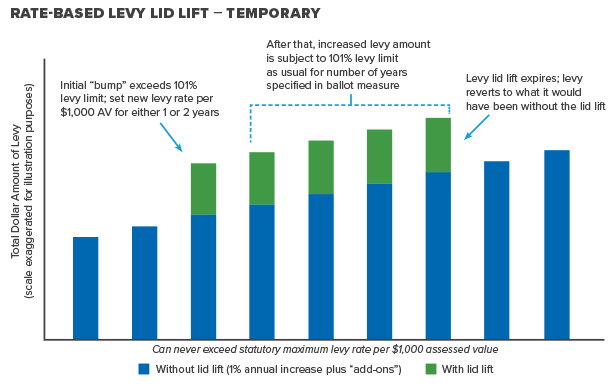
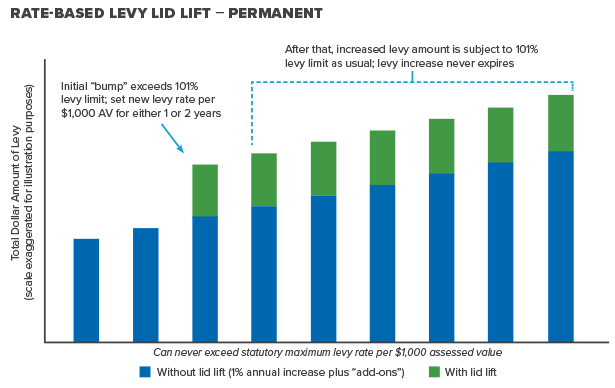
A rate-based levy lid lift allows your jurisdiction to increase its levy amount by more than 1% for one or two consecutive years. The increase for each year is stated as a rate per $1,000 assessed value, not a percentage. The levy amount in the final year is then used as a base to calculate all future 1% levy limitations for the duration of the levy.
A rate-based levy lid lift can either be:
- Temporary, in which case the increased levy amount expires after a certain number of years. Once the levy lid lift expires, the levy amount reverts to what it would have been if the levy lid lift never happened and the jurisdiction had just increased its levy the normal 1% each year in the meantime. See RCW 84.55.050(5). Or:
- Permanent, in which case the levy amount in Year 1 (or Year 2, if applicable) is used to calculate all future 101% levy limitations and the levy increase never expires.
See below for conceptual examples. Click on the images to view larger versions.
Examples of Rate-Based Levy Lid Lift Ballot Language
Below are simplified examples showing how a rate-based levy lid lift might appear on the ballot. The exact levy rates, durations, and language will vary between agencies and must be written by the city/town attorney or county prosecuting attorney, as appropriate.
| Rate-Based Temporary Levy Lid Lift—Resets Levy Rate for 1 Year, Expires After 10 Years | Rate-Based Permanent Levy Lid Lift—Resets Levy Rate for 2 Years and Never Expires |
|---|---|
| If approved, this proposition would restore the [agency's] levy rate to $1.50 per $1,000 assessed value for collection in 2027. The 2027 levy amount will be used to calculate subsequent levy limits through 2036 under chapter 84.55 RCW. | If approved, this proposition would restore the [agency's] levy rate to $1.50 per $1,000 assessed value for collection in 2027 and 2028. The 2028 levy amount will be used to calculate subsequent levy limits under chapter 84.55 RCW. |
Multi-Year Levy Lid Lifts
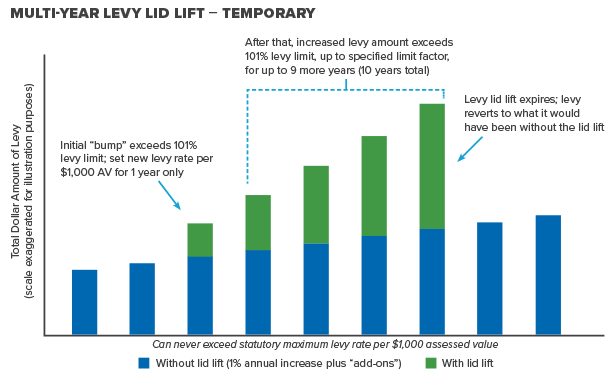
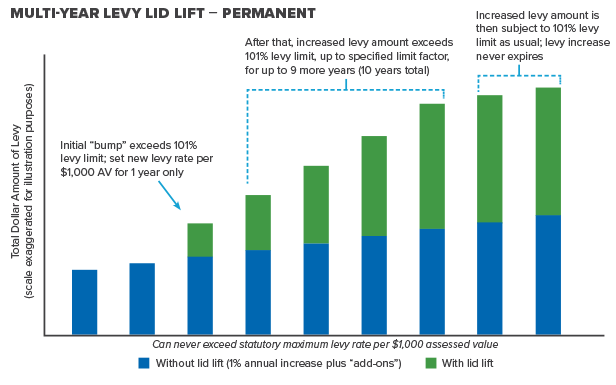
A multi-year levy lid lift allows your jurisdiction to increase its levy amount by more than 1% for up to 10 consecutive years.
A multi-year levy lid lift measure must state the limited purposes for which the increased levy will be used (unlike a rate-based lid lift, where there is no requirement to state the purpose).
The levy lid lift must state the total tax rate per $1,000 assessed value for the first year only – it cannot state the maximum rate in future years. For all subsequent years, the measure must identify a maximum “limit factor” which the total levy amount cannot exceed.
The limit factor can be stated as an annual percent increase or tied to a specific inflation index. For example, the limit factor might be:
- 103% (a 3% annual increase)
- A 6% annual increase for the first two years and 4% annual increase after that
- The annual change in the specified Consumer Price Index or other inflationary index
- Etc.
Similar to a rate-based levy lid lift, a multi-year levy lid lift can either be:
- Temporary, in which case the increased levy amount expires after a certain number of years. Once the levy lid lift expires, the levy amount reverts to what it would have been if the levy lid lift never happened and the jurisdiction had just increased its levy the normal 1% each year in the meantime. See RCW 84.55.050(5). Or:
- Permanent, in which case the levy amount in the final year of the levy is used to calculate all future 101% levy limitations and the levy increase never expires.
See below for conceptual examples. Click on the images to view larger versions.
What Limit Factor Should We Use for a Multi-Year Levy Lid Lift?
It depends. Factors to consider when choosing a limit factor include how much your costs and assessed valuations are increasing.
For example, if a city wants to raise its levy rate to $3.00 per $1,000 assessed value, and assessed valuations are rising about 6% annually, the city might want to establish an annual limit factor of 6% (sometimes expressed as 106%) in an attempt to maintain the $3.00 levy rate. If the city uses a limit factor of less than 6% in that situation, the levy rate will likely fall in subsequent years as the increase in current assessed valuation outpaces the annual levy lid increase.
If using an inflation index such as the Consumer Price Index (CPI), you should identify the specific regional index you want to use in your ballot measure. In addition, many jurisdictions add language to the effect of "the percent change in the [CPI index] or 1%, whichever is greater." This allows these agencies to take the normal 1% annual increase even if the CPI falls below 1%.
For more information on the various CPI options and considerations, see our webpage on the Consumer Price Index.
Examples of Multi-Year Levy Lid Lift Ballot Language
Below are simplified examples showing how a multi-year levy lid lift might appear on the ballot. The exact levy rates, durations, limit factors, and language will vary between agencies and must be written by the city/town attorney or county prosecuting attorney, as appropriate.
| Multi-Year Temporary Levy Lid Lift—Resets Levy Rate for 1 Year, Sets Limit Factor for 5 More Years, Then Expires | Multi-Year Permanent Levy Lid Lift—Resets Levy Rate for 1 Year, Sets Limit Factor for 9 More Years, Never Expires |
|---|---|
| If approved, this proposition would restore the [agency's] levy rate to $1.50 per $1,000 assessed value for collection in 2027 and authorize a [limit factor chosen by agency, such as 106% or CPI increase] for 2028-2032, not to exceed the $1.50 rate. | If approved, this proposition would restore the [agency's] levy rate to $1.50 per $1,000 assessed value for collection in 2027, authorize a [limit factor chosen by agency, such as 106% or CPI increase] for 2028-2036 not to exceed the $1.50 rate, and use the 2036 levy amount to calculate subsequent levy limits under chapter 84.55 RCW. |
When Can We Submit a Levy Lid Lift to Voters?
Rate-based levy lid lifts may be submitted to the voters at any special, primary, or general election. However, multi-year lid lifts are limited to the August primary or November general elections.
Assuming the measure passes, the election date will determine when you will get your first tax receipts. Levy lid lifts must be submitted no more than 12 months before the levy is made (the date your budget is certified), and taxes levied in November are first due on April 30 of the following year. This means to receive increased tax revenues next year, your election can be no later than November of the current year. If you wait until September or October, during budget discussions, to begin discussing a levy lid lift for the coming year, it is too late because the general election deadline will have already passed. It pays to plan ahead!
For more information on election timing and deadlines, see our page Local Government Ballot Measures.
What Are the Ballot Measure Requirements?
All levy lid lifts require a simple majority (50% plus one) for passage. Levy lid lifts do not have any validation (minimum voter turnout) requirements. However, there are slightly different ballot requirements for rate-based and multi-year lid lifts.
Rate-Based Levy Lid Lift Ballot Requirements
A rate-based levy lid lift ballot measure must:
- State the maximum tax rate to be imposed in the first year and, if applicable, the second year (for instance, $1.50 per $1,000 AV).
- If temporary, state the total duration of the levy (number of years).
- If permanent, state that it is permanent or that the dollar amount of the levy will be used for the purpose of computing the limitations for subsequent levies.
- State the exemption for senior citizens and persons with disabilities under RCW 84.36.381, if the jurisdiction wishes to exempt these individuals (cities and counties only).
The ballot measure does not have to state:
- The purpose, although doing so is a good idea.
- The increase in the levy rate (for instance, an increase of $0.20 per $1,000 AV), although some jurisdictions do so.
- The maximum total levy amount (for instance, a total levy amount of $300,000). In fact, including the total dollar amount can lead to confusion or even legal challenges if the levy lid lift passes. For instance, if there are significant increases to assessed valuation in Year 1 of the levy lid lift, multiplying the levy rate stated in the ballot measure by the new assessed valuation might result in a levy amount that is higher than the dollar amount approved by voters.
Multi-Year Lid Lift Ballot Requirements
A multi-year lid lift ballot measure must:
- State the total levy duration (number of years).
- If permanent, state that it is permanent or that the dollar amount of the levy will be used for the purpose of computing the limitations for subsequent levies.
- State the maximum tax rate to be collected in the first year (for instance, $1.50 per $1,000 AV).
- State the limit factor to be used for all subsequent years (stated as an annual percent increase or inflation index). The amounts do not need to be the same for each year.
- State the exemption for senior citizens and persons with disabilities under RCW 84.36.381, if the jurisdiction wishes to exempt these individuals (cities and counties only).
The ballot measure cannot state the maximum levy rate for subsequent years after the first year.
Local Ballot Measures: For general information on ballot measures, including ballot title composition, pro and con committees, and more, see our page Local Government Ballot Measures. In addition, levy lid lifts have a number of specific ballot title requirements as indicated below.
Local governments are limited in what they can do to support a ballot measure. For more information, see our page on Use of Public Facilities in Election Campaigns.
Which Option is Better?
It depends. There are several factors that may impact the decision of rate-based vs. multi-year lid lifts. Here are a few to consider:
- How much money you need to raise.
- What you need the revenue for, and for how long (for instance, continued operating costs versus a capital project that will only last a few years).
- How quickly your costs, and property values, are increasing.
- Your desired election date (special, primary, or general).
- How you think voters will respond to the different alternatives (for instance, a permanent versus temporary tax).
The multi-year lid lift is slightly more restrictive in its uses, since the purpose must be stated in the ballot title. However, as stated earlier it is a good idea to state the purpose even if it is not required.
Levy Lid Lift Election Results
Want to know how other recent lid lifts have been structured or fared at the polls? Use our Local Ballot Measure Database to find out! Select “Filter by Ballot Categories” and, under “Funding Type/Statutory Authority,” select “Levy Lid Lift.” You can further refine your search by government type, subject matter, county, and years, if desired.
In recent years, about 75% of levy lid lifts have passed, although the individual results can vary widely depending on local circumstances.
Examples of Levy Lid Lifts
Below are examples of levy lid lift resolutions, along with supporting information such as staff reports, ballot resolutions, and fact sheets.
General
- Washington Fire Commissioners Association: Sample 101% Levy Lid Lift Packet (2026) – Includes sample resolutions and ballot titles for single-year rate-based, two-year rate-based, and multi-year levy lid lifts. Multi-year lid lift resolutions include options for fixed percentage increases, indexing to the Consumer Price Index, or variable percentages.
Rate-Based Temporary Lid Lifts
- Bellingham Resolution No. 2018-09 (2018) – 10-year levy, combining a rate-based levy lid lift with an affordable housing levy under RCW 84.52.105.
- Duvall Resolution No. 16-13 (2016) – Rate-based lid lift (9 years) for debt service on ballfields, as well as a full-time school resource officer and IT infrastructure improvements.
- San Juan County Resolution No. 33-2014 (2014) – Rate-based lid lift (6 years) for a wide variety of county services, canceling an existing levy lid lift.
Rate-Based Permanent Lid Lifts
- Cheney Ordinance No. W-68 (2015) – Rate-based lid lift (permanent) for public safety, governmental services, communications/technology upgrades, and capital facilities.
- Clark County Fire District No. 6 Resolution No. 2015-04 (2015) – Rate-based lid lift (permanent) for fire and EMS.
- YouTube: 2015 Levy Lid Lift – 9-minute recorded presentation.
- Kitsap Regional Library Resolution 2017/04 (2017) – Rate-based lid lift (permanent) to maintain and improve library services and prevent service cuts over the next five years.
- Port of Klickitat Resolution No. 5-2012 (2012) – Rate-based lid lift (permanent) for development and expansion of port district’s industrial facilities and properties, replacing an expiring industrial development district levy.
- West Richland Resolution No. 25-16 (2016) – Rate-based lid lift (permanent) for library services, replacing an existing 2.5% utility tax Also includes staff report evaluating various levy lid lift options and a mailer explaining the proposal to residents.
Multi-Year Temporary Lid Lifts
- Port of Klickitat Resolution No. 2-2013 (2013) – Multi-year levy lid lift for port district operations, offsetting an expired industrial development district levy. 6 years, limit factor of 3%. Includes fact sheet.
Multi-Year Permanent Lid Lifts
- Shoreline
- Ordinance No. 873 (2019) – Setting property tax levy (dollar amount and percent increase) for next year; regular levy increased more than 1% since it was tied to the Seattle CPI-U.
- Resolution No. 389 (2016) – Multi-year lid lift for police, parks and recreation, and community services. 6 years/permanent, limit factor tied to Seattle CPI-U index. Includes staff report, FAQs, mailer, and community presentation.
- Where Do Your Property Taxes Go? – One-page overview of where each dollar of property taxes goes; used in conjunction with levy lid lift.
- South Kitsap Fire & Rescue Resolution No. 2017-01 (2017) – Multi-year lid lift for fire and EMS. 6 years/permanent, limit factor tied to Seattle CPI-W index.
- Stanwood Resolution No. 2015-16 (2015) – Multi-year lid lift for contracted police, fire, and EMS services. 6 years/permanent, limit factor of 6%. Includes staff report evaluating levy lid lift options, as well as FAQs.
- Stevens County Fire District No. 6 Resolution No. 2026-01 (2026) – 10 years/permanent. Increases levy rate to $1.09 per $1,000 AV for first year. Limit factor is West Region CPI-U or 1%, whichever is greater. Includes explanatory statement.
Interlocal Agreements
- King County/Fire Districts Levy Buy-Down Agreement (2015) – County will buy down fire district levy rates under RCW 39.67.020 if any fire district has its levy reduced through prorationing as a result of proposed countywide levy lid lift.
Recommended Resources
- MRSC: Use of Public Facilities in Election Campaigns – Information on what local governments can and can’t do to support a ballot measure
- Foster Garvey: Comparison of Levy Lid Lift Mechanisms (2026) – One-page table comparing "basic" (one- or two-year) and multi-year options
- WA Department of Revenue Ballot Measure Requirements – Explains the requirements taxing districts must follow to create property tax ballot measures, including levy lid lifts


