
Historic Preservation
This page provides an overview of historic preservation for local governments in Washington State, including state and national designations, examples of local historic preservation programs and ordinances, relevant court decisions, and related resources.
Overview
Historic preservation helps maintain and restore cultural resources for future generations, while supporting environmental goals. By preserving historically significant neighborhoods, structures, and archaeological sites, local governments can revitalize downtown areas, encourage tourism, and bolster their economies.
Preserving historic buildings also almost always offers environmental and energy savings over demolition and new construction. According to the U.S. Environmental Protection Agency, renovating existing buildings reduces carbon usage from demolition, then transporting and using new materials.
This page provides an overview of national, state, and local opportunities for historic preservation, as well as examples of plans and municipal codes supporting this goal. It also lists tools local governments can use to fund and incentivize historic preservation.
National and State Historic Landmark Designations
The National Historic Preservation Act of 1966 outlines federal and state historic preservation programs, including the National Register of Historic Places and National Historic Landmark listings. The Washington Heritage Register, maintained by the state Department of Archaeology and Historic Preservation (DAHP), includes sites, buildings, structures, and objects. This designation offers recognition and protection for important resources.
National Designations
There are two federal programs that designate historic landmarks: the National Register of Historic Places (36 CFR Part 60) and the National Historic Landmarks Program (36 CFR Part 65). Both are managed by the National Park Service (NPS).
- National Register of Historic Places – Over 1,600 properties in Washington are on the register. However, a listing does not impose restrictions on a non-federal owner's actions, including demolition. Restrictions are only triggered when the property receives federal assistance (36 CFR Part 60).
- National Historic Landmarks Program – Includes properties with national historical significance, not just local or regional importance. There are 25 National Historic Landmarks in Washington State.
For a comprehensive list of federal statutes, see the DAHP website.
Washington State Designations
The following is an abbreviated list of state laws regarding Historic Preservation (the DAHP maintains a more complete list):
- Executive Order 21-02 (2021) – Requires state agencies that use capital funds to consider cultural resources when planning projects.
- WAC 365-196-450 – Historic Preservation
- RCW 19.27.120 – Part of the Washington State Historic Building Code.
- Chapter 84.26 RCW – Historic Property
Washington State historic designations are managed by DAHP. Below are the two state programs that DAHP manages to designate historic landmarks:
- Washington Heritage Register – Honorary designation that recognizes places of historic significance.
- Heritage Barn Register – Historic listing to commemorate historically significant barns.
Local Historic Preservation
Though state and federal historic preservation programs do exist, plans and codes at the local level typically provide more robust protection.
While local governments are not required to include a historic preservation element in their comprehensive plans, Washington's Growth Management Act (GMA) does mandate a preservation goal be considered (RCW 36.70A.020(13)). So, many cities and counties prepare historic preservation elements as part of their planning processes.
Local governments also play an important role in following through with the State Historic Preservation Plan (2020). Developed with input from tribes, the preservation community, and other stakeholders, this plan provides a vision and strategic direction for preservation efforts across the state.
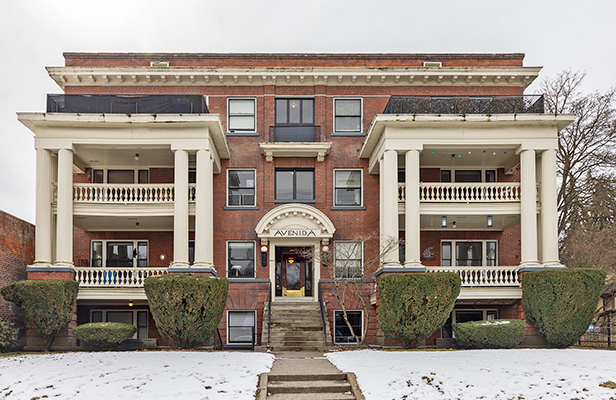
Image credit: Spokane Register of Historic Places, the Avenida Apartments built in 1909.
Creating a Historic Preservation Commission/Certified Local Government (CLG)
Created by ordinance, a historic preservation commission is typically comprised of architects, historians, real estate professionals, and residents. The commission reviews applications for historic landmark status and permits for the alteration of historic properties.
A historic preservation commission recognized by the NPS is called a Certified Local Government (CLG). The CLG program, administered by DAHP in Washington, creates a partnership between federal, state, and local preservation efforts, allowing these commissions to benefit from financial grants, tax incentives, and technical assistance from DAHP.
A CLG must also adopt a preservation ordinance, create a local register of historic places, and use a design review process to approve changes to buildings. See MRSC's Design Review page for more information on this advisory board.
Examples of Historic Preservation Commissions
- Bainbridge Island
- Historic Preservation Commission – Includes composition, term, vacancies, powers and duties, and more for the Historic Preservation Commission
- Municipal Code Sec. 18.24.020 – Established the Historic Preservation Commission and detailed its intended operations.
- Snohomish County Code Ch. 2.96 – Includes membership, powers and duties, rules, and more for the Historic Preservation Commission.
- Spokane
- Historic Landmarks Commission
- Municipal Code Ch. 4.35 – Includes policies and procedures for the Landmarks Commission.
Surveying and Inventorying Potential Historic Properties
A survey and inventory process as defined by the DAHP identifies and evaluates potential historic properties. The survey and inventory:
- Serves as a planning tool to meet local, state, and federal requirements;
- Helps identify properties that are potentially eligible for listing on a register; and
- Minimizes conflict between development and preservation goals.
Buildings included are typically evaluated based on age, physical integrity, architectural style, and historic significance.
Examples of Surveys and Inventories
- Bainbridge Island Historic Resources Survey and Inventory (2017)
- Puyallup Historic Properties Surveys and Inventories
Creating Historic Districts
Local historic districts aim to preserve the historic character of an entire area, rather than just a single structure. Many Washington jurisdictions have code provisions establishing local historic designations and register programs. Designation of historic districts may have nomination processes similar to those for local landmarks but often result in new zoning designations or overlay districts with stricter permitting and review processes.
Historic Districts
- Bellingham Historic Places – Includes an interactive story map with historic register sites and districts (national, state, and local).
- Spokane City/County Historic Preservation Office – Includes detailed information on the city’s 21 historic districts.
- Tacoma Historic Districts – Includes information on the city’s nine historic districts and one pending district.
Developing Historic Preservation Plans and Codes
According to the National Alliance of Preservation Commissions, historic preservation plans guide the protection of a community’s historic resources and ensure that preservation aligns with broader goals. Ordinances typically establish historic preservation plans and programs.
Additionally, though historic preservation elements are not required in comprehensive plans, adding a chapter and/or supportive policies in other chapters is a common best practice for local governments. As an implementation strategy, development codes outline regulations for protecting and maintaining historic resources, often addressing designation, rehabilitation, and demolition standards.
Note that in 2025, the legislature passed a new law codified in RCW 35.21.995 that prevents a city from designating a property as a historic landmark if the property is less than 40 years old; or the designation would restrict use, alteration, or demolition of the property and the owner’s consent was not obtained. Properties may be nominated as a historic landmark without the property owner’s consent, but the owner’s consent must be obtained before designation. The following are exempt from requirements in the bill:
- Properties within a historic district that were established through a local preservation ordinance
- Properties that are more than 125 years old
Cities must amend ordinances to meet these requirements in residential and mixed-use zones by July 27, 2026, or the bill’s requirements supersede and invalidate any conflicting local codes.
Examples of Historic Preservation Plans and Comprehensive Plan Elements
- Clark County Comprehensive Growth Management Plan, Chapter 8 – Includes goals, policies, and strategies related to historic, archaeological, and cultural preservation.
- King County Historic Preservation Program Strategic Plan – Includes strategic priorities, goals, objectives, actions, and measures. Sets the framework for implementation through the county’s Historic Preservation Program.
- Puyallup Historic Preservation Plan – Includes goals, policies, and priorities, partners, inventory data, historic registers, incentives, and more.
Examples of Historic Preservation Codes
- Clark County Code Sec. 40.250.030 – Applies to property listed on a variety of local, state, and federal registries.
- Port Townsend Municipal Code Ch. 17.30 – Covers design review, historic place designation, demolition standards, and maintenance (demolition by neglect).
- Ritzville Municipal Code Ch. 11.70 – Standards for the city’s historic preservation overlay zone.
- Spokane Municipal Code Ch. 17D.100 – Includes information about the Spokane Register of Historic Places, rehabilitation, changes to historic properties, and neighborhood preservation.
Demolishing Historic Properties
A demolition permit is typically required to tear down a property eligible for or listed on a local historic register. Individuals or entities wanting to demolish these properties must submit reports analyzing alternatives to demolition, such as adaptive reuse or relocation. Historic preservation commissions typically review these proposals and make decisions. Public notice of the demolition request may also be required. If no feasible alternatives are found, a permit or certificate allowing for demolition is issued.
An example of the demolition permit application and appeals process can be found in the Bainbridge Island Municipal Code Chapter 18.24.070-.090.
Preservation Tools and Incentives
This section includes several examples of grants and funding local governments can use to identify, protect, and rehabilitate local historic sites and buildings. Additional opportunities are listed on the DAHP's website.
Financial Incentives
- Easements – An owner grants a portion of their property to a historic preservation organization, retaining ownership while maintaining the property’s historical character. Also prevents demolition and may offer tax benefits.
- Façade Improvement Grants – Façade improvement programs offer financial incentives to property owners to enhance building exteriors. See these two examples from Port Angeles and Spokane.
- Federal Historic Tax Credit – Funds used to rehabilitate historic properties listed on the National Register may be eligible for federal income tax credits.
- Main Street Tax Credit Program – Provides a business and occupation or public utility tax credit for private contributions to eligible downtown organizations (Washington Main Street Communities). Local governments can also donate to eligible nonprofit organizations, making them eligible for this credit.
- Special Tax Valuation – A property owner who incurs substantial rehabilitation costs (at least 25% of the building's assessed value) may subtract qualifying costs from the new assessed value for 10 years. Local governments must first adopt ordinances enabling the use of special tax valuation (Ch. 84.26 RCW).
Other Types of Incentives
- Adaptive reuse – Adaptive reuse involves repurposing buildings for new functions while preserving original elements of design and structure. This approach helps maintain the historical character of buildings while addressing evolving needs.
- Flexible building codes – Local governments may allow exceptions for historic buildings within the International Existing Building Code (IEBC) and the Washington State Energy Code (WAC 51-11C). These exceptions allow developers more flexibility in applying codes to historic structures while still aiming to meet safety and energy efficiency standards.
Court Decisions
University of Washington v. City of Seattle (2017) – The University of Washington sought to demolish a building previously housing a nuclear reactor, which was nominated for protection under Seattle’s Landmark Preservation Ordinance (LPO). The university argued that the LPO didn’t apply to it, but the trial court sided with the university, ruling it was not a “person” under the ordinance. The city appealed, and the Supreme Court reversed. The court found that the Growth Management Act (GMA) allowed local governments to regulate development, including applying the LPO to the university. It also ruled that the university, as a state agency and property owner, must comply with local regulations.
Conner v. City of Seattle (2009), review denied (2010) – Conner sought to develop property designated as a landmark, arguing the designation applied only to the house and not the surrounding grounds. The court disagreed, ruling the designation included both. Conner also claimed the Landmarks Preservation Ordinance was unconstitutionally vague, and the restrictions constituted an unlawful tax and regulatory taking. The court found the ordinance was not vague, as each property was reviewed individually, and ruled there was no unlawful tax or taking, as the city was not required to prove a compelling interest.
City of Tacoma v. Zimmerman (2004) – The court upheld a Tacoma ordinance allowing the city to acquire a historic structure through eminent domain. The owner had allowed the structure to deteriorate despite the city's efforts to have it maintained. The court found no abuse of discretion in the city council's decision to use eminent domain under Tacoma's Derelict Building Procedure to preserve the Old Elks Temple, a key building in the Old City Hall Historic District.
Swoboda v. Town of La Conner (1999) – The court upheld La Conner's denial of permits to demolish a structure in its Historic Preservation District and replace it with a commercial building. The developer challenged the ordinance as unconstitutionally vague, but the court disagreed, finding the code had clear standards. The developer also argued the ordinance applied only to designated landmarks, but the court ruled it applied to all buildings within the Historic Preservation District.
Swinomish Indian Tribal Community v. Island County (1997) – Counties are obligated under the Shoreline Management Act to establish procedures protecting buildings, sites, and areas having historic, cultural, educational, or scientific value. Island County violated the statute and its own Shoreline Management Master Plan by issuing sewer repair permits without adopting any procedures protecting known Indian archaeological sites in the area. Implementing protective procedures is especially critical where, in an effort to keep the sites from being looted, only the county knows where the sites are located.
First United Methodist Church of Seattle v. Hearing Examiner for the Seattle Landmarks Preservation Board (1996) – The Landmarks Preservation Ordinance, which prohibits United Methodist from making any alterations or significant changes to the church without city approval, burdens free exercise of religion because it forbids United Methodist to sell its property and use the proceeds to advance its religious mission. The ordinance is invalid as applied because the free exercise clause of the United States Constitution prevents government from engaging in landmark preservation when preservation has a coercive effect on religious practice.
Munns v. Martin (1997) – The demolition permit ordinance, which provides for a waiting period preceding issuance of a permit to demolish any structure over 50 years old or a "place of historic value," is an unconstitutional violation of the Catholic Bishop's right to demolish a school building that was once part of his religious ministry. Delaying demolition and development for long periods of time and compelling the Bishop to seek approval of his "religious mission" from secular authorities burdens the free exercise of religion.
First Covenant Church of Seattle v. City of Seattle (1992) – Seattle's Landmarks Preservation Ordinance, which requires First Covenant to obtain approval before altering the church's exterior, was found to violate the church's right to free exercise of religion. The church building itself is a religious expression, and the ordinance burdens the church both administratively (requiring approval for alterations) and financially (reducing the property's value). The city's interest in preserving historic structures was not deemed compelling enough to justify infringing on the church's free exercise rights.
Buttnick v. City of Seattle (1986) – In commanding building owner to remove and replace a parapet/pediment, the Pioneer Square Historic Preservation Board did not work an unconstitutional taking of property. Local governments may enact land use restrictions or controls to enhance quality of life by preserving the character and desirable aesthetic features of a city. Furthermore, the estimated cost of replacing the parapet does not impose an unnecessary or undue hardship on the property owner, considering the building's high market value and income-producing potential.
Penn Cent. Transp. Co. v. New York City (1978) – The New York City Landmarks Preservation Commission denied plans to build a 50-story office over Grand Central Terminal, a designated landmark. The owner appealed, claiming the landmark law constituted a taking without compensation and violated due process. The Supreme Court ruled: (1) a taking was not established by denial of airspace use; (2) landmark laws preserving historic structures are not discriminatory; (3) unequal impact on owners did not constitute a taking; and (4) the law did not interfere with current use or prevent a reasonable return, as air rights could be transferred to nearby properties.
Recommended Resources
Below are a number of publications and organizations that support local historic preservation programs through technical assistance and other resources.
- National Institute of Building Sciences, Whole Building Design Guide: Historic Preservation – Discusses issues related to historic preservation, relevant codes and standards, and more.
- National Trust for Historic Preservation – National private nonprofit organization dedicated to historic preservation.
- Washington Trust for Historic Preservation – Statewide nonprofit organization dedicated to preserving historic places through advocacy, education, collaboration, and stewardship. Programs include the Washington Main Street Program, Maritime Washington, and Most Endangered Places.


