
Eating on the Go: Regulating Food Trucks
August 4, 2025
by
MRSC Insight
Category:
Licensing and Regulation
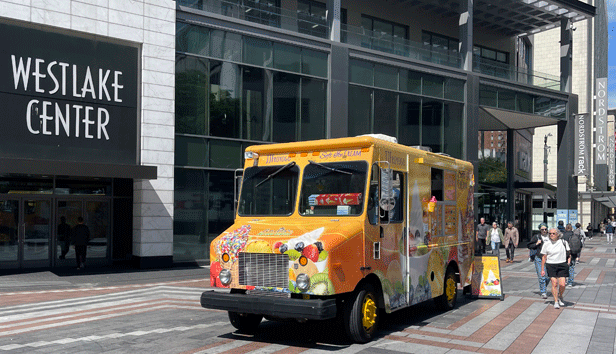
A decade ago, food trucks may have seemed like a fad, but they have proven popular among diners and can provide entrepreneurs a more affordable entry into the local dining scene. Food trucks can also be a way to expand local dining options.
This blog will sort through applicable food truck laws and regulations and cite examples of approaches taken by Washington cities and towns.
Food Trucks are Regulated at Multiple Levels of Government
First, let’s look at the regulatory landscape for food truck operators — it can be complicated!
At the state level
Food truck operators must have their vehicle inspected and permitted by the Washington State Department of Labor and Industries (L&I), which outlines the process on their Food Trucks & Trailers webpage.
Per L&I, a food truck is a licensed vehicle from which food is sold at temporary sites. It is no more than 8.5-feet wide and has at least one of the following: an electrical system, a water or drain system, or a propane gas system.
Workers work inside a food truck and serve food to customers who stay outside. If workers serve and deliver food outside, then the unit would more likely be classified as a food cart (or pushcart, such as hot dog carts) or a food delivery truck.
At the county level
The Retail Food Code gives local governments authority over permit approval for “mobile food units” (WAC 246-215-09110), which primarily falls to county health departments. Food trucks are expected to follow proper procedures to minimize the risk of food contamination. This commonly includes making sure the vehicle has the proper equipment (i.e., for food storage and preparation, sanitation, safety) and has access to an approved commissary or commercial kitchen where the food will be prepared.
Under RCW 43.20.149, county health departments are required to provide for reciprocity if an operator has obtained a permit from another health department in the state. For example, see Tacoma-Pierce County Health Department’s Plan Review Reciprocity.
At the city/town level
Food truck operators also may have to obtain permits to place their vehicles in a specific location within a city or town, and local governments have a broad amount of discretion with respect to issuing such permits. Some commonly found requirements of local codes regulating food truck operation include:
- Obtaining local fire department or fire district approval;
- Compliance with applicable electrical codes;
- Possession of liability insurance with the local government as a named insured;
- Following local restrictions on signs, lights, awnings, and overhangs, and prohibition of sidewalk and right-of-way obstructions;
- Evaluating the impacts of any off-site parking displacement when food trucks are proposed on private property; and
- Managing/disposing of trash, recyclables, and wastewater generated.
Some local codes will limit food truck hours of operations or limit operations to certain zones. Here are a few examples:
- Longview Municipal Code Sec.19.41.020 — Limits food truck operation to specific zoning districts and requires operators to obtain temporary use permits for each site.
- Marysville Municipal Code Ch. 22C.260 — Limits hours of operation and prohibits food trucks from operating in residential zones or within 100 feet of an eating or drinking establishment.
- Ocean Shores Municipal Code Ch. 17.56 — Specifies zones where food trucks are authorized and requires operators get city or private property owner approval.
Some codes address the cumulative time a truck may operate within the jurisdiction, including:
- Port Angeles Municipal Code Ch. 17.26 — Allows mobile vendors operating four days or fewer per year to apply for a minor permit at no cost, while those selling goods or services five or more days per year must purchase a major permit.
- Ridgefield Municipal Code Ch. 18.510 — Allows long-term operation of food trucks only within specific zones.
As a business, a food truck is required to have a state business license, and localities often require local business licenses as well. To reduce the costs associated with operating food trucks, some local governments dispense with requiring a business license if the truck is operating as part of an approved special event.
Special Concerns When in Agency Right-of-Way
Local governments have additional obligations when asked to authorize the use of their publicly owned property or right-of-way (ROW) for food truck operations. In these situations, a city or town must act as both a regulatory body and a property owner. Here are a few approaches some have taken:
- Newcastle Municipal Code Ch. 18.23 — Limits food truck operation to sponsored events within certain zones or street right-of-way.
- Tacoma Municipal Code Ch. 6B.175 — Allows food trucks at identified pre-approved locations in the city ROW.
- Yelm Municipal Code Ch. 18.68 — Allows operation of a mobile food truck on city ROW if it is located at least 100 feet from existing food establishments and does not block sidewalk access.
Food trucks operating on public property, such as a park, trigger a requirement to pay leasehold excise tax pursuant to chapter 82.29A RCW. Agencies will want to factor these costs into account when setting food truck rates and be sure to remit the tax to the state department of revenue.
Special Concerns When on Private Property
Some businesses, such as brew pubs, consider food trucks to be complimentary to their operations and allow them to provide service on their property. To the extent a business owner provides space for food trucks on a regular basis, the use of that space may be subject to transportation impact fees. For example, Mount Vernon provides in its zoning provisions that transportation impact fees shall be assessed for food truck uses.
Conclusion
Although the regulatory requirements can seem daunting, food trucks can expand the culinary options in a community. One option for local governments to consider is a food truck pilot program. Recent pilots include Pasco’s mobile vending program and Thurston County’s Street Vending program. The Washington State Food Truck Association is also a good resource. It runs pilot food truck programs or can manage a food truck lot in partnership with local governments.
MRSC is a private nonprofit organization serving local governments in Washington State. Eligible government agencies in Washington State may use our free, one-on-one Ask MRSC service to get answers to legal, policy, or financial questions.


