
Culture by Design, Not Accident: The Hidden Driver of Performance
May 28, 2026
by
Julie T. Underwood
Category:
Guest Author
,
Administration and Management

In my 25-plus year career in local government, I have learned that leaders truly do shape their organizational culture, whether they intend to or not. As the author James Clear noted in Atomic Habits, "You do not rise to the level of your goals. You fall to the level of your systems."
Goals alone do not drive performance, achieving long-term success requires intentionally and actively shaping the culture of your organization—those shared values, norms, and behaviors that shape how everything gets done.
Workplace culture is linked to motivation and performance, and according to the Society for Human Resource Management, 83% of those who rate their workplace culture as good or excellent are motivated to produce high-quality work as compared to 45% of those in poor or terrible cultures.
In his book The Culture Code: The Secrets of Highly Successful Groups author Daniel Coyle notes, “A strong culture increases net income 756% over eleven years, according to a Harvard study of more than 200 companies.” For the public sector that equates to steady organizational leadership, financial stability, and high community survey ratings.
Employees who are strongly aligned with their organization’s culture are more engaged, committed to staying, and perform better. However, unfortunately, according to Gallup, only 20% of U.S. employees strongly agree that they feel connected to their organization's culture. How can a leader build a culture where employees are engaged by and committed to a shared vision, and excel at their work?
Five Action Steps Leaders Should Take to Design a Culture
Organizational culture is a leadership imperative. Leaders who ignore it are sure to see a workplace experiencing burnout, low morale, and high turnover. Below are five action steps I have employed with success throughout my career.
Use vision, mission, values to guide actions
The mission defines the organization’s purpose, and the values articulate the behaviors that are expected of employees. If your organization already has stated values, then a survey can measure if there is organizational alignment.
If employees are unclear about the organization’s values, then it may be time to evaluate their staying power or relevance. Mapping out a thoughtful employee engagement process can be an empowering and meaningful experience for the organization.
For the Kirkland Public Works Department, we formed an employee team to help develop our department’s vision. Our goal was to capture the values of the department and to situate our role in the overall operations of the city.
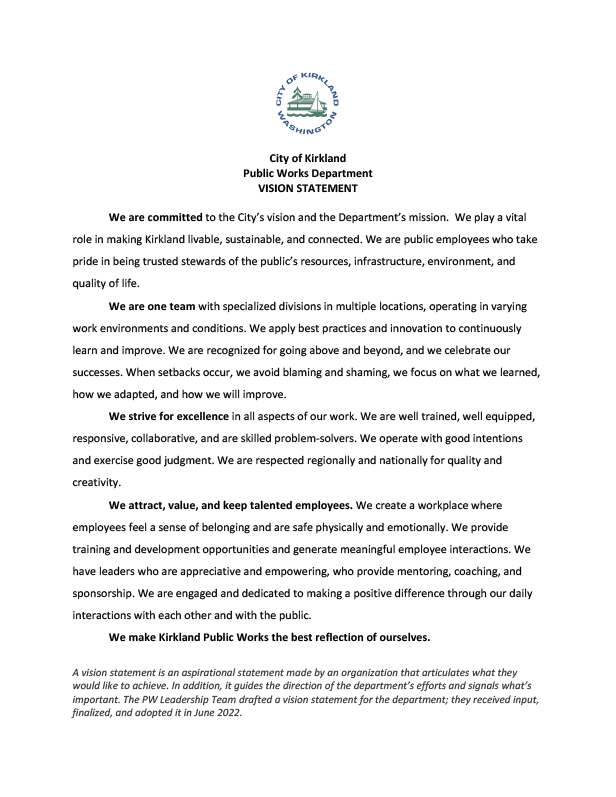
From the vision statement came the subsequent action plan, which guides our priorities and signals to the department that this is what matters to us.
Assess the culture
Climate surveys, one-on-ones, and informal conversations can daylight employee perceptions about the workplace. Are leaders trusted? Do employees believe communication is effective? Are there silos or does the culture embrace collaboration and teamwork?
Keep in mind, employees will want the survey to be anonymous and for leaders to take their feedback to heart. Once a survey is conducted, being transparent and sharing the results with staff will go a long way in demonstrating transparency and accountability.
Develop an action plan
The results of an organizational survey will reveal gaps in the culture. It is critical that the leadership team studies the results and identifies what it wants to focus on.
- Do the results indicate that employees do not feel valued and appreciated? Perhaps it is time to examine reward systems and recognition programs.
- Are the results revealing that a particular leader is not measuring up to organizational values? A deeper dive may be necessary to determine root cause.
An action plan provides an opportunity for leadership to effect positive changes.
Consider a leadership change, if warranted
If the survey and subsequent assessment determines that it is time for a leadership change, then do not hesitate to act. This signals to employees that leadership is listening, it cares, and it wants to demonstrate accountability.
According to Daniel Goleman in Primal Leadership:
- 50-70% of how employees perceive their organization’s culture can be traced to the actions of one person—the Leader.
- More than anyone else, a leader creates the conditions that directly determine people’s ability to work well.
Find your culture champions
A culture champion is a leader who actively embodies and promotes an organization’s core values and mission and reinforces a positive work environment. They function as ambassadors for organizational culture, driving employee engagement and fostering inclusivity, trust, and high performance.
A culture champion could be an assistant/deputy city manager/administrator, HR director, or organizational development manager. I have even had the privilege of serving in this role when I worked at the City of Shoreline as the assistant city manager.
While at Shoreline, I worked closely with the city manager and the director’s team to ensure the action plan was implemented. As a result, I believe the city’s community survey, which improved over time, illustrated our strong commitment to creating a positive workplace culture, as seen with the following survey question:
| Do you think the City of Shoreline is moving in the right direction? | |
|---|---|
| Year | Yes Responses |
| 2004 | 58% |
| 2008 | 60% |
| 2012 | 72% |
While these improved survey results required a team effort, having a champion who owns the action plan ensures that the changes leaders want to see happen are carried out.
Psychological Safety is Key
Our workplaces require learning and collaboration, and brain science has demonstrated that fear inhibits learning and cooperation. If there is only one aspect of a culture to focus time and energy on, I believe it is on a culture that prioritizes psychological safety.
Harvard professor Amy C. Edmundson, author of The Fearless Organization; Creating Psychological Safety in the Workplace for Learning, Innovation, and Growth, defines psychological safety as the belief that the work environment is safe for interpersonal risk taking—employees are able to speak up with relevant questions, ideas, or concerns, can admit mistakes, and challenge assumptions. She writes, “Psychological safety is present when colleagues trust and respect each other and feel able—even obligated—to be candid.”
Culture is a foundational force that affects behavior, performance, and resiliency across the entire organization. As Edgar Schein wrote in his book, Organizational Culture and Leadership: A Dynamic View, “The only thing of real importance that leaders do is to create and manage culture.”
Leaders should not leave culture to chance. Building a strong organizational culture requires developing a clear vision, identifying strengths and gaps in the workplace, creating an action plan, and ensuring that psychological safety is always present for employees.
MRSC is a private nonprofit organization serving local governments in Washington State. Eligible government agencies in Washington State may use our free, one-on-one Ask MRSC service to get answers to legal, policy, or financial questions.

About Julie T. Underwood
Julie T. Underwood is currently the Director of Public Works for the City of Kirkland, where she also served as the city’s Deputy City Manager of Operations. She has over 25 years of local government management experience, including serving as the Assistant to the City Manager for Rockville (MD) and as the assistant city manager for the cities of Shoreline and Daly City (CA). She had the privilege of being the first woman and person of color to serve in the city manager role for the cities of Shoreline and Mercer Island.
Julie is passionate about promoting diversity and inclusion in local government and has spearheaded the Northwest Women’s Leadership Academy, which prepares and promotes women into local government leadership roles.
Julie is writing as a guest author. The views expressed in guest columns represent the opinions of the author and do not necessarily reflect those of MRSC.


