
How Did Local Ballot Measures Fare in the November 2024 General Election?
December 9, 2024
by
Steve Hawley
Category:
Parks, Recreation, and Culture
,
Transportation
,
Emergency Medical Services
,
Fire Protection
,
Revenues
,
Minimum Wage
,
Law Enforcement
,
Ballot Measures
,
Special Districts
Well, another election has come and gone. While many people were focused on the federal and state races, let’s give some attention to all those local measures that appeared on the ballot across Washington State.
Here at MRSC, our Local Ballot Measure Database has been tracking the results of all local ballot measures statewide since 2011 (except school financing measures, which are tracked separately by the Washington State Office of the Superintendent of Public Instruction).
This time around, there were 116 measures on the ballot, excluding schools. Here are some of the areas that caught my attention, with links to local news coverage where possible. As always, there were far too many ballot measures for me to write about all of them, so my apologies if I didn’t get to yours. For the complete details of all 116 measures, see our Local Ballot Measure Database.
Tax Measures Struggle
Three-quarters of the ballot measures (89 of 116) concerned tax increases — including bonds, levy lid lifts, sales taxes, and more. Over one-third of those measures failed, which strikes me as significantly higher than usual. Failure rates of 15-25% are more typical according to our database, and the failure rate for taxation measures in a general election has not exceeded 24% in recent years (see chart).
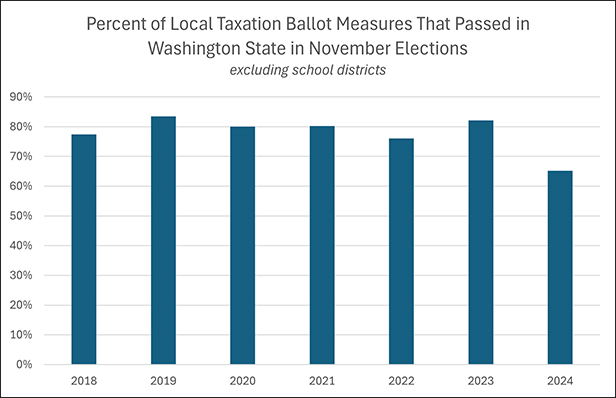
It’s extremely difficult to generalize about this — bonds and certain taxes require a 60% supermajority, which can be difficult for some jurisdictions to attain even in the best of times, and there are countless local factors and nuances at play. Turnout can vary at different points in the election cycle, and small things can make the difference between a measure narrowly passing and narrowly failing.
But it does make me wonder, particularly with recent inflation and cost of living challenges, whether some voters may be getting “tax fatigue.” I don’t mean to sound negative — after all, almost two-thirds of the local tax measures passed! Then again, the failure rates looked normal in the February, April, or August elections this year. Is November 2024 a one-off exception due to a unique combination of factors, or does it indicate something else? Only time will tell.
Cities and Towns
Cities and towns placed a number of police and public safety measures on the ballot, with mixed results.
In Vancouver, a proposed levy lid lift for a variety of police and public safety services narrowly failed, as did a proposed levy lid lift for law enforcement and other city services in Edgewood. Des Moines voters said no to a proposed levy lid lift for police staffing and public safety, following an earlier attempt in August that also failed.
Meanwhile, voters in the City of Spokane approved a new public safety sales tax for the police department, fire department, municipal court, and related services. A public safety sales tax in Longview passed and will allow the city to increase its police staffing. Voters in Langley overwhelmingly supported a new sales tax for police and criminal justice purposes, while Tonasket voters approved a renewal of the city’s existing public safety sales tax.
Voters in Woodway supported a levy lid lift for public safety services, while Monroe voters rejected a levy lid lift for community services, including public safety and parks.
In Tacoma, voters opposed a levy lid lift to improve the fire department’s response capabilities. Last year, voters had supported a separate lid lift for the emergency medical services levy.
In College Place, voters rejected a $14 million bond measure to build a new and larger police station. The existing building was built in 1958 as a chicken coop, then later served as an auto mechanic shop, student housing, and city offices before the police department moved in seven years ago.
On the transportation side, voters supported a transportation benefit district (TBD) sales tax renewal in Friday Harbor but rejected a TBD sales tax increase in Kelso. In Chelan, a new TBD sales tax just barely eked out a victory — more on that later! In Seattle, voters approved a the city’s largest-ever levy, a $1.5 billion levy lid lift for transportation projects.
In Toppenish, voters rejected the proposed creation of a new metropolitan park district (MPD) to fund the city’s parks, recreation services, and swimming pool. City leaders are trying to figure out how to address the city’s budget deficit.
Counties
In unincorporated Kittitas County, a levy lid lift for the road and bridge fund was overwhelmingly defeated. The measure would have raised the road levy from $0.77 per $1,000 assessed value (AV) to $1.01 per $1,000 AV to help the county deal with rapidly rising road construction costs.
Voters in Lewis County supported a new 0.2% emergency communications (E-911) sales tax. Currently, the county’s 911 call center is funded by user fees from the various first responder departments, which in turn are funded by property taxes. This was Lewis County’s second attempt at passing the measure, as an earlier attempt last November fell just short.
Meanwhile, a similar E-911 sales tax fell narrowly short in Franklin County. The first 0.1% of that sales tax would have expired after three years, while the remaining 0.1% would have been imposed permanently. The revenues would have been used to upgrade radio towers and eliminate “dead spots” within rural areas.
Voters opposed two public safety sales taxes — a proposed 0.3% sales tax in Skamania County for additional sheriff’s office personnel and a dedicated animal control officer, and a proposed 0.2% sales tax in Snohomish County to address crime and the fentanyl crisis. Some observers speculated about tax fatigue, as several cities within Snohomish County are tied for the highest sales taxes in the state at 10.6%.
In an advisory vote, Cowlitz County voters opposed reinstating a 0.1% mental health and chemical dependency sales tax. Last year the board of county commissioners voted to end the sales tax, which generated $2.5 million annually for the county drug court and other related programs.
Voters in San Juan County agreed to extend their conservation areas real estate excise tax (REET) to fund the county land bank for another 12 years, while Spokane County voters extended an existing juvenile detention and jails sales tax for another 10 years.
In Whatcom County, voters approved a charter amendment to prohibit county elected officials from holding any other elected public office during their term. The amendment was proposed by the county council rather than the charter review commission.
Citizen Initiatives
The only initiatives on the ballot were in Everett, where voters approved a minimum wage increase (plus related worker rights) and granted legal rights to the Snohomish River.
The minimum wage will increase to $20.24/hour, not including tips, and will be indexed to inflation, although it will not apply to small businesses with less than 15 employees. (Voters rejected a nearly identical but competing initiative that would have counted tips and certain benefits toward the minimum wage calculations.)
The Snohomish River initiative will allow any party that negatively impacts the watershed (within the city limits only) to be sued. If the party is found liable, they will have to pay damages to the city, with the funds dedicated exclusively to watershed restoration projects. This is part of a growing worldwide “Rights of Nature” movement, although as far as I am aware this appears to be the first successful effort in Washington State.
Fire Districts
Voters in West Pierce Fire & Rescue approved the initial imposition of fire benefit charges, part of a growing trend of fire districts using benefit charges to supplement or replace a portion of their property taxes.
In Whatcom County, a proposed $13 million bond measure to build a new fire station for Fire District No. 1 fell short of the required 60% supermajority. An earlier attempt at the bond measure also failed in August.
Fire districts submitted 12 levy lid lifts to voters in this election, of which eight passed and four failed. Fire districts also submitted six excess operations and maintenance levies, of which half passed and half failed.
Public Hospital Districts
In Yakima County, voters overwhelmingly approved the creation of a new Lower Valley Public Hospital District, the first public hospital district (PHD) in the county and the 57th statewide. Proponents said the PHD was necessary after the sudden closure of the Toppenish maternity and labor center in late 2022, part of a nationwide trend of labor and delivery closures in largely rural and low-income areas.
Voters had previously supported the creation of the PHD in August 2023, but voter turnout in that election was so low — less than 2,500 people voted on the measure — that it did not meet its validation requirements. But turnout was no problem this year with the presidential election also being held, and over 10,000 people voted on the measure.
The ballot measure did not authorize any funding sources, so that will be something for the newly elected PHD commissioners to figure out.
Other Measures
In Grant County Port District No. 4 (Coulee City), voters approved a measure to eliminate the port commissioner districts and allow all commissioners to be elected at-large.
Voters supported six-year park and recreation district levies in North Whidbey Island and the Underwood Park & Recreation District in Skamania County. But in Whatcom County, a similar park levy for the Columbia Valley Park & Recreation District failed. The park district purchased its first park property two years ago using grant funds, but it does not have a property tax levy to provide regular funding.
Periodic Reminder That Every Vote Counts
There were several nail-biters in this election, with the two closest outcomes occurring in Eastern Washington. In the City of Chelan, a transportation benefit district sales tax had been trailing as of mid-November and city officials thought it had failed. However, with the final votes tallied and certified, the sales tax eked out a victory by five votes out of more than 2,300 cast.
And in Lincoln County Park and Recreation District No. 3 (Davenport), a six-year park levy barely reached the required 60% supermajority, winning by just two votes out of more than 1,800 cast.
Every. Vote. Counts. Especially in local elections.
Is Your Jurisdiction Planning a Ballot Measure?
If so, be sure to review MRSC’s Local Government Ballot Measures webpage, which includes information on election timing considerations, the ballot title and explanatory statement, pro and con committees, and more. You can also look at our Local Ballot Measure Database to get insights on how similar ballot measures may have fared in other jurisdictions.
If your ballot measure requires “validation,” or minimum voter turnout, note that it may be harder for some jurisdictions to hit the validation numbers next year. Statewide voter turnout in the 2024 general election was almost 79% due to the presidential and state elections, and the 2025 validation numbers will be calculated based on this year’s turnout.
MRSC is a private nonprofit organization serving local governments in Washington State. Eligible government agencies in Washington State may use our free, one-on-one Ask MRSC service to get answers to legal, policy, or financial questions.


