
Surface Mine Reclamation Program: Interaction with Local Governments
February 12, 2025
by
Rian Skov
Category:
Guest Author
,
Environmental Laws and Regulations
,
Rural Uses
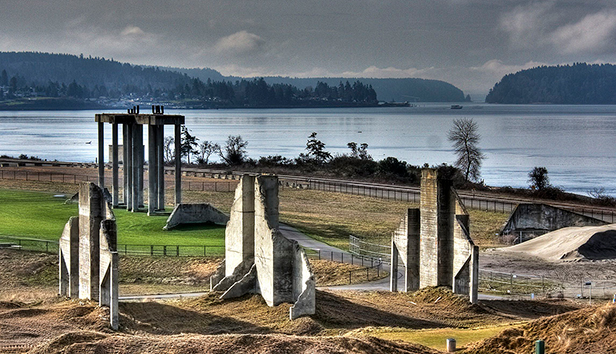
The Chambers Bay Golf Course in University Place, WA, host of the 2015 U.S. Open, was constructed on a reclaimed gravel mine. The concrete structures shown in the photo were once used for keeping different sizes of aggregate separate. Photo by Michael D. Martin (Flickr Creative Commons).
The Surface Mine Reclamation Program (SMRP) is a regulatory program of the Washington Geological Survey within the Washington State Department of Natural Resources (DNR). The program was established in 1971 after the legislature created the Surface Mining Act (RCW 78.44).
The SMRP works with permit holders to ensure that all lands and waters within the state are protected and reclaimed after mining is complete. It also strives to provide consistent regulation of surface mines statewide. The SMRP monitors surface mines and issues reclamation permits. Monitoring for compliance is usually performed by on-site inspection. Aerial photography is frequently used as well to document mining activity.
Our program covers the whole state, and with only a staff of 10 (five of whom are inspectors, or specialists) we regulate and inspect over 850 surface mines annually throughout the life of the mine to ensure that reclamation is achieved once mining is complete. Mines generally operate for years or decades, and the SMRP is involved with each of our mines throughout their life.
Mine permitting and regulation is a complicated task with multiple jurisdictions involved during the life of a surface mine. In this blog we hope to shed light on some of those jurisdictional boundaries as well as clarify how the Surface Mining Act apportions regulatory authority to DNR and local governments.
Background: The Surface Mining Act
Enacted in 1971, the Surface Mining Act (Act) requires mines that create mine-related disturbances larger than three acres or 30 feet in depth obtain a Surface Mine Reclamation Permit through DNR.
The Act also apportions regulatory authority to DNR for sole jurisdiction over reclamation and to local governments (counties, cities and towns) for jurisdiction over operations and land use (RCW 78.44.011). This requires close interactions between DNR and local governments, specifically when it comes to verification of land use for a Surface Mine Reclamation permit application.
The Role of Local Governments in Permitting
Under RCW 78.44.091(4) any applicant who wishes to open a surface mine is required to provide verification from the local government that surface mining has been approved as a land use for the proposed location. This verification is accomplished using DNR’s Form SM-6: County or Municipality Acknowledgment of Surface Mining, or Form SM-6 (a requirement of WAC 332-18-01002).
Form SM-6 is presented to the local government planning department by the applicant and asks the following questions of local governments for verification:
- Has the proposed surface mine been approved under local zoning and land-use regulations? (And, if not, does the site have an existing non-conforming use or is there a local use permit that allows surface mining?)
- Is the proposed subsequent use of the land after reclamation consistent with the local land-use plan/designation?
Simply responding to these questions does not mean the local government approves the surface mining permit nor does it change currently approved local land use designations. DNR uses the SM-6 form to verify that the current local land use classification allows surface mining to occur, and the subsequent use given on the SM-6 form will be consistent with the land use designation.
If a local government is presented with the SM-6 form and has questions about it or what is implied by its use, please feel free to contact Rian Skov, Lead Regulatory Geologist, or Nicole Damer, Regulatory Geologist/ Plan Specialist.
Mine Permitting and Regulation
Multiple agencies are involved in mine permitting and regulation, including DNR (which has jurisdiction over reclamation). The Washington State Department of Ecology (Ecology) administers the Sand and Gravel General permit, which covers stormwater and process water discharge from mine sites. The federal Mine Safety and Health Administration (MSHA) covers miners’ safety, and the regional air quality authority has jurisdiction over dust and air pollution.
Local governments have jurisdiction over operations at mine sites. RCW 78.44.031(8) defines “operations” as:
all mine-related activities, exclusive of reclamation, that include, but are not limited to activities that affect noise generation, air quality, surface and ground water quality, quantity, and flow, glare, pollution, traffic safety, ground vibrations, and/or significant or substantial impacts commonly regulated under provisions of land use or other permits of local government and local ordinances, or other state laws.
Operations specifically include:
(a) The mining or extraction of rock, stone, gravel, sand, earth, and other minerals;
(b) Blasting, equipment maintenance, sorting, crushing, and loading;
(c) On-site mineral processing including asphalt or concrete batching, concrete recycling, and other aggregate recycling;
(d) Transporting minerals to and from the mine, on-site road maintenance, road maintenance for roads used extensively for surface mining activities, traffic safety, and traffic control.
Reclamation and the SMRP
The focus of the SMRP is to ensure that the reclamation of mines occurs at the earliest possible opportunity, and that at the end of the mine’s life, the land is left in a condition that supports subsequent use. Mines can be reclaimed to a multitude of subsequent uses depending on approved zoning. In many cases, preparation of the land for the subsequent use includes grading final slopes to more gentle angles and incorporating sinuous topography and vegetation that closely mimics the surrounding terrain.
Below are photo sets showing two former mining locations. The photo on the left shows the land while the mine was still in operation, and the photo on the right shows the land after the reclamation process.


Photos courtesy of DNR.
From permitting to completion of reclamation, the SMRP is directly involved with a surface mine. Five reclamation specialists conduct annual site inspections to check that surface mines across the state are compliant with their approved plans/permits and to provide technical assistance to the permit holder.
SMRP specialists are based around the state to allow for quick response time and to keep them proximal to their coverage areas. The map below shows each specialist’s area and provides contact information. If you have questions regarding a specific mine, contact the specialist for the corresponding county.
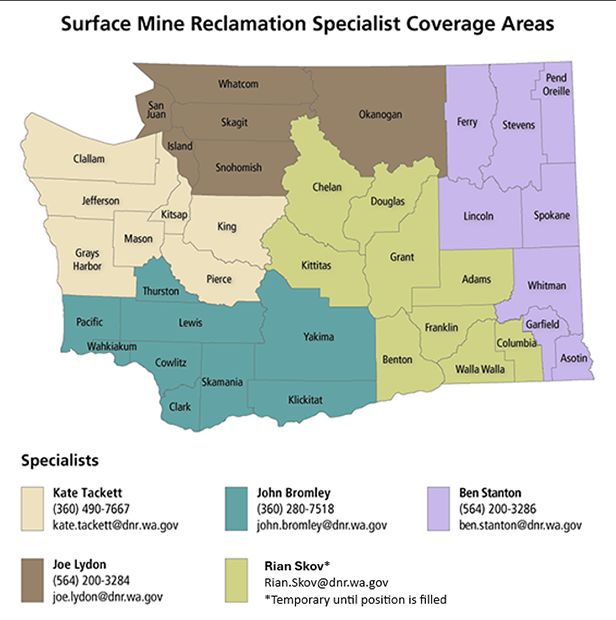
Image courtesy of DNR.
Conclusion
Regulation of mines in Washington State can be confusing at times due to the number of agencies involved and the specific activities and situations at each mine. If you have any questions regarding surface mining or metals mining, please don’t hesitate to reach out to the SMRP. We’re happy to answer questions.
MRSC is a private nonprofit organization serving local governments in Washington State. Eligible government agencies in Washington State may use our free, one-on-one Ask MRSC service to get answers to legal, policy, or financial questions.

About Rian Skov
Rian Skov is a licensed Engineering Geologist (No. 2917) with the State of Washington with 18 years of experience. He began his career working for a geotechnical consulting firm in the Seattle area as a field geologist for about two years. He joined the Washington Department of Natural Resources (DNR) in 2008 as a surface mine reclamation specialist and spent approximately 16 years working in the Surface Mine Reclamation program. Rian currently serves as the state expert in surface mine reclamation as the Chief Reclamation Geologist as well as the Deputy Oil and Gas supervisor for the Washington Geological Survey at DNR.
Rian is writing as a guest author. The views expressed in guest columns represent the opinions of the author and do not necessarily reflect those of MRSC.


