
First Amendment Audits Explained: Common Questions and Agency Guidance
February 23, 2026
by
Harry Boesche
Category:
Public Records Act
,
Operating Policies
MRSC commonly gets questions from various agencies about First Amendment 'audits', which can leave agencies confused about First Amendment auditor rights and the agency’s corresponding rights and responsibilities.
MRSC’s popular webinar, How to Recognize and Respond to First Amendment Audits, last offered in December 2025, tackled the legal issues that First Amendment audits raise. This companion blog gives an overview of what a First Amendment audit is and answers some frequently asked questions (FAQs) about audits and auditors.
What Are First Amendment Audits, Who Conducts Them, and Why?
While First Amendment audits are not formally defined, they are commonly understood as individuals or groups contacting or visiting government agencies to 'test' agency employee understanding and respect for individual First Amendment rights.
Auditor identity varies widely. They may act alone or in a group. They commonly visit agencies wearing masks, and they may refuse to identify themselves.
Auditors can engage in a variety of confrontational or disruptive tactics, including:
- visiting agency premises with confrontational demands;
- attending agency meetings to cause disruptions or to give challenging public comments;
- making numerous and extensive public records requests;
- bombarding an agency with e-mails that assert agency ‘violations’ of law or rights; and
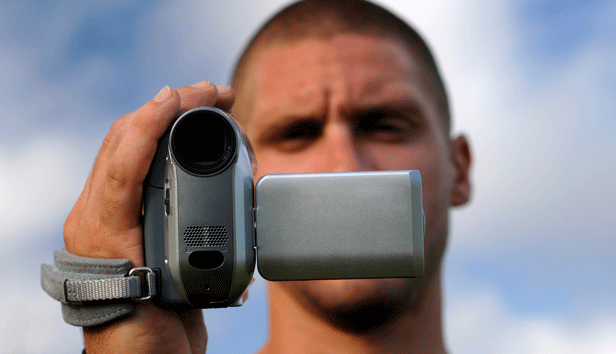
- filming interactions with public agency employees and premises and then posting the recordings online to enlarge their social media presence or get monetary donations from viewers.
These and other auditor tactics can leave agency personnel uncomfortable, confused, angry, and/or frightened.
FAQs About First Amendment Audits
Does the First Amendment allow these auditor tactics in pursuit of the above goals? Here are some frequently asked agency questions about First Amendment auditor rights.
Are auditors allowed to film an agency’s public meetings?
Generally, yes, auditors are allowed to film public meetings.
The court in Zink v. City of Mesa held that agency restrictions on filming public meetings generally violate RCW 42.30.040, which prohibits conditions on public meeting attendance. But the Zink court also noted two important exceptions to a public meeting attendee’s ability to film the meeting.
First, governing bodies can limit or prohibit filming that 'interrupts' a meeting. Meeting interruptions are events that make it unfeasible to conduct an orderly meeting (see RCW 42.30.050).
While auditor filming can make meeting attendees uncomfortable or uneasy, that alone likely isn’t enough to declare a meeting interruption. However, other acts (besides unobtrusive filming) that disrupt the meeting’s order or that impede the governing body’s ability to receive needed information may rise to the level of interruptions.
Second, because of their frequently confidential nature, agencies can prohibit public attendance and filming during executive sessions within meetings. (For more information, visit our webpage on Executive Session Basics.)
Are there any areas of an agency’s premises that auditors cannot film?
Can an agency make certain areas off-limits? For example, can agencies prohibit auditors from filming where customers discuss medical or other private information?
The short answer is yes—the First Amendment does not necessarily allow auditors to film all areas of a public agency’s premises. Instead, auditor filming rights depend on whether a specific filming location includes any features that reasonably convey public filming restrictions. If it does, an auditor’s filming rights may be more limited, and the agency may have a greater ability to regulate or prohibit auditor filming.
In First Amendment cases courts must ultimately decide:
- whether a location is 'basically compatible' with First Amendment expression, and
- whether the public could reasonably expect an ability to exercise First Amendment rights in that location.
Courts consider several factors in answering these questions, including whether a location’s physical layout and historical use support First Amendment expression, and whether the area includes any signs, barriers, or boundaries indicating restrictions on free expression. Courts also look at agency policies related to the location’s public use, and whether the agency consistently enforces those policies to restrict expressive acts like filming.
Based on these factors, auditor filming rights are stronger in areas like sidewalks, parks, and the open public portions of agency lobbies, while agencies have a greater ability to restrict auditor filming in private areas or locations restricted to certain persons, such as restrooms, private offices, conference rooms, employees only areas behind public agency counters, or police facilities accessible only to law enforcement.
See our blog, Rights and Limits on Filming in Public Facilities, for additional information about the legalities of auditor filming at agency premises.
Are agencies required to honor public records requests submitted by First Amendment auditors?
Yes, agencies must generally honor all public records requests regardless of who submits them and must do so in accordance with agency policies and Public Records Act (RCW 42.56) requirements.
The Public Records Act (PRA) gives agencies very few instances to ‘distinguish’ among requesters by treating them differently based on their identity or request purpose. A requester’s status as a First Amendment auditor is not, by itself, a basis to distinguish them from other requesters, and agencies should generally process an auditor’s public records request like any other.
By the same token, auditors have no ‘special’ public records rights above those of other requesters, so agencies processing an auditor’s request must do so according to PRA requirements and their customary policies—agencies do not have to acquiesce to an auditor’s ‘demand’ for immediate public records disclosure.
Despite the above, the specific records an auditor seeks might justify inquiring into the request’s purpose. For example, if an auditor requests a list of individual names, the SEIU v. DSHS case requires the responding agency to investigate and ensure that the request is not made for a commercial purpose. (For more information on the commercial purpose prohibition, see Exemptions and Prohibitions for Local Government Records.)
Our agency has court facilities. Can auditors film court proceedings?
Court facilities and proceedings are part of the judicial branch and regulated by different filming authorities.
Washington Supreme Court General Rule (GR) 16 regulates “news media” courtroom photography and recording, seeking to balance First Amendment rights with concerns over courtroom privacy and a judge’s inherent ability to control court proceedings.
RCW 5.68.010(5) defines “news media” to include those “in the regular business of news gathering and disseminating news or information to the public by any means,” which is a broad definition that could arguably include First Amendment auditors.
Under GR 16, filming court proceedings requires a judge’s advance permission, and the filming cannot distract court proceeding participants or adversely affect the “dignity and fairness of the proceedings.” This rule gives the presiding judge reasonable discretion in setting limits on filming in the courtroom based on “sufficient reasons” and “particularized findings on the record.”
What happens if an auditor is filming where sensitive or confidential information is displayed?
At MRSC, we get questions regarding employees who work in public-facing positions (i.e., front counters) and may have sensitive or confidential information displayed on their computer screens or personal effects at their desks. Can these employees refuse to be filmed by an auditor in order to protect these items?
Generally, no. While this may be distressing to hear, there is no reasonable expectation of privacy in spaces that are publicly accessible and viewable.
If an auditor films within a location allowing First Amendment expression (see the 'filming rights in public facilities' question above), anything reasonably within the auditor’s vantage point is subject to filming. This can include documents, computer screens, employees, and areas surrounding desks or workspaces that are within the auditor’s view.
While the above is true, agency employees can take practical steps to protect sensitive information or items using computer privacy screens or positioning physical items (e.g., a plant) in such a way to block the public’s visual access to the information/item.
Agency Tips for First Amendment Audits
First Amendment audits are likely to continue. Agencies can consider employing these helpful tips:
- Communicate with other nearby agencies when an audit is anticipated (or after it occurs) to share information and insights for better preparation.
- Train employees, supervisors, and elected officials regarding First Amendment auditor rights and corresponding agency responsibilities.
- Train public-facing staff to ensure they have the understanding and resources they need to effectively handle an audit (and to keep any personal sensitive information safe).
- Review policies, procedures, and enforcement practices regarding public access and use of agency facilities, and update these if necessary.
- Consider the physical characteristics and signage within agency facilities—do these features convey restrictions on access and/or expressive acts like filming?
Pursuing these strategies can help agencies demystify First Amendment audits and better prepare for and successfully navigate one should an auditor show up on agency property.
MRSC is a private nonprofit organization serving local governments in Washington State. Eligible government agencies in Washington State may use our free, one-on-one Ask MRSC service to get answers to legal, policy, or financial questions.

About Harry Boesche
Harry Boesche joined MRSC as a legal consultant in 2024. Prior to this, he was the Deputy City Attorney for the City of Auburn for 17 years.
His municipal law practice includes advising elected officials and appointed board and commission members on public records act and open government issues.


