
Not to Be Too Alarmist, but, Being a Realist …
January 27, 2015
by
Jim McEntire
Category:
Guest Author
,
Revenues
By Jim McEntire, Commissioner, Clallam County
Aside from locally derived tax revenues, cities and counties with slow-to-no economic growth coupled with higher-than-state-average unemployment can expect scant additional financial help from the State and Federal budgets. Apart from the new political makeup of Congress, and the unchanged political configuration in Olympia, here’s why:
Focus on the graphical analysis derived from a table in the President’s FY 2015 budget request, especially the one entitled “year to year interest payment growth” (see below). The yearly amounts in the chart are additive. The net interest payments on the Federal debt held by the public - increasing yearly as interest rates are normalized by the Federal Reserve - flow out of the Treasury's general fund as "outlays" to private or foreign holders of U.S. Debt - and due to the Constitution's "full faith and credit" clause, they are the first dollars that flow from the Treasury as scheduled payments occur. The difference between “interest held by the public” and total Federal debt (not shown on this 2015 Budget table) is debt held by various trust funds, such as Social Security, Medicare, Unemployment Insurance, etc. Those trust funds hold special federal paper, and interest is accrued but not paid annually out of the Treasury – until a trust fund goes cash flow-negative, such as the Social Security trust fund now is (since 2010).
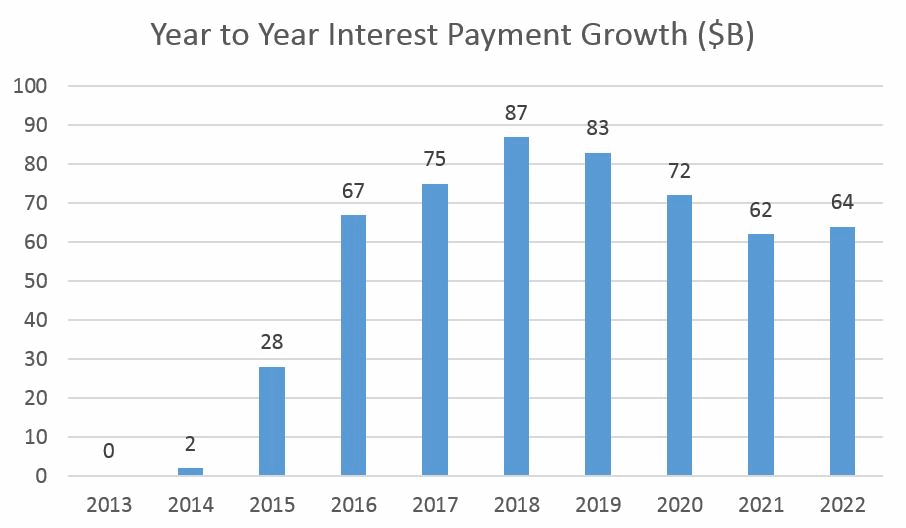
At which point, the excess of entitlement payment outflows over payroll tax inflows must be made up by additional borrowing (compounding the problem by raising the annual deficit, thereby increasing the total debt), or by reduced spending so that regular tax receipts make up the difference. Either way involves pain, either now or later. If the Congress decides to take some of the pain now, via reduced appropriations for all manner of things both defense and non-defense, we will see less federal money coming to Washington State. If Congress decides to defer the pain and float additional debt, it will add to the outlays for debt service, and we will see less federal money coming to Washington State. If the Federal Reserve decides to hold interest rates abnormally low in a variety of ways, eventually stoking inflation, it will result in an inflation “tax” on State and local budgets. If the Fed normalizes short interest rates without inverting the yield curve, it will add to the outlays for debt service. Pick your poison. The only way out of this ugliness is to have national economic growth throwing off increased tax revenues greater than the interest rate-driven growth in interest payments. Unless that happens, we are likely to see less Federal money flow to States and localities.
See this ‘Government Executive’ story saying essentially the same thing as above.
See this ‘Olympian’ story re: additional pension payments -- another unpredictable expense.
On top of the federal situation and the pension situation, the Legislature will be looking under all the couch cushions to find money for K-12 education and mental/behavioral health services, due to a recent Washington Supreme Court decision. This could, and likely will, involve reductions in State grants for any and all non-education purposes funded by the State general fund (where the tax revenue is not dedicated to a specific purpose). I really doubt that all the additional McCleary spending will come from tax increases through loophole closures. Add to that, whatever gasoline tax increase the legislature comes up with - I think there is very likely to be a transportation tax increase next year. Add to that whatever carbon tax or cap-and-trade system the Governor comes up with - not likely to pass the Legislature, but you never know.
All in all, a pretty stormy fiscal policy picture “forward of the bowsprit”. Forewarned is forearmed. No wonder economics is called the “dismal science”!
MRSC is a private nonprofit organization serving local governments in Washington State. Eligible government agencies in Washington State may use our free, one-on-one Ask MRSC service to get answers to legal, policy, or financial questions.

About Jim McEntire
Jim McEntire writes for MRSC as a guest author.
Jim McEntire serves in his first term as a Clallam County Commissioner, representing the east end of Clallam County. He and his wife live north of Sequim. In prior lives, he retired after 28 years as a U.S. Coast Guard officer, ten years of which were at sea in six ships, commanding the last three. After retirement from the Coast Guard, he had further service as a career civilian in three Federal cabinet departments (Transportation, Labor, and Homeland Security), retiring from the Senior Executive Service. In Clallam County, he has served as a Commissioner for the Port of Port Angeles in addition to his current office.
The views expressed in guest author columns represent the opinions of the author and do not necessarily reflect those of MRSC.


