
Battery Energy Storage Systems – Coming Soon to Your Community?
January 22, 2025
by
Steve Butler
Category:
Climate and Sustainability
,
Development Regulations and Zoning
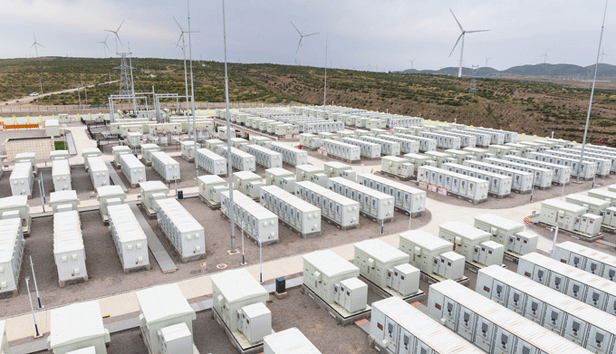
Demand for electricity as an energy source is increasing in Washington State and throughout the U.S. This increased reliance on electrical power holds the promise of a more carbon-neutral future, but the demand for ever more electricity has had some unanticipated impacts — including the emergence of “battery energy storage systems” (often referred to as BESS)
BESS facilities are increasingly being used by energy companies to help store electricity and release it on demand. As BESS’ popularity increases, there will be a corresponding increase in the need to find sites upon which to locate new BESS facilities. In fact, there have been several newspaper articles over the past few months about BESS facilities being proposed in different parts of Washington State
This is a relatively new type of land use that may not be adequately addressed in local zoning codes and associated regulations. As a result, local governments across the U.S. need to be prepared when a BESS application is submitted at their permit counter.
This blog is the first in a two-part series, with the second part highlighting examples of local BESS regulations.
Description of Battery Energy Storage Systems (BESS)
In simple terms, a BESS uses “large” batteries to store electrical energy generated at one point in time and then discharge it later when needed.
The City of Sumner defines BESS as:
[a] facility consisting of any combination of electrochemical storage batteries, battery chargers, controls, power conditioning systems and/or associated electrical equipment, including transmission lines, whether assembled together or separately, capable of storing at least 200 megawatt hours of electrical energy in order to supply energy at a future time to the electrical grid of a public utility provider(s).
The City of Arlington’s BESS code provisions (see AMC 20.114.125) includes the following introductory description:
Batteries are a unique class of energy storage system infrastructure. Because the basic unit is a small cell or pouch, a BESS is modular in nature and can be configured in virtually any size. Additionally, a BESS has relatively limited infrastructure requirements, needing a concrete pad to sit on and a connection to the electric grid. These two factors - modularity and limited infrastructure needs - mean that a BESS can be built virtually anywhere, including in close proximity to existing commercial and residential uses. [Emphasis added]
Larger than batteries typically used in consumer goods and automobiles, as well as those used in individual charging stations for electric vehicles (EVs), the size of an individual BESS “unit” (which contains several individual battery “cells”) is still fairly compact in size.
Several BESS units will typically be grouped together in a container (sometime referred to as a “Control Enclosure”) that measures around 10 feet wide, 10 feet high, and 30 feet long. Only one or two BESS containers may be needed to store electricity created by a small energy generator.

Individual BESS containers are often combined together on a single site to provide more storage capacity. Large-scale BESS facilities are sometimes referred to as “battery farms” (see the photograph at the beginning of this blog), which are typically located near major producers of electricity, such as large solar farms or windmill installations.
Benefits and Potential Impacts
BESS is viewed as one component of the state’s approach to clean energy, as these facilities have the ability to store electricity created intermittently by “clean energy” generators, such as solar panels and windmills. For example, while solar panels produce ample energy during the day, peak electricity demand often occurs in the evening and the surplus energy generated during daylight hours is wasted. Solar panels combined with BESS allows an operator to store this excess power for use during peak demand times.
Another benefit is that BESS can quickly provide backup power, with less noise and without the harmful greenhouse gas emissions caused by diesel emergency generators.
Regarding potential impacts, battery storage systems (particularly those using lithium-ion technology), can present potential safety risks, such as fire hazards and thermal runaway events. It should be noted, however, that national fire and electrical standards have been recently updated to address those risks. More information may be found in the National Fire Protection Agency’s (NFPA) BESS Safety Fact Sheet.
Aesthetics and noise are also among the list of impacts caused by BESS. Local regulations can mandate safety standards for the design, installation, and operation of BESS and reference the appropriate national and state standards.
Where a BESS Facility Can Be Located
As mentioned earlier, the modular nature of BESS means they can be sited in a wide variety of locations, based both on the size and functionality of their associated primary use. For example, BESS that act as storage for solar panels or windmills will be located in close proximity to those uses, with a larger number of clean energy generators needing a corresponding higher number of associated BESS facilities.
Conversely, BESS that are used as back-up power sources (as an alternative to a diesel generator) for a single business operation will typically occupy a smaller site “footprint.”
Larger BESS facilities will almost always not be located within a building, due in part to help address any heat build-up generated with larger clusters of BESS containers. There are examples of BESS sites in Washington that range from one BESS container to large BESS battery farms.
Local zoning maps and codes can also influence where BESS facilities are allowed to be located, as well as requiring compliance with applicable performance standards.
Conclusion and Additional Resources
Given the benefits of BESS to our state’s energy future, it is very likely that Washington will see a growing number of these facilities being constructed in locations throughout our state. Local governments can play an important role by adopting proper standards and procedures to ensure that public safety, environmental protection, and other community concerns are adequately addressed.
Part 2 of this series on BESS will focus on examples of local BESS projects and the regulatory approaches developed by some Washington local governments.
Below are additional resources:
The author wants to thank Ryan Windish, Community & Economic Development Director, City of Sumner; Marc Hayes, Director, and Amy Rusko, Deputy Director, Community & Economic Development, City of Arlington; Christine Nhan, Local Government Affairs & Public Policy Manager, Puget Sound Energy; and Abby Newbold, Public Policy Intern, MRSC.MRSC is a private nonprofit organization serving local governments in Washington State. Eligible government agencies in Washington State may use our free, one-on-one Ask MRSC service to get answers to legal, policy, or financial questions.


