
Slow Down, You Go Too Fast: Traffic Camera Use By Local Government
January 28, 2025
by
Harry Boesche
Category:
Traffic Regulation and Enforcement
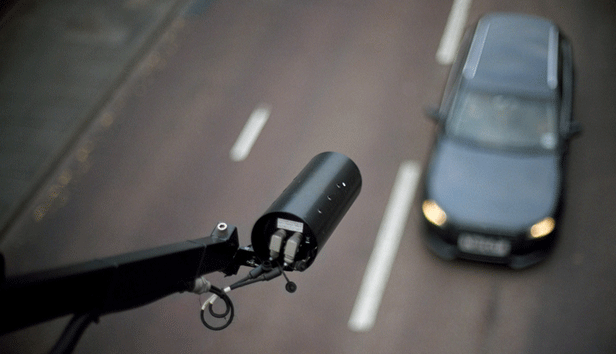
The use of automated traffic safety cameras is growing in Washington. For instance, Seattle’s traffic camera program had just four cameras in 2007, but that number increased to 31 by 2013.
Recent changes to state law have also expanded local government ability to use traffic cameras. Some laud these cameras as an important step toward improving traffic safety, while others see them as a needless government expansion with little real effect on public safety. This blog examines traffic cameras, how and why local governments are using them, and legal restrictions on their use.
What Traffic Cameras Are (and What They Aren’t)
Traffic cameras are devices posted at designated locations to detect and record certain non-criminal traffic violations. State law officially calls these cameras “automated traffic safety cameras.” In practice these cameras are also known by other names like “stop light cameras,” “red light cameras,” “speed cameras,” “school zone cameras,” or others, but this blog refers to them as “traffic cameras.”
It is important to distinguish the traffic cameras discussed in this blog from other types of public safety cameras that are subject to different legal requirements and restrictions. For example, the traffic cameras covered in this blog are different from police body worn cameras, police vehicle dash cameras, or “neighborhood” or “public safety” cameras used by some law enforcement agencies to detect criminal violations or document police activities.
The traffic cameras discussed here also differ from speed safety camera systems that operate similarly but are used exclusively by the Washington State Department of Transportation (DOT) and the Washington State Patrol to detect speeding vehicles in state highway work zones.
Although traffic cameras photograph and document vehicle license plates, they also differ from license plate recognition cameras (LCRs) that some police agencies use to detect stolen vehicles or a vehicle’s possible connection to a crime or a wanted person.
Who Can Use Traffic Cameras?
Cities and counties can use traffic cameras, and those that do commonly use them to catch cars running red lights or speeding. But cities and counties can also use traffic cameras to detect other violations, like failing to stop at railroad crossings (see RCW 46.63.240).
In addition, cities with populations over 500,000 (currently only Seattle; see RCW 46.63.260 (1)(a)) can use them to detect vehicles violating bus lane restrictions along bus rapid transit corridors, and transit authorities in counties with populations exceeding 1,500,000 can use vehicle-mounted traffic cameras to detect vehicles that unlawfully stop, stand, or park at bus stops — see RCW 46.63.260(3).
Traffic cameras take still photos and record videos of traffic violations and document the violation’s date, time, and location. These cameras also zoom in on a violating vehicle’s license plate to identify it.
Traffic cameras are “automated” because they can automatically detect violations according to how they are programmed to operate. For example, jurisdictions using traffic cameras to detect school zone speeding can program the cameras to start detecting speeding vehicles in school zones automatically during certain school hours or at selected times when school children are likely to be present.
Why Do Localities Use Traffic Cameras?
Local governments may use traffic cameras for many reasons, but those commonly cited are to increase public safety and to address staffing issues associated with enforcing traffic violations. A recently published Washington Traffic Safety Commission (WTSC) traffic camera guide (2024) includes these traffic safety statistics:
- From 2019 to 2023, traffic fatalities increased by 51% (with fatalities caused by speeding increasing by 65%);
- From 2014 to 2023, 21% of traffic fatalities were pedestrians or cyclists; and
- In Washington, vehicle speed plays a role in 31% of fatal crashes.
Regarding jurisdictions that use traffic cameras, the WTSC reports:
- One jurisdiction that used traffic cameras at three school locations cut speeding vehicles at those locations by nearly half in two years; and
- Another city that used speed cameras at eight locations saw speed violations drop in those locations from 45,000 to 20,000 in two years.
Law enforcement agency staffing has also played a role in rising traffic camera use. As law enforcement agencies increasingly struggle to maintain adequate staffing, traffic cameras may be viewed as a feasible alternative to address some traffic offenses. A 2023 U.S. Bureau of Justice Assistance report lamented:
In the wake of the COVID-19 pandemic, a tightening labor market, heightened community frustration with the policing profession, and concerns about officer safety and well-being, law enforcement agencies across the country face an historic crisis in recruiting and retaining qualified candidates.
Using traffic cameras to detect and enforce minor traffic offenses can reserve a local jurisdiction’s limited police staff and resources to address more serious crimes and public safety issues.
Violations to Target
Washington’s first traffic camera law (RCW 46.63.170) passed in 2005. This law initially only allowed jurisdictions to use traffic cameras to detect vehicles running red lights, speeding in a school zone, or failing to stop at railroad crossings.
However, in 2024 the legislature repealed RCW 46.63.170 and replaced it with several new laws (RCW 46.63.210 – .260) that expand the ability of cities and counties to use traffic cameras. Localities may use traffic cameras to detect when vehicles fail to stop:
- At a stoplight, and/
- At a railroad crossing.
The new laws also allow cities and counties to detect violations related to speeding in the following locations:
- School zones: Includes areas within 300 feet of marked school or playground crosswalks or within 300 feet around the border of actively used school or playground property, where the speed limit can be 20 miles per hour (mph);
- School walk zones (or “walk areas”): Includes areas with roadways enabling students to walk less than a mile to school, or roadways within a mile radius of a school that students use to get to school by walking or use of other active transportation;
- Public park or hospital speed zones: Includes areas within 300 feet around the border of an active hospital or public park that are marked by signs identifying the zone;
- Roadway work zones: Includes roadways undergoing construction, maintenance, or utility work for 30 days or more (for this purpose, “roadways” can include both city streets and state highways that are also designated as city streets); and
- One additional location: A city or county legislative authority can locate a traffic camera at one additional location (per 10,000 jurisdiction residents) that it determines is at a higher crash risk due to vehicle speeding.
Conclusion
Now that we’ve reviewed how, when, and where local governments can use automated traffic safety cameras, the second part of this blog series will cover implementation, including what an agency must do to begin using such cameras, how it should process infractions detected by them, and how it should treat revenue earned though fines as well as the footage and related information produced by camera use.
MRSC is a private nonprofit organization serving local governments in Washington State. Eligible government agencies in Washington State may use our free, one-on-one Ask MRSC service to get answers to legal, policy, or financial questions.

About Harry Boesche
Harry Boesche joined MRSC as a legal consultant in 2024. Prior to this, he was the Deputy City Attorney for the City of Auburn for 17 years.
His municipal law practice includes advising elected officials and appointed board and commission members on public records act and open government issues.


