
Got Waste? What to Know About the New System for Annual Dangerous Waste Reports Due March 1
January 28, 2026
by
Stacy Fox
,
Julie Nicoll
Category:
Guest Author
,
Environmental Laws and Regulations
,
Hazardous Materials and Substances
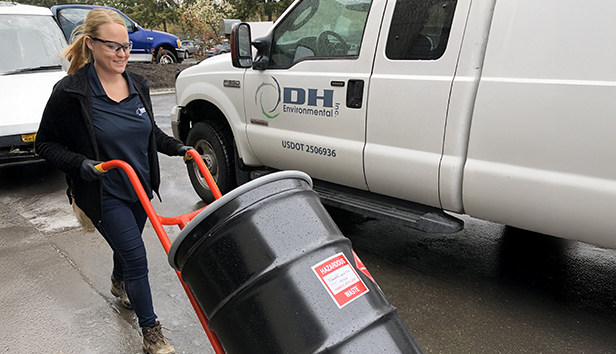
Photo courtesy of DH Environmental, Inc.
If you are a city or county facility manager, operations and maintenance manager at a public hospital district, chemistry lab manager at a public educational institution, or another role that manages dangerous waste, you should be aware of the new system for annual dangerous waste reports.
Generators of “dangerous waste” in Washington State, including government agencies, must file an annual Dangerous Waste Report each year by March 1. For over 25 years, these reports were submitted through the state’s TurboWaste system. TurboWaste has been retired for reporting purposes, but archive records can still be accessed on the site. All annual reports must now be submitted through the U.S. Environmental Protection Agency’s (EPA) RCRAInfo system.
Dangerous waste compliance is often overlooked by government agencies, especially if waste is periodically generated, such as during a one-time construction project. This blog explores the recent changes to annual reporting and recordkeeping of dangerous waste, as well as tips on how to ensure a smooth reporting transition. It is the first of a two-part series on dangerous waste compliance for government agencies in Washington.
Dangerous Waste Generators
Dangerous waste poses a risk to human health and the environment and is defined in the Dangerous Waste Regulations at WAC 173-303-040. Washington uses the term “dangerous waste” rather than the federal term “hazardous waste,” and state regulations are more comprehensive and protective than federal laws regulating hazardous waste.
The most common types of dangerous waste are paints, used solvents, cleaners, and chemical products that are no longer useable. Under WAC 173-303-040, a dangerous waste “generator” is any person or business whose act or process produces dangerous waste, which includes government agencies.
Generator Categories
Generators must properly designate, store, and dispose of dangerous waste in compliance with WAC 173-303. These regulatory requirements are defined by category based on the amount of dangerous waste generated in a calendar month at a specific site. As noted in the table below, the Washington State Department of Ecology (Ecology) and EPA use different terminology for generator categories.
Generators are independently responsible for determining what category of generator they are and following the appropriate regulations. Since generator status can change on a monthly basis, it is crucial to understand the requirements of each category.
| Ecology* (State) | EPA (Federal) | Generator Category Definition |
|---|---|---|
| Large Quantity Generator (LQG) | Large Quantity Generator (LQG) | Generate more than 2,200 lbs. of dangerous waste in one month |
| Medium Quantity Generator (MQG) | Small Quantity Generator (SQG) | Generate less than 2,200 lbs. but greater than 220 lbs. of dangerous waste in one month and store less than 6,600 lbs. on-site |
| Small Quantity Generator (SQG) | Very Small Quantity Generator (VSQG) | Generate less than 220 lbs. of dangerous waste in one month and store less than 2,200 lbs. on-site |
*For the remainder of this blog, we will reference the Ecology generator category definitions.
Dangerous Waste Annual Reporting
Under Washington law, Medium Quantity and Large Quantity Generators are required to obtain an EPA/State ID number (also known as a Site ID number) through RCRAInfo for each site where dangerous waste is generated. For example, a city could have several Site ID numbers if it generates and stores waste at various properties.
Any site that has an active Site ID number is required to complete the annual Dangerous Waste Report by March 1 through the RCRAInfo portal (no extensions or exceptions). An “authorized representative” must set up their own account and connect the agency’s existing Site ID numbers to the account. EPA has provided an instructional guide and video for more information.
The authorized representative can then approve access to additional authorized representatives, employees, or consultants. The authorized representative can also inactivate Site ID numbers for sites that no longer generate waste. If an authorized user needs to establish a new Site ID number, EPA has developed guidance on how apply for a new number.
Some challenges with setting up a new account include:
- The RCRAInfo platform utilizes login.gov, which is the same system used by the Social Security Administration. Therefore, the system may recognize an individual’s personal account first when logging in. A second account for business activities should be set up instead.
- The login.gov system requires multi-factor authentication (MFA), which is unique to each user logging in.
- A new electronic signature agreement is required, and the system will perform an electronic proof of identity. A user will be asked to supply personal information, such as home mailing address, date of birth, and last four digits of a social security number. If the system is unable to electronically verify a user’s identity, additional information will be required.
For any questions on reporting, including whether you have an active Site ID number, contact the Washington Department of Ecology at WA-RCRAInfo@ecy.wa.gov or (800) 874-2022. See also RCRAInfo Reporting Guide for Washinton State Generator.
EPA’s e-Manifest System
As of February 2025, dangerous waste disposal facilities are no longer required to mail hard copies of signed manifests back to the generator. Instead, the disposal facility is only required to upload manifests into EPA's e-Manifest system, which is a component of the RCRAInfo portal. Generators with active Site ID numbers are now required to retrieve their own copy of the manifests from the e-Manifest system to comply with recordkeeping requirements.
If your agency is a Small Quantity Generator and is not required to have a Site ID number, your manifests will not be available in the e-Manifest system, which only tracks manifests from sites with Site ID numbers. Accordingly, alternative arrangements should be made with the disposal vendor to obtain final copies of the manifests to ensure compliance with recordkeeping requirements under Washington law.
Conclusion
Dangerous waste reporting and recordkeeping has finally entered the electronic age, which will lead to increased efficiency. Accordingly, it is important to understand how these changes impact dangerous waste compliance for your agency.
Stay tuned for Part 2 of this blog series where we will cover dangerous waste designation, preparing for a dangerous waste inspection, and general compliance tips.
MRSC is a private nonprofit organization serving local governments in Washington State. Eligible government agencies in Washington State may use our free, one-on-one Ask MRSC service to get answers to legal, policy, or financial questions.

About Stacy Fox
Stacy Fox is a Senior Project Manager at DH Environmental Inc., which specializes in dangerous waste compliance support. She brings over 25 years of experience supporting environmental compliance programs for public and private sector industrial facilities throughout the state. Stacy now focuses on helping clients successfully meet regulatory requirements and maintain compliance.


