
Flag Display: Requirements, Protocols, and More
June 8, 2026
by
MRSC Insight
Category:
Flag Display
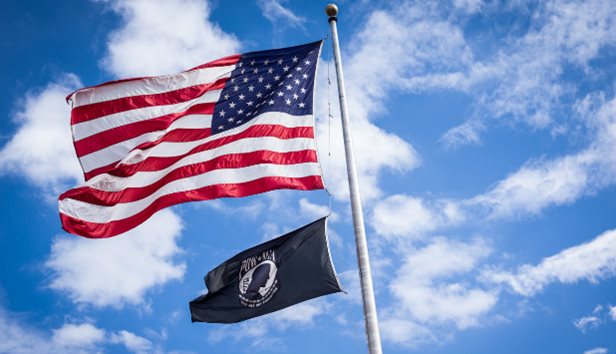
Our official flags and government buildings go hand-in-hand. Typically, government entities will fly the national and state flag on or at their buildings, and in fact, this is mandated by law on certain days.
This blog will cover required dates for flying certain flags, proper display of flags, and local policies regarding flag display, including display of non-governmental flags. MRSC also has a Flag Display webpage with additional information.
Requirements for Flying a Flag
The U. S. Flag Code (4 U.S.C. Ch. 1) provides protocols for flying the U.S. flag but does not mandate its display. State law, on the other hand, requires display of the U.S., Washington State, and prisoner of war/missing in action (POW/MIA) flags on certain days at government buildings. A summary of these state regulations is provided below.
Required dates for flag display
Under RCW 1.20.017, every city, town, and county, as well as state agencies, must display the U.S. flag, the Washington State flag, and the POW/MIA flag upon or near its principal building on the following days:
- March 30: Welcome Home Vietnam Veterans Day
- April 9: Former Prisoners of War Recognition Day
- Third Saturday in May: Armed Forces Day
- Last Monday in May: Memorial Day
- June 14: Flag Day
- July 4: Independence Day
- July 27: Korean War Veterans Armistice Day
- Third Friday in September: POW/MIA Recognition Day
- November 11: Veterans’ Day
- December 7: Pearl Harbor Remembrance Day
Note: If the designated day falls on a Saturday or Sunday, the POW/MIA flag will be displayed on the preceding Friday. See RCW 1.20.017(1).
While the U.S. Flag Code suggests flying the U.S. flag on additional dates, such as New Year's Day and Labor Day, the only required dates are those addressed in state law.
Additional flag display requirements—for certain agencies
Beyond RCW 1.20.017, a few other statutes apply to flag display but only for certain agencies. These are:
- RCW 1.20.015, which requires municipal, district, and superior courts; schools; and state buildings display the U.S. and Washington State flags.
- RCW 35A.21.180, which requires code cities display the U.S. and Washington State flags on city buildings. (There is no corollary provision for first- and second-class cities, towns, or counties.)
With the exception of school districts, there are no requirements in state law that require special purpose districts fly the U.S., Washington State, or POW/MIA flags at thier facilities.
Protocols for Displaying the Flag
Display of the U.S. flag should generally follow the protocol in the U.S. Flag Code. Courts have interpreted this code to be advisory only and there are no penalties for violating it.
Protocols for the U.S. flag include:
- It should be displayed every day of the year (except on days of inclement weather) on or near the main administration building of every public institution.
- It should be flown only during daylight hours, but it may be flown permanently if properly illuminated at night.
- It should fly in the highest position of honor, and no flag may be flown higher.
- It should be hoisted briskly and lowered ceremoniously.
According to the Washington Secretary of State, the state flag should be displayed in the highest position of honor after the U.S. flag and the flags of any other nations, and in a higher position of honor than the flags of other states, counties, cities, or any other entity.
However, if the U.S., Washington State, and POW/MIA flags are flown on a single pole, the U.S. flag should be on top, followed by POW/MIA flag, and then the state flag, per the state department of veterans affairs' POW/MIA Flag Display webpage.
Alternative Means of Displaying Flags
While displaying a flag on a pole outside a building is typical, there are guidelines for displaying the U.S. flag in other ways:
- When carried in procession with other flags, the U.S. flag should be either on the marching right (the flag’s right) or to the front and center of the flag line.
- When displayed on a float in a parade, the flag should be hung from a staff or suspended so it falls free.
- When displayed with one other flag against a wall from crossed flagstaffs, the U.S. flag should fall to its right and its staff should be in front of the other flag's staff.
- When included in a group of flags displayed from flagstaffs mounted on a wall, the U.S. flag should be at the center and the highest point.
- When the U.S. flag is displayed other than from a flagstaff, it should be displayed flat or suspended so that its folds fall free.
- When used on a speaker’s platform, the flag, if displayed flat, should be displayed above and behind the speaker and the flagstaff should always be placed to the right of the speaker (observer’s left) without regard to a platform or floor level.
Flying a Flag at Half-Mast
Local governments have the authority to lower the U.S. and state flags to half mast, though state law provides no guidance on when this should be done.
When trying to determine if a flag should be flown at half mast, many agencies follow the lead of the state and federal government. For example, the governor can order flags be lowered to half-staff for the following events:
- May 15: Peace Officers Memorial Day
- Last Monday in May: Memorial Day
- September 11: Patriot Day
- October: National Firefighters Memorial Day (typically during Fire Prevention Week)
- December 7: Pearl Harbor Remembrance Day
You can sign up to be notified by email when the governor directs flags to be lowered to half-staff. Note that anytime the U.S. flag is flown at half-staff, the state flag should also be flown at half-staff.
Local policy can also designate special occasions on which to lower flags, such as to honor death of a local agency employee or elected official, as the two examples below show:
Commemorative Flags and Banners
Local governments may adopt flag display policies (see the Flag Display webpage for examples) addressing which flags to display, and how, when, and under what circumstances they will be displayed.
Some local governments will periodically fly other non-governmental flags such as the Pride flag or other commemorative flags. Generally, when a local government chooses to fly a flag on agency property, this is considered government speech. Unlike the public’s First Amendment right to freedom of speech, the government is not required to display any and everything that is requested by members of the public—nor does the government need to allow flag display requests at all. Rather, a local government has discretion to fly non-governmental flags and commemorative flags of its choosing.
Importantly, if a local government chooses to fly certain flags at the request of the public, it should have clear policies regarding the flag selection process. A 2022 U.S. Supreme Court decision looked at the City of Boston’s flag display policy and held that the city’s refusal to fly a religious flag violated the plaintiff’s First Amendment rights when the city had indiscriminately allowed various other flags to be flown at the request of the public. For more information, see Shurtleff v. City of Boston(2022) and Speaking Versus Regulating — The Government Speech Doctrine.
The following local flag display policies were adopted after the Shurtleff decision and make clear the intent to establish flag display as governmental speech:
- Bellingham Resolution No. 2022-13(2022)
- Grant County Policy 305 (2025)
- Lacey Resolution No. 11120(2022)
- Lynnwood Policy EXE-001-2026 (2026)
- Sequim Ordinance No. 2022-023(2022)
Conclusion
Flag display by local governments involves a mix of legal requirements, established protocols, and local policy choices. While state law mandates certain displays and dates, the U.S. Flag Code provides widely accepted guidance on respectful presentation.
Beyond these baseline rules, local jurisdictions may adopt policies that reflect community values, particularly when it comes to half-mast observances and commemorative flags. Clear, consistent policies are essential to ensure compliance, maintain dignity in flag display, and avoid legal or constitutional concerns.
MRSC is a private nonprofit organization serving local governments in Washington State. Eligible government agencies in Washington State may use our free, one-on-one Ask MRSC service to get answers to legal, policy, or financial questions.


