
A Scenic Soak: Navigating the Rise of Mobile Saunas Along Public Waterfronts
March 26, 2026
by
Lisa Pool
Category:
Parks and Recreation Facilities
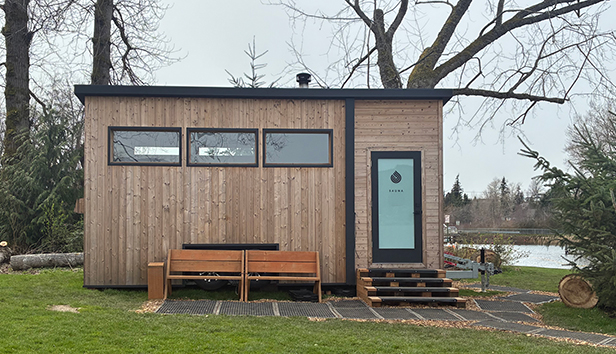
Sauna in Bellingham’s Bloedel-Donovan Park. Photo provided courtesy of the author.
As Pacific Northwesterners look for relief from dark, rainy winters, mobile saunas have found a natural home in city parks along the region's scenic waterfronts. These wood-fired retreats are popping up across Washington State—from Seattle’s Golden Gardens Beach to Bellingham’s Bloedel-Donovan Park—and local governments are increasingly being asked about them.
This blog outlines key considerations for local governments regarding mobile saunas, including permitting requirements, waterfront regulations, health and safety standards, and examples from Washington communities.
What Is a Mobile Sauna—and Why Does It Matter?
Typically mounted on wheels and heated by a wood-fired stove, mobile saunas are privately owned and operated wellness facilities. Operators set rules for their use, such as banning minors or requiring customers to wear swimsuits during sessions.
To maximize health benefits, saunas are often located near natural water bodies, like the Puget Sound, or include an onsite pool to provide cold plunge opportunities.
For customers, the appeal includes both mental and physical health benefits, including:
- Improved circulation and reduced inflammation,
- Boosted post-exercise recovery,
- Strengthened immune system,
- Reduced stress and improved mental health, and
- Opportunities for social connection.
For local governments, the benefits are equally compelling. Mobile saunas can:
- Activate underused parks and waterfronts during colder months;
- Attract visitors and support wellness tourism;
- Generate local jobs, tax revenue, and public-private partnerships;
- Advance public health goals with low-impact, community-minded businesses; and
- Create unique gathering spaces that strengthen community resilience.
As more operators enter the market, many local governments are now proactively developing regulatory frameworks.
Health and Safety
While saunas are aimed at promoting well-being, they present unique health and safety considerations that local governments should address, including:
- Sanitation – A few common sanitation requirements include regular cleaning and asking customers to shower before using the sauna and to sit on a towel during sessions.
- Fire safety – If the mobile sauna uses a wood-burning stove or gas heater, it will likely require a fire safety inspection.
- Liability insurance – Due to the heat-intensive nature of saunas, liability insurance is sometimes difficult for operators to obtain, often requiring a WETT (Wood Energy Technical Training) certification for wood-fired stoves.
Some municipalities require sauna businesses to have customers sign liability waivers. Bellingham's Hot Spot Sauna Club, for example, requires a client waiver that covers voluntary participation, assumption of risk, medical disclaimers, and safety guidelines.
The waiver also recommends that customers exit the sauna if they experience discomfort or dizziness. Customers also are cautioned to stay hydrated and limit sessions to no more than three consecutive 10-to-15-minute increments. Customers with medical conditions are required to consult a physician before sessions.
Varied Siting Processes Across Jurisdictions
Cities in Washington State, like Seattle, Tacoma, and Bellingham, have successfully sited private sauna companies in their public parks, offering useful models for other local governments. One initial step for cities to take is to review existing land use definitions of mobile saunas to ensure they reflect today’s goals of community health and wellness.
Permitting
When saunas are located in public parks, local governments should decide whether operators need a permit from the parks department. Depending on local building codes and the type of sauna, a building permit may be required as well. These permitting processes allow a jurisdiction to review potential site impacts and regulate health and safety, including compliance with the Americans with Disabilities Act (ADA).
Below are a few types of permits that might apply to mobile saunas in local parks:
- Park use permit – This type of permit includes review of siting and safety concerns and may be accompanied by one of the permits below. It may result in additional costs for vendors, as fees are typically assessed on an hourly basis.
- Concessions, special events, or vending permit – Most cities classify any business operating in a park—especially temporary vendors providing a service to visitors—as a concession. In many cases, these permits are more affordable than park use permits for seasonal vendors, as fees are generally assessed on a monthly basis instead of hourly.
- Commercial permit – A city may require a commercial use permit if the sauna affects pedestrians, traffic, and emergency access. These permits are potentially more affordable for vendors, as they are typically issued for a full season.
In addition to local review processes, mobile sauna business owners are also subject to various state and federal requirements, including holding a valid business license and liability insurance.
Seattle currently allows mobile saunas through its park use permit, which is needed to reserve a space, facility, stage, performing arts area, or playfield in a city park for public gatherings. Applications are accepted on a rolling calendar, with mobile sauna businesses required to seek a permit for each day of operation with hourly fees.
While mobile sauna vendors in Seattle can batch these applications, daily permits have a tendency to be logistically challenging and more expensive than other types of vendor permits, with fees of over $50 per hour.
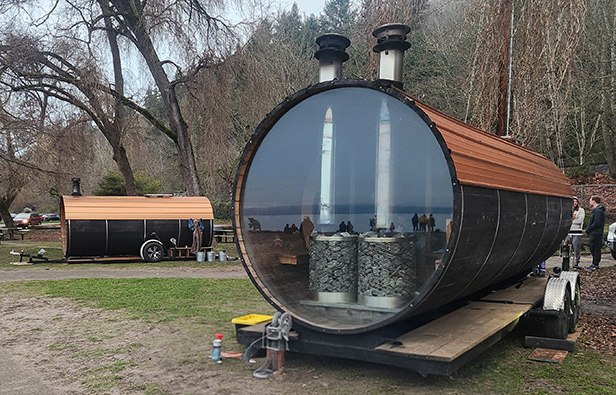
Sauna in Seattle's Golden Gardens Park. Photo provided courtesy of Steve Butler.
Seasonal concession permits for Seattle are lower (e.g., at Lake City Mini Park, they are $150 per month) and one permit can cover a whole season; however, mobile sauna businesses can’t currently apply for this type of permit.
Another Washington-based local example is Svette Sauna, which operates year‑round at Owen Beach in Tacoma’s Point Defiance Park, offering communal hot–cold contrast therapy sessions complemented by natural cold plunges in Puget Sound. Svette operates under a revocable commercial permit issued by Metro Parks Tacoma, which authorizes the sauna to remain onsite overnight at Owen Beach.
What About Waterfront Locations?
Because mobile saunas are often sited along waterfronts—both for scenic value and cold-plunge access—they often share space with other commercial and recreational uses, such as food trucks, coffee and ice cream stands, playgrounds, trails, beaches, and docks. A use permit or Request for Proposals (RFP) process can help cities manage competing vendors’ interests and potential impacts to the waterfront, like noise, crowding, and parking.
Any private commercial operations on park beaches, piers, tidelands, or similar publicly owned spaces typically requires a shoreline development permit or exemption. The state’s Shoreline Management Act (SMA) requirements and local Shoreline Master Programs (SMPs) protect ecological functions, ensure public access, and carefully manage private commercial activity.
Applicants for a permit to conduct a commercial activity along a shoreline must show that their presence will not degrade the shoreline environment or displace the public's ability to use the space. A mobile sauna may only be allowed if the local SMP designates that stretch of shoreline for water-oriented recreation, commercial activity, or temporary uses compatible with public access and environmental protection. For example, Entiat includes saunas in its definition of “health/fitness activity” in its Waterfront Business Zoning District.
RFPs
Some cities will solicit requests for mobile sauna businesses in response to public demand for the service. This allows staff to select the business model that is most compatible with park operations. According to Melissa Bianconi, Recreation Manager at the City of Bellingham, the city originally issued a broad RFP for parks concessionaires and recreation service providers.
The city had such strong interest from sauna providers that they later issued another RFP for just saunas. Using an example from Bend, Oregon, parks staff worked with their purchasing department to issue an RFP for mobile sauna providers.
Hot Spot Sauna Club was eventually chosen as the vendor and is now located in Bellingham’s Bloedel Donovan Park for the season but may move seasonally or expand into other parks.
Referring to the RFP process, Melissa noted:
It was important for us to make sure we made it clear that the call for proposals was for mobile units only. We needed that level of flexibility for our park locations, especially if there are unexpected issues that arise or if we want to ask the provider to change locations, come to an event in a different location, or move for a construction project. Further, if we were asking for a permanent unit to be built, it would have been considered a public work, which would have changed our solicitation method. We had eight respondents, all of which provided quality submittals.
Melissa also noted that RFPs are a good opportunity let the public know that mobile saunas are not only a great wellness amenity but also produce revenue for the city. She has this advice for other jurisdictions that are considering hosting saunas in their parks:
It was a bit too easy for folks to say “No taxpayer funded saunas!” on social media. I wish we had been a little more direct on that front in our outreach; it would have made it clear that this is a win-win-win for the community, for the business operator, AND for the taxpayer. Also, it is a great way to activate waterfronts in the off season.
Conclusion
Mobile saunas have been used in Scandinavia for decades but have recently emerged as a feature of Washington’s outdoor recreation landscape. They can contribute to community wellness, activate underused public spaces, and generate local economic activity. However, as a new use, they are not always addressed by existing local permitting frameworks.
Some cities across the state have begun developing approaches to these facilities. By clarifying zoning, shoreline, and health and safety considerations, local governments can evaluate mobile sauna proposals more consistently while protecting public spaces, including sensitive waterfront areas.
MRSC is a private nonprofit organization serving local governments in Washington State. Eligible government agencies in Washington State may use our free, one-on-one Ask MRSC service to get answers to legal, policy, or financial questions.

About Lisa Pool
Lisa Pool joined MRSC in June 2021. Most recently, she served as a senior planner for Bellingham. In this role, she primarily focused on long-range planning projects, including the city’s comprehensive plan and new housing regulations. Prior to moving to Bellingham, she worked on regional sustainability and transportation issues for a metropolitan planning organization and conducted development review for cities and counties in the Midwest.
Lisa holds a Bachelor of Arts in environmental policy and a Master of Urban Planning, both from the University of Kansas in Lawrence. She has been a member of the American Institute of Certified Planners since 2009.


