
Local Government-Supported Urban Agriculture Adds Equity and Climate Change Benefits for the Public
May 1, 2024
by
Alicia Bones
Category:
Climate and Sustainability
,
Parks, Recreation, and Cultural Programs
,
Inclusive Communities
The property surrounding the Woods Creek Hydroelectric Project in Monroe is anything but an afterthought. The Snohomish County Public Utility (PUD)-owned grounds are home to mature fruit trees, berry bushes, grape vines, wild strawberries, chives, carrots, radishes, and other native, food-producing plants.
The PUD's Woods Creek Sustainability Center and Food Forest is a combination of history and intention. The one-acre grounds, which have been home to various hydropower projects since the 1920s, were first developed by an on-site keeper who planted apple trees. To extend this legacy, the PUD's staff biologists proposed the food forest, which has been in development since 2021.
Food forests typically include seven "layers," including trees, bushes, and root vegetables. Food forests can either be large scale, like the PUD's version or Seattle's well-known Beacon Food Forest, or small. A community could develop a food forest around a single fruit tree, known as a "guild."
Another important component of the Woods Creek project is education and community engagement. Volunteers help with planting, weeding, composting, and other tasks, and food is donated to local food banks. When plants fully mature, the PUD aims to produce more than 1,500 pounds each year.
Visitors can also learn how to grow food by following a trail that leads them to various demonstration habitats they could replicate at home or in community plots.
The PUD's food forest is just one example of urban agriculture. Local governments supporting this type of food production can have a variety of goals: diminishing food deserts, lessening the impacts of climate change on underserved communities, or teaching community members how to grow their own food, to name a few.
This blog focuses on fruit and vegetable-production components of urban agriculture and shares local government codes and projects from across the state.
Benefits of Urban Agriculture
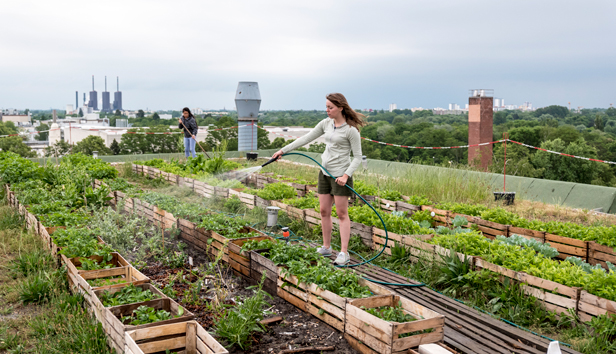
Urban agriculture is defined as the growing of fruits, vegetables, and other edible foods, as well as raising livestock, in urban settings. Often, urban agriculture projects also include donating or selling food to the public and the production of small-scale "cottage foods" like jams or pickles.
Some examples of urban agriculture include:
- Planting strip zoned for personal gardens,
- Container or rooftop gardens,
- Beekeeping,
- Urban farms that sell at farmers' markets or on-site farm stands (larger farms typically require business licenses),
- Cottage food production for sale (with permit), and
- Community gardens where residents can grow their own food.
According to the United State Department of Agriculture (USDA), urban agriculture has many benefits. For instance, it promotes positive equity outcomes by developing urban greenspaces that add shade and cooling. The USDA adds:
As urban populations grow, cities can consider strategically placing urban agriculture plots to reduce heat island effects. In addition, when these areas are cooler in the summer, people use less energy and emit less greenhouse gases through the use of air conditioners or fans.
A Baltimore-based study also discusses how urban agriculture can offer underserved communities more control over the fresh food in their diets. Specifically, how alternative food networks (AFNs) connect farmers with consumers and distribution channels to provide residents with access to fresh food they wouldn't have otherwise. Study authors say that AFNs "not only improve food security, but also address issues such as unemployment, community decline, and food deserts."
In connection, community members educated on food production go on to decrease carbon in their diets by an average of 10%. These projects also give the public ideas and opportunities to grow their own food.
Washington Urban Agriculture Codes and Projects
Some government agencies, like the Snohomish County PUD, improve the public's knowledge of native plants and food production. Other local governments support urban agriculture by adding elements to their local codes. Under RCW 35.21.192 (for cities and towns) and RCW 35A.21.420 (for code cities), municipalities can create urban agriculture zones by ordinance.
Federal Way, for instance, developed robust urban agriculture zoning in Chapter 19.62 FWRC. This chapter aims to increase locally-produced food, food security, and economic opportunities, while reducing greenhouse gases produced by more dispersed food distribution. As part of the code:
- Community gardens and urban farms are allowed in any zone "if approved by the director;"
- Temporary farmers markets are permitted in all zones (Chapter 19.275 FWRC), and permanent ones are allowed in non-residential zones that allow retail use;
- Farm stands (with several size and time restrictions) connected with permitted urban agriculture projects are allowed in any zone for farmers to sell what they produce on site (FWRC Sec,19.262.050); and
- Cottage food operations are permitted in any zone under RCW 69.07.100 and 69.07.120.
The City of Spokane developed a similar, more limited urban agriculture zone. The city's residential agriculture (RA) zone is a single zone in the Latah Valley, colloquially known as Vinegar Flats because of a turn-of-the-century vinegar facility in the area.
For more than 100 years, the Latah Valley has been agriculturally significant, even as the city developed, and farming continues to be a significant endeavor in the area. Notes Spokane City Planner, Tirrell Black:
In the old aerial pictures on our GIS, you can see all the farming that occurred in that area. You can see the little farm plots, and Spokane natives who are older remember, like, oh yeah, that was where you can get farm goods.
So, the city created the RA zone specifically for the Vinegar Flats area, the only part of the city with this particular code:
The RA zone is a low-intensity residential zone that is applied to areas that are designated agriculture on the land use plan map of the comprehensive plan.
Uses allowed in this zone include farming, green house farming, single-unit residences and minor structures used for sales of agricultural products produced on the premises.
The Vinegar Flats Farm, an urban farm in the RA zone, is fewer than three miles away from Spokane's city center.
The Olympia Parks & Recreation department is also working to create an Urban Farm Park that incorporates many of the cornerstones of urban agriculture: a place where residents can grow and sell food, and learn to produce fresh food themselves.
Currently, the city is in the feasibility study phase, exploring what the public wants in what's being called the Urban Farm Park. In a recent survey, the majority of respondents were supportive of the farm park and interested in the following amenities:
- Farmer training and youth education,
- Regenerative farming,
- Community garden spaces,
- An incubator farm to help gardeners develop new businesses,
- A demonstration garden,
- A commissary kitchen where residents can make goods to sell,
- Pop up market space,
- Inclusion and equity, and
- Opportunities for the community to come together and support each other in local food production.
Eventually, the city will need to identify a park space for the project. This could mean purchasing a new property or determining if a parcel they own already could accommodate the park.
The project will be a public/private partnership, and Sylvana Niehuser, Olympia’s Director of Parks Planning and Maintenance, and her team plan to hire a park operator. Sylvana says:
The best type of partnership is where you both benefit. We will work on developing a framework and selecting a partner whose values align with the city. Then, we'll learn more about their needs so we can start thinking about what sort of infrastructure we need.
In 2026, the team will continue sharing project proposals with the public, an outreach effort that usually takes about a year and a half. Sylvana adds:
We'll ask the public to rank the farm park with other projects that we've heard they've wanted or needed. That helps us prioritize and figure out how we're going to allocate the resources we have.
Local Governments and Urban Agriculture
Urban agriculture has many benefits, ranging from increased food sovereignty and climate change resistance to lower-carbon diets for those knowledgeable about food production.
Local governments can take a range of approaches to support urban agriculture in their municipalities, including making farming and food sales more possible within city boundaries, to developing community garden projects or creating demonstration gardens that can inform residents about food production. But, as with many local projects, the most important aspect of urban agriculture development is soliciting community feedback to determine which aspects matter most.
Below are some additional resources on the topic:
- American Planning Association: Urban Agriculture: Offers resources that provide background, policy guidance, and examples of comprehensive plans and zoning ordinances that address urban agriculture.
- USDA: Urban Agriculture and Innovation Production Grants: Funding can be used for projects that target food access; education; business and start-up costs for new farmers; as well as development of policies related to zoning and other needs.
- Vermont Law and Graduate School’s Center for Agriculture and Food Systems: Zoning for Urban Agriculture (2024): Intended for use by planners, local policy makers, food policy councils, and members of the public who want to promote urban agriculture through zoning reform.
MRSC is a private nonprofit organization serving local governments in Washington State. Eligible government agencies in Washington State may use our free, one-on-one Ask MRSC service to get answers to legal, policy, or financial questions.


