
Five Actions to Strengthen Local Government Earthquake Preparedness
October 13, 2025
by
Alicia Bones
Category:
Emergency Management
,
Interlocal Cooperation
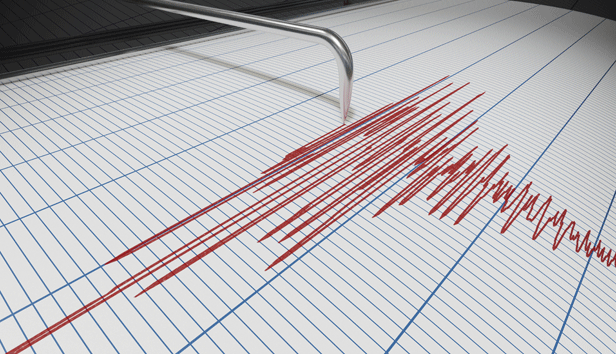
Recent seismic events—including the magnitude 4.6 earthquake that struck Western Washington in July 2019 and the magnitude 2.3 quake that hit the Tri-Cities this past July—underscore Washington's position as one of the nation's most earthquake-prone states. The Washington Department of Natural Resources reports that Washington has the second highest earthquake risk in the United States, with more than 1,000 earthquakes occurring in the state each year.
With the Great Washington ShakeOut scheduled for October 16, 2025, local governments have a reminder to assess their broader earthquake preparedness efforts. Here are five actions local governments can take to strengthen their readiness.
1. Establish Regular Earthquake Drill Programs
Earthquake drills teach people the "Drop, Cover, Hold On" response. According to the Earthquake Country Alliance, rescue teams from the United States and other countries that have conducted searches for trapped individuals in collapsed buildings agree that the protocol minimizes injuries and fatalities during earthquakes.
The Great Washington ShakeOut website emphasizes the importance of regular drills, noting that individuals may have only seconds to protect themselves before stronger shaking begins. The Washington Military Department, which oversees the state’s Emergency Management Division, notes that over 1.2 million Washington residents have registered for the 2025 earthquake and tsunami drill.
Many local governments encourage drill participation. Pierce County encourages residents to participate in the annual ShakeOut drill and offers emergency kit preparation activities. According to the Columbia Basin Herald, Grant County had 9,120 registered ShakeOut participants, and Adams County had 4,768 registered participants in 2024.
Bellingham also offers Community Emergency Response Team (CERT) training, which provides residents with hands-on emergency preparedness education, including triage, first aid, and fire suppression skills.
More resources can be found at the Great Washington ShakeOut website.
2. Address Communication System Vulnerabilities
In 2016 and 2022, the Federal Emergency Management Agency (FEMA), along with the Washington Emergency Management Division, carried out Cascadia Rising, a multi-state disaster preparedness exercise simulating the response to a large earthquake in the region.
The report identified several areas for improvement in Washington, with key communication problems including:
- Agencies lacked access to basic contact information for partners when computer systems were down;
- Agencies did not have emergency communication capabilities, such as access to amateur radios and personnel trained to use them, to cover their needs when normal modes of communication were down; and
- Public messaging options employed by agencies did not adequately communicate changing conditions or life-sustaining information.
Jefferson County demonstrates one approach to addressing these gaps. The county's emergency management department works with the Jefferson County Amateur Radio Emergency Service (ARES/RACES) and the Volunteer Emergency Communications Group (VECOM). The City of Bellingham notes that ham radios have proven to be useful when cell service is not available. The difficulty here, of course, is encouraging community members to purchase these radios prior to an emergency.
3. Improve Inter-Agency Coordination
Cascadia Rising also revealed coordination difficulties. Poor internal coordination between departments and externally with neighboring jurisdictions resulted in either response failures or duplicated efforts. Some emergency plans also lacked pre-established resource prioritization across departments and agencies.
Shaunna Lee, emergency manager for the City of Maple Valley, said: "These discussions help test our plans and how we will work together in a disaster. Without solid plans in both transportation and mass care, we will never be successful in such a massive disaster—both are critical to ensuring lifesaving and life-sustaining personnel, equipment, and supplies get to the people that need them most."
4. Update Public Preparedness Messaging
Historically, Washington advised residents to maintain preparedness supplies for a minimum of 72 hours. The state recently revised this guidance to recommend two weeks of supplies after Cascadia Rising exercises demonstrated that assistance would require days rather than hours to reach affected populations. This updated recommendation is known as Be 2 Weeks Ready.
Some local governments go beyond this guidance. For instance, Jefferson County advises that residents should plan to remain self-sufficient at home for 30 days. The county offers detailed guidance on food, water, and grab-and-go kits, along with information on sanitation solutions, such as twin bucket septic systems. It also provides comprehensive preparedness information and neighborhood initiatives, including Neighbors Helping Neighbors and Emergency HUBS, where community members can assemble following a catastrophic disaster.
Other outreach programs inform residents about emergency preparedness in their communities:
- Island County offers detailed information about county-specific earthquake activity, including fault lines running through Camano and Whidbey Island.
- Kitsap County highlights that damage to bridges and marine infrastructure could isolate Kitsap County from the rest of the Puget Sound following a major earthquake.
- Edmonds describes its Comprehensive Emergency Management Plan and offers guidance on individual and community preparedness.
5. Address Unreinforced Masonry Buildings
Falling objects and collapsing buildings represent the primary sources of injuries and deaths during earthquakes. Unreinforced masonry buildings (URMs) feature walls constructed from masonry materials (brick, concrete block, stone, etc.) without embedded steel reinforcement bars to provide structural support. These buildings pose significant earthquake safety risks.
The Washington URM Dashboard displays all URMs, suspected URMs, and reinforced URMs throughout the state.
In 2017, Seattle established a seven- to-13-year timeline in 2017 for landlords to complete seismic upgrades to URM buildings. In 2019, the city’s department of construction and inspections presented financing options for URM retrofits. In 2024, the city adopted code as part of the 2021 Seattle Existing Building Code and is developing a mandatory unreinforced masonry retrofit for over 1,100 buildings at risk of collapse.
Taking the First Step
The Great Washington ShakeOut provides a practical entry point for enhancing earthquake preparedness, but it is just the beginning. After the 2016 Cascadia Rising simulation, local officials advanced their efforts in resolving coordination issues, revising emergency plans, and enhancing communication systems. However, additional work remains to be done. These five strategies can help local governments enhance resident protection and strengthen recovery following an earthquake.
This year's Great Washington ShakeOut falls on October 16, 2025, at 10:16 am (local time). Organizations may register a local ShakeOut drill for any date throughout the year, though participation at the scheduled time is encouraged.
Here are some additional resources:
MRSC is a private nonprofit organization serving local governments in Washington State. Eligible government agencies in Washington State may use our free, one-on-one Ask MRSC service to get answers to legal, policy, or financial questions.


