
Updating Local Regulations to Encourage More Accessory Dwelling Units
April 15, 2025
by
Steve Butler
Category:
Housing
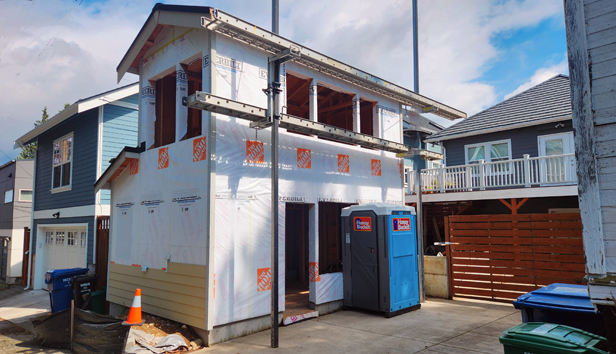
Photo: credit of the author
Washington is in the midst of an affordable housing crisis, with population and household growth occurring faster than the growth of new housing units. This imbalance has led to a significant increase in the cost of housing, resulting in more households paying more than 30% of their monthly income for housing (which is the federal determination of when a household is “cost burdened”). Additionally, this housing problem is hitting lower income households the most (i.e., those making less than 80% of the median family income).
To address its major housing problem, Washington State and its local governments are exploring several different approaches, one of which is to relax regulations on the construction of accessory dwelling units (ADUs). An ADU is typically less expensive to construct than a single-family home and provides another option for people who do not want a larger home.
ADUs are small, self-contained, residential units located on the same lot as an existing single-family home. An ADU has all the basic facilities needed for day-to-day living, such as a kitchen, sleeping area, and a bathroom, and may be either attached to or detached from the primary residence (see diagram below for attached and detached ADU images).

Summary of Washington’s ADU Requirements
State law related to ADUs was significantly changed in 2023 with the signing into law of HB 1337. Based on those new statutory requirements (RCW 36.70A.680 and 36.70A.681), all GMA-planning local governments — which includes cities and unincorporated urban growth areas within counties (regardless of population size) — are required to revise their ADU regulations as needed to conform with the new requirements within six months after their periodic update due date.
A summary of the new ADU requirements that must be incorporated into local regulations/processes are as follows:
- A minimum of two ADUs must be allowed per lot (in addition to the principal unit) in all GMA urban growth areas for lots that meet the minimum lot size required for the principal housing unit.
- Local governments may not require ADUs to be smaller than 1,000 gross square feet in size.
- Local governments must be flexible with regard to onsite parking requirements for ADUs and cannot require any onsite parking if the site is located within a half mile of a major transit stop. Parking regulations must also comply with RCW 36.70A.620 and RCW 36.70A.622.
- Local governments may not impose more restrictive ADU design standards/ mandates than those for principal units for the following components: entry door locations, aesthetic requirements, requirements for design review, setback requirements, yard coverage limits, or tree retention requirements.
- Street improvements may not be a condition of permitting ADUs.
- Owner occupancy of the principal unit or ADU may not be a requirement for permitting.
- Sale or other conveyance of a condominium unit independent of a principal unit may not be prohibited based solely on the grounds that the condominium was originally built as an ADU.
- ADU impact fees are limited to no more than 50% of those assessed by the principal housing unit.
- Common Interest Communities (commonly called CC&R, and can include such examples as a new subdivision with a homeowners association) are prohibited from adopting covenants, conditions, and restrictions that limit the construction of new ADUs on any lot within the community (Existing CC&Rs, however, remain in effect).
A fuller discussion can be found on our Accessory Dwelling Units (ADUs) webpage, and a complete set of statutory requirements are contained in RCW 36.70A.681.
Local Government and ADU Code Examples
Several cities are working diligently to update and adopt their ADU code provisions to meet the state’s June 30, 2025, deadline (for local governments in the first tier of periodic comprehensive plan updates), but a few jurisdictions have already updated their ADU code provisions early (or are in the final phases of doing so). Those “early bird” cities include Auburn, Lake Stevens, Moses Lake, Olympia, Port Angeles, and Port Townsend.
Moses Lake
Moses Lake amended its municipal code (MLMC) in September of 2024 by adding a new unified development code title, within which they included the city’s updated ADU code standards. Some highlights from Moses Lake’s new ADU provisions include:
- All ADU permit applications shall be processed administratively as a type I permit.
- One off-street parking space is required for each ADU.
- The new ADU code also innovatively allows micro (tiny) homes to be utilized as an ADU — See MLMC Section 15.415.090(C).
- ADUs are explicitly prohibited from being used as short-term rentals — due to the city’s goal of increasing affordable housing (instead of creating short-term “hospitality units” for visitors).
Auburn
Auburn updated several development code sections in its municipal code in December 2024 (by adopting Ordinance 6959), with the new ADU provisions in Chapter 18.32: Accessory Dwelling Unit Development Standards.
In addition to meeting the new statutory requirements, Auburn’s ADU provision explicitly states that off-street parking is not required for any ADUs located within one-half mile walking distance of a major transit stop. The city also mandates that all new ADUs must record a statement with King County to ensure that future owners know they must comply with all applicable city ADU requirements.
Olympia
Olympia is currently in the process of updating its ADU standards in Title 18 of the city’s unified development code. In addition to its goal of meeting the new statutory requirements, Olympia explicitly provides for the use of unit lot subdivisions when creating separate lots between a primary residential structure and a detached ADU. This approach would most likely be used in a situation where the primary residential unit and a detached ADU were to be sold and then owned separately.
Olympia currently has requirements for where an ADU’s primary doorway may be placed. In order to comply with state law, and as part of its code update, the city is proposing to apply this type of doorway locational standard to all new single-family residential housing units and ADUs.
Port Angeles
Port Angeles’ new ADU regulations have a companion code section that allows a recreational vehicle, or RV (referred to as a “Park Model” in the city's municipal code) to be used as a detached ADU in all zones where ADUs are an allowed accessory use, subject to a set of development standards (see PAMC Section 17.21.021: Park model alternative).
Port Townsend
Similar to Port Angeles, Port Townsend allows a tiny home on wheels to be used as a detached ADU in Chapter 17.58 of its municipal code. The city also allows ADUs to be configured as a duplex structure when detached from a primary residence, subject to certain condition — see PTMC Sec. 17.16.020(C).
Lake Stevens
Lake Stevens’ newly adopted ADU regulations do a good job of complying with what is required by state law. One interesting code section allows for a “commonsense” increase in the maximum size of an ADU if it is completely located on a single floor within the footprint of the primary residential unit or an existing legal accessory structure (e.g., a detached garage or outbuilding)
Conclusion
There is not just one solution that will adequately address our state’s affordable housing problem. Instead, it will take consideration and adoption of several different options to begin to “move the needle” on this challenging issue. Reducing barriers to make it easier to construct ADUs in communities throughout Washington State is an important step for local governments to take.
Readers interested in learning more on how Moses Lake, Olympia, Pierce County, and Port Townsend have developed targeted approaches to promoting the development of ADUs within their jurisdictions should register for Encouraging Accessory Dwelling Units in Your Community, which will be held on Wednesday, June 4, from 11:00 a.m. to 12:30 p.m.
Here are some additional resources from the Washington State Department of Commerce:
- Guidance for Accessory Dwelling Units in Washington State (2024) – Prepared in collaboration with MRSC, this publication discusses benefits, regulatory issues, and zoning regulations for ADUs.
- ADU Housing Checklist – This checklist can help planning staff ensure local ADU codes are in compliance with state laws.
MRSC is a private nonprofit organization serving local governments in Washington State. Eligible government agencies in Washington State may use our free, one-on-one Ask MRSC service to get answers to legal, policy, or financial questions.


