
Growth Management Act Basics
This page provides an overview of the Growth Management Act (GMA) in Washington State, including information on its goals, legal requirements, urban growth areas, the Growth Management Hearings Board, and other recommended resources.
It is part of MRSC's series on the Growth Management Act.
Overview
The Growth Management Act (GMA) is a series of state statutes, first adopted in 1990, that requires fast-growing cities and counties to develop a comprehensive plan to manage their population growth. It is primarily codified under Chapter 36.70A RCW, although it has been amended and added to in several other parts of the Revised Code of Washington (RCW).
Under RCW 36.70A.020, the GMA establishes a series of 15 goals that should act as the basis of all comprehensive plans. The GMA specifically notes in the statute that the goals "are not listed in order of priority and shall be used exclusively for the purpose of guiding the development of comprehensive plans and development regulations." Below you will find a list of those goals along with an abbreviated description (for the full descriptions, see RCW 36.70A.020).
| GMA Goals (RCW 36.70A.020) |
|---|
|
The Washington State Department of Commerce is the primary state-level contact for GMA-related issues. They provide technical assistance to help local governments comply with the GMA and implement their comprehensive plans effectively.
Which Cities and Counties Are Required to Plan Under GMA?
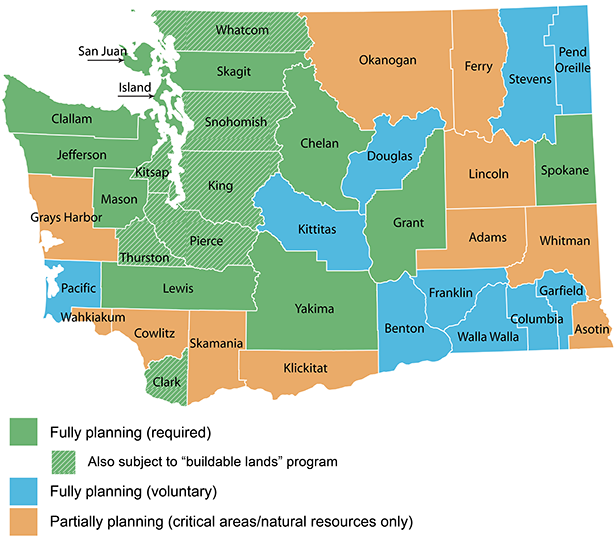
Twenty-eight of the 39 counties in Washington State must "fully plan" under the GMA, comprising roughly 95% of the state’s population. All cities and towns located within fully planning counties are also required to fully plan, except that certain cities and towns under 500 population may opt out under RCW 36.70A.130(1)(b).
Eighteen of these 28 counties are required to fully plan under RCW 36.70A.040, while another 11 voluntarily opted in following the passage of the GMA in the 1990s. Once a jurisdiction has begun fully planning, it cannot opt out unless specifically authorized by law. One of those 11 "voluntary" GMA counties—Ferry County—later opted out under RCW 36.70A.040(2)(b).
Occasionally, it matters whether a fully planning jurisdiction is required to plan or is voluntarily planning. For example, voluntary jurisdictions must get voter approval to implement the "REET 2" real estate excise tax, but voter approval is not needed for jurisdictions that are required to fully plan.
In addition to the basic GMA requirements, some fully planning counties have additional "buildable lands" planning requirements discussed below and/or participate in the Puget Sound Regional Council’s Vision 2050 regional plan.
Any cities, towns, or counties that are not "fully planning" must still "partially plan" for critical areas and natural resource lands under the GMA.
The map below shows the planning status of each county.
Growth Management Act Requirements by County
Comprehensive Plans
The GMA establishes the comprehensive plan as the centerpiece of local long-range planning, which contains a vision, goals, objectives, policies, and implementation actions that are intended to guide day-to-day decisions by elected officials and local government staff. For information on the comprehensive planning process, see our page on Comprehensive Planning.
Urban Growth Areas and Accommodating Future Growth
Under the GMA, the state Office of Financial Management (OFM) develops population projections for the state and each county (see OFM's GMA county projections). Each "fully planning" county is then mandated to determine, in consultation with cities, where that growth should be directed to occur. Once these growth projections are adopted, then the county and cities are to use them in their comprehensive planning processes and make sure that their plans can accommodate the projected level of growth (RCW 36.70A.115).
This process involves reviewing urban growth areas (UGAs), which are areas where “urban growth shall be encouraged and outside of which growth can occur only if it is not urban in nature” (RCW 36.70A.110). Based on OFM population projections, UGAs and zoning densities within them should be set to accommodate growth that is projected to occur in the county or city over the next 20 years, although they can provide additional capacity to accommodate a “reasonable land market supply factor” (RCW 36.70A.110(2)).
The GMA was amended in 2021 to require that designated cities also identify the capacity and actions needed to accommodate future housing growth within four household income categories (based on U.S. Housing and Urban Development Department guidelines using Average Median Income, or AMI): moderate (80-95% AMI), low (50-80% AMI), very low (30-50%), and extremely low (<30 AMI).
If the UGA review determines that future growth can’t be accommodated within the existing boundaries of the UGA, or the UGA’s developable lands exceeds future growth projects, the UGA may be changed subject to certain requirements such as limitations on floodplain areas and national historic reserves. In 2024, the GMA was amended to allow additional conditions under which UGAs may be revised (SSB 5834). Counties are responsible for designating, expanding, and reducing UGA boundaries, although they are required to consult with the cities in their determinations.
Areas within the UGA but outside city or town boundaries should be addressed by the adjacent city and the county through the county-wide planning policies process. Outside the UGA, cities and towns are limited in the actions they can take regarding those areas. For example, cities are highly limited in their ability to extend utilities and other governmental services outside the UGA (RCW 36.70A.110(4)). However, RCW 36.70A.211 creates a narrow exception to this rule, explicitly permitting an extension of public sewer (along with other public facilities and utilities) to “serve a school sited in a rural area that serves students from a rural area and an urban area” if specific conditions are met.
While all "fully planning" counties are required to conduct land capacity analyses to ensure their UGAs can accommodate future growth, Clark, King, Kitsap, Pierce, Snohomish, Thurston, and Whatcom counties also have to submit Buildable Lands reports that look back at actual development to determine if cities and counties have designated adequate amounts of residential, commercial, and industrial lands to meet the growth needs incorporated in their comprehensive plans (see Commerce's Buildable Lands page).
For more information on UGAs, see the Department of Commerce’s Urban Growth Area Guidebook (2012).
Natural Resource Lands and Critical Areas
Under the GMA, all cities and counties - even if they are not subject to comprehensive planning - are directed to designate natural resource lands (including those related to forestry, agriculture, fisheries, and mining) and identify steps to preserve them. For more information, see the Department of Commerce's Natural Resource Lands page.
In addition, all cities and counties in Washington are also required to adopt critical areas regulations. As defined in RCW 36.70A.030(6):
"Critical areas" include the following areas and ecosystems: (a) Wetlands; (b) areas with a critical recharging effect on aquifers used for potable water; (c) fish and wildlife habitat conservation areas; (d) frequently flooded areas; and (e) geologically hazardous areas. "Fish and wildlife habitat conservation areas" does not include such artificial features or constructs as irrigation delivery systems, irrigation infrastructure, irrigation canals, or drainage ditches that lie within the boundaries of and are maintained by a port district or an irrigation district or company.
In 2023, SB 5374 amended RCW 36.70A.060 allowing a city of fewer than 25,000 people to adopt their county’s GMA critical area regulations by reference. Counties and cities are required to include the best available science in developing policies and development regulations to protect the functions and values of critical areas (RCW 36.70A.172).
For more information, see our page on Critical Areas and the Department of Commerce's page on Critical Areas Protection, including their useful Critical Areas Handbook (2023).
Growth Management Hearings Board
The Growth Management Hearings Board resolves disputes concerning comprehensive plans and development regulations adopted under the GMA. The board is made up of five members (RCW 36.70A.250)
Challenges to the GMA are heard by a three-member panel comprised of two members residing in the geographic area of a challenge (Eastern Washington, Central Puget Sound, and Western Washington), with one acting as the presiding officer. A third member is drawn from one of the other regions. Each hearing panel must include “a member admitted to practice law in the state,” a former city or county elected official, and must “reflect the political composition of the board” (RCW 36.70A.260).
The governor has the authority to impose sanctions on cities, counties, and state agencies that do not comply with the GMA, as determined by the Growth Management Hearings Board (RCW 36.70A.340-.345). Sanctions may include withholding or temporarily rescinding the authority to collect portions of one or more of the following:
- Motor vehicle fuel tax
- Transportation improvement account
- Rural arterial trust account
- Sales and use tax
- Liquor profit tax
- Liquor excise tax
- Real estate excise taxes (REET)
Under RCW 36.70A.330, a local government found by the Growth Management Hearings Board to be out of compliance with the GMA may not be found to be back in compliance unless it has amended the noncompliant plan or regulations and the amendments are compliant with the GMA.
The Growth Management Hearings Board website contains numerous resources, including a handbook (2023) for practicing before the board and digests of decisions (2023).
Recommended Resources
- Washington State Department of Commerce
- Growth Management Services – The go-to resource for guidebooks, grants, training, and other resources to help jurisdictions comply with GMA
- Short Course on Local Planning – Very helpful online resources and in-person training courses on most aspects of local planning in Washington, including a downloadable guidebook and a series of short videos including Growth Management topics, laws and guidebooks.
- Office of Financial Management: GMA County Projections – Population projections (updated every 5 years) for each county under low, medium, and high levels of growth, as well as population change over the last 10 years.


