
Dealing with Housing Displacement in Your Comprehensive Plan
May 29, 2024
by
Carson Bridges
,
Steve Butler
Category:
Guest Author
,
Comprehensive Planning-Growth Management
,
Housing
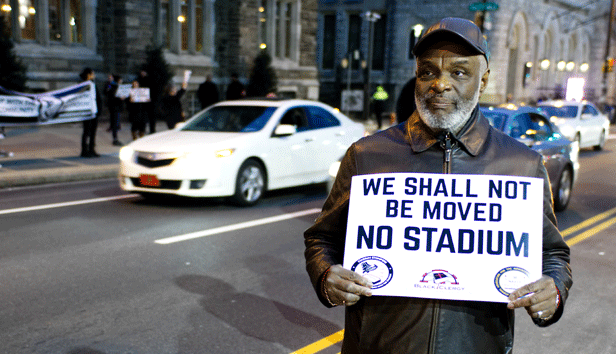
Across Washington State, cities and counties of all sizes are dealing with housing affordability, some of which may be the result of gentrification. As communities accommodate needed new residential development, gentrification and displacement of existing households often occurs. For local governments, finding the right balance between new development, gentrification, and displacement can be challenging.
Gentrification is caused by changing preferences and new development, with the influx of new people and capital into stable, previously undeveloped areas. While gentrification and displacement can affect anyone, it disproportionately impacts renters, BIPOC (Black, Indigenous, and People of Color) communities, and people with low incomes. This can lead to worsening inequities across a community since displaced residents lose neighborhood ties, resources, and even communal identity. Keeping people in their current homes and neighborhoods can strengthen communities and improve quality of life for many.
Displacement can occur for both residential and commercial land uses, but this blog focuses on housing displacement.
Types of Displacement
Displacement manifests in many ways but the three most identified categories are:
- Economic displacement, which occurs when increasing housing costs create pressure, forcing a household or business to move to a less expensive location.
- Physical displacement, which occurs when a project — such as building demolition, renovation, or infrastructure — creates such adverse conditions that a resident can no longer physically stay in their unit. For example, when an existing apartment building is purchased and then demolished to accommodate a new, higher-density development project.
- Cultural displacement, which occurs when changes render a neighborhood quite different, as many cultural institutions leave, creating a sense of isolation for long-term residents.
Displacement is a problem with serious consequences for communities. For affected individuals and groups, being displaced can often mean being forced to move from their current neighborhoods to areas with a worse quality of life. Displacement can also result in increased regional inequality, as newly gentrified areas are often characterized by an influx of higher-income households and reduced socio-economic diversity.
Many people think that gentrification and displacement only occur in large cities, but that is not the case. The Washington State Department of Commerce's (Commerce) Displacement Risk Map shows that displacement is a statewide issue, though at varying levels. At a regional level, the risk of residential displacement in the Central Puget Sound is shown to be concentrated in South King County, as shown in the Puget Sound Regional Council’s Displacement Risk Mapping Tool.
Planning for Anti-Displacement
Due to displacement's adverse effects on the social, economic, and physical well-being of community members, many local governments in Washington are interested in reducing displacement and mitigating its future impacts.
The passage of HB 1220 in 2021 requires all counties and cities planning under the Growth Management Act (GMA) to include anti-displacement measures in their upcoming periodic comprehensive plan updates. Commerce’s Updating GMA Housing Elements webpage and Guidance to Address Racially Disparate Impacts contain a lot of helpful information for local governments to review and use.
While a few Washington cities have been working on anti-displacement policies — such as the cities of Oak Harbor, Renton, and Seattle — two cities that have most directly addressed displacement in detail are Tacoma and Vancouver.
Case Study: Tacoma
Existing high and rising housing costs in Tacoma have led to a significant rise in housing uncertainty across the city. Tacoma’s Anti-Displacement Strategy was adopted in February of 2024 by the city council and includes many strategies for preventing rising housing costs and displacement. This plan contains 21 actions that fit into the following four categories:
- Create Housing for More People
- Keep Housing Affordable and in Good Repair
- Help People Stay in Their Homes and Communities
- Reduce Barriers for Those Who Often Experience Them
The broad framework includes many pieces that fit into the affordability and displacement puzzle, with preservation, stabilization, and equity considerations woven throughout.
The Anti-Displacement Strategy also includes ambitious programs that may be harder to implement but would have significant impact. A few examples include: Action 2.4: Housing Preservation Fund, which would require a large amount of public funding; and Action 4.2: Housing and Land Reparations, which proposes the city implement a land reparations program similar to one in Evanston, Illinois.
Case Study: Vancouver
As part of the rapidly growing Portland-Vancouver-Hillsboro Metropolitan Statistical Area (MSA), Vancouver has been experiencing significant population growth and housing affordability issues. With declining vacancy rates and a high percentage of residents who report paying more than 30% of their income toward housing, community members were worried about the potential for residential displacement in many city neighborhoods.
Reside Vancouver: An Anti-Displacement Plan is a policy document that was adopted in 2019 by the city council. Prepared in collaboration with a student group from Portland State University, the plan separates its proposed anti-displacement strategies into two categories: An aspirational package and a capturing momentum package
- Aspirational — As the name implies, the policies in this category are more difficult to implement than those in the ‘capturing momentum’ category, and include, for example, creating a new Anti-Displacement Impact Assessment program or passing a Tenant Right of First Refusal program.
- Capturing momentum — This package covers actions and policies that build from what the city already has in place. Examples include extending the timeline on the Affordable Housing Fund and revamping the city’s multifamily tax exemption program to require developers to form community benefits agreements with the community if they wish to get the eight-year tax exemption.
The two-pronged anti-displacement approach has been incorporated into Vancouver's equitable development framework for the Tower Mall Subarea, which is undergoing development (including new residential development).
Conclusion
Displacement is a serious concern for many communities in Washington State. With HB 1220’s passage, any GMA-planning local governments updating their comprehensive plans will need to directly address residential displacement in their plans’ policies and implementation strategies. This focus will hopefully result in those communities finding a way to effectively accommodate new development while maintaining stability in vulnerable neighborhoods at the greatest risk of displacement.
A MRSC webinar titled Addressing Housing Displacement in your Comprehensive Plan Update is scheduled for Thursday, June 27, 2024, from 11:00 a.m. — 12:00 p.m., with presenters from the cities of Tacoma and Vancouver, and the University of Washington’s Department of Urban Design and Planning. This webinar will cover what displacement is, its effects on communities, and how local governments can meaningfully set goals to address these issues. We hope you will join us for a meaningful conversation on a crucial issue facing many cities and households across the state.
MRSC is a private nonprofit organization serving local governments in Washington State. Eligible government agencies in Washington State may use our free, one-on-one Ask MRSC service to get answers to legal, policy, or financial questions.


