
Office-to-Housing Conversion Adds Vibrancy to Downtowns
April 2, 2025
by
Leonard Bauer
Category:
Development Regulations and Zoning
,
Housing
,
Downtown Revitalization Series

Recently, communities such as Olympia, Spokane, and Bellingham have adopted plans to revitalize their downtowns and increase housing. One way to help realize this dual vision is to incentivize the conversion of vacant office buildings into residential uses. There are many challenges to successfully converting office buildings to housing units — and some conversions are completely infeasible, but despite these challenges, there is a continuous pipeline of office-to-residential conversions across the country.
What makes some office conversion projects successful? Can local governments remove some of the obstacles that discourage conversions? Which incentives are most effective in stimulating property owners to pursue conversion projects? This blog will explore these questions and share examples of local government actions that led to successful office conversion projects in Washington.
Background
In many Washington communities, increased options to work remotely led to a sharp decrease in office occupancy in recent years. This led to empty office buildings and fewer people traveling downtown — with fewer customers for cafes, coffee shops, and other businesses that depend on daily visits.
At the same time, an on-going housing shortage and decreasing affordability of housing are urgent crises. Over the next 20 years Washington State needs to add more than a million housing units to catch up with today’s undersupply and to accommodate new population growth. According to the Washington State Affordable Housing Advisory Board, nearly half of these new units will need to be affordable to families making less than 50% of the median family income (Housing Advisory Plan 2023-2028).
In 2022, about 55% of households in Washington consist of one or two people (Washington Office of Financial Management) increasing demand for smaller housing units (e.g., 1-2 bedrooms, studios and micro-apartments) which are more affordable for households below median income.
Trends and Challenges for Office-to-Residential Conversions
In the report, The Future of American Downtowns, the Urban Land Institute (ULI) states: “The modern downtown must become a mixed-use urban environment — single-use office districts will not survive.” Diversity, in all forms, should be encouraged to help downtowns remain vibrant through future economic shifts, and increased downtown living is playing a critical role.
ULI’s report on downtown office-to-residential conversions estimates that adaptive reuse of buildings will account for 20-50% of new housing in cities. Cities that convert empty downtown offices to housing will experience clear social, environmental, and economic benefits that will likely last over time, as long as they also address the changes that will occur as conversions happen, such as an increased need for parking, public open spaces, and grocery stores.
Office-to-residential conversions have occurred more often in older, smaller office buildings. There are two main reasons:
- As demand for office space dwindled, existing businesses took advantage of lower rents to vacate older buildings and consolidate into higher-quality office space.
- Older, smaller office buildings are often the best candidates for conversion to residential uses. Many are more than 40 years old, when office construction favored narrower buildings with central hallways. The narrower shape and high ceilings lend themselves to residential conversion because it is easier to provide windows and light into each unit.
The architectural firm Gensler analyzed over 1,300 office buildings for potential conversion to residential units. Their scoring criteria included numerous physical characteristics of a building and site along with construction cost, potential local/state incentives, and a variety of time estimates (for tenants to vacate, permitting, construction). They found that about 25% of office buildings nationally are likely to be suitable for conversion.
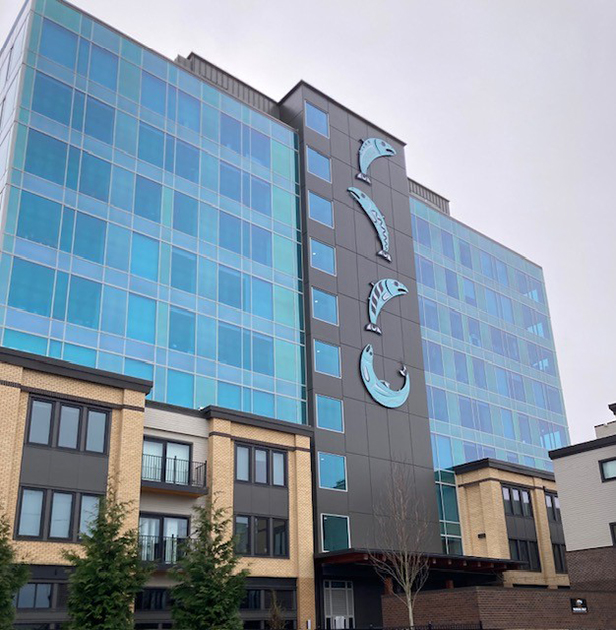
The Views on 5th Project in downtown Olympia transformed a long-vacant office building into 140 apartments and ground floor commercial. Photo courtesy of the author.
Surprisingly, office conversions in Washington have trailed the rest of the country, particularly in the Puget Sound region. One reason is that a large portion of existing office buildings in our state are relatively new. Fewer than 1% of Puget Sound office buildings qualify as good conversion candidates according to the CBRE, a real estate service company. Additional challenges include generally higher construction costs required for retrofitting seismic, electric, plumbing, fire protection and HVAC systems. Zoning requirements such as density limits, single-use zoning, or inflexible parking and amenity requirements may also discourage conversions.
How Can Local Governments Encourage Conversions?
Local governments should ensure their zoning codes are conversion-friendly by allowing mixed uses, removing or raising density limits, removing or lowering minimum parking requirements, and allowing shared parking arrangements. Live-work units should be permitted, as some buildings lend themselves to these residential units with a commercial component, such as the Tashiro Kaplan artist lofts/art space in Seattle’s Pioneer Square.
Downtowns should also allow conversions to co-living housing (a.k.a. micro-apartments or single-room occupancy), which is required for jurisdictions fully-planning under the WA Growth Management Act (RCW 36.70A.535).
A 2024 Pew Trust study found that converting an office building to dormitory-style conversions — where small apartments ring the perimeter of each office floor and shared kitchens, bathrooms, living rooms, and laundry are at the center — reduces construction costs by 25% to 35% compared to the cost of converting to conventional apartments. Some cities have also adopted tax exemptions, fee reductions, and permitting incentives to help offset challenges faced by property owners and developers.
Examples in Washington Downtowns
Spokane’s downtown has seen a number of recent conversions of commercial buildings to residential, including the Marjorie Apartments, Chronicle Apartments, M Apartments (the former Macy’s department store), and 508 West. The seven-story Peyton Building is also planned for conversion from office use to 96 apartment units. Spokane’s Commercial Conversion Incentive takes advantage of the construction sales tax exemption in RCW 82.59. Combined with its Multifamily Tax Exemption (MFTE) program authorized under RCW 84.14, Spokane offers strong incentives for property owners to convert underutilized buildings to housing.
In 2023, Seattle held a design competition for office-to-residential conversions to help spur innovative ideas consistent with Mayor Bruce Harrell’s Downtown Activation Plan. Building off ideas from that competition, Seattle amended its land use code in 2024 to incentivize conversions of empty office buildings to housing. The amendments exempt conversions from dimensional and design development standards downtown, as well as the city’s mandatory housing affordability requirements. These exemptions work together with a city program, which provides early staff consultation on meeting seismic and energy codes and potential partnership on federal funding applications to the Build America Bureau, and 2024 state legislation (RCW 82.59) offering exemption of construction sales tax for projects with 10% affordable housing units. (See Washington Department of Revenue’s Interim Guidance). One of the first office-to-residential conversion projects underway is the four-story Queene Anne Plaza building.
Olympia has had strong success implementing its downtown plans through office-to-residential conversions. Olympia offers a significant number of financial, regulatory and procedural incentives for downtown housing projects, as well as grant and loan programs for affordable housing. Five recent office conversion projects in downtown Olympia have created 264 new housing units, four of them mixed-use buildings with ground floor commercial uses. A proposal to convert another office building to 64 affordable housing units is currently being reviewed by the city. Conversions don’t all have to be large buildings either — a proposal for a small office building in Olympia was redesigned mid-construction to create four apartments.
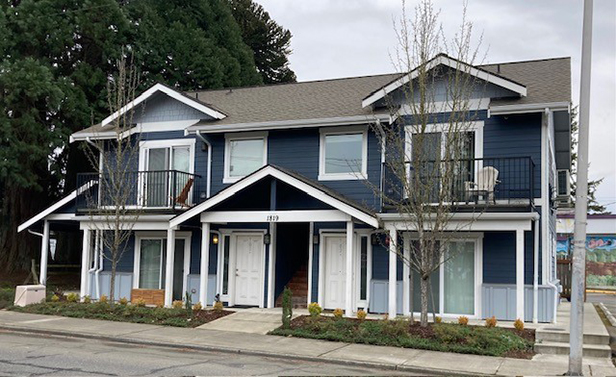
This small apartment building in Olympia was re-designed from an original office building proposal. Photo courtesy of the author.
Burlington added 35 housing units at Cascade Landing, a partial conversion of an existing office building. The units are designed to be affordable for residents earning 60% of area median income. The first floor retained offices, including for several social service agencies.
In Lacey, the conversion of an empty office building into Hub Apartments on the Park, a 50-unit residential building, is currently under construction. The building will provide easy pedestrian access to shopping and employment and is adjacent to Huntamer Park, which hosts regular community events and a farmer’s market.
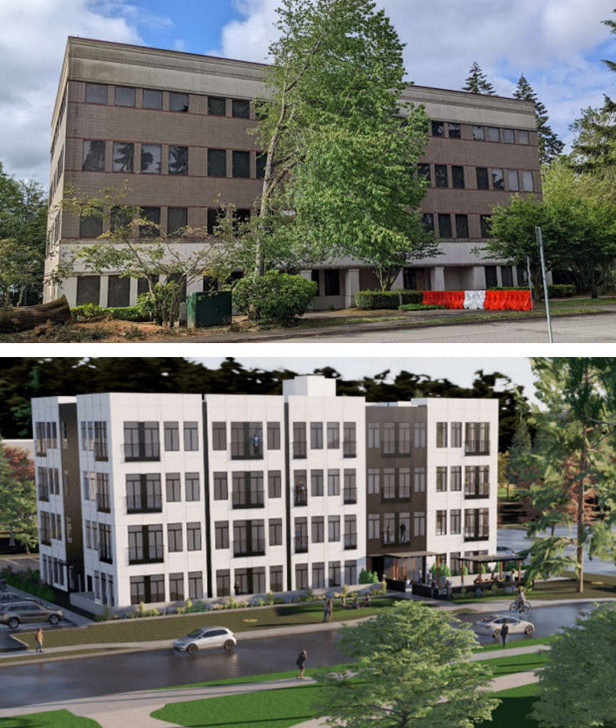
This vacant office building in Lacey is being converted into a fifty residential apartments. Photo courtesy of the city of Lacey
Takeaways
Converting offices into apartments can simultaneously address two issues facing downtown areas in many Washington communities: a lack of housing and empty office space. Activating empty buildings with downtown residences increases activity in downtown areas and supports retail, entertainment, and other uses. While not all office buildings are good candidates for conversion to residential use, buildings that do provide those opportunities can be readily identified.
MRSC is a private nonprofit organization serving local governments in Washington State. Eligible government agencies in Washington State may use our free, one-on-one Ask MRSC service to get answers to legal, policy, or financial questions.

About Leonard Bauer
Leonard Bauer has over 35 years of public service experience in planning and community development.
He worked for MRSC from 2024 through fall of 2026 as a planning consultant. Prior to that he was the community planning and development director for Olympia for 10 years. He also served the Cities of Sumner and Tumwater, a regional council of governments in Eugene, OR, and the Washington State Growth Management Services Office at the Department of Commerce.
Leonard is writing as a guest author. The views expressed in guest columns represent the opinions of the author and do not necessarily reflect those of MRSC.


