
Yes, You Can! Revitalizing Downtowns Through Brownfields Cleanup and Reuse
December 10, 2025
by
Leonard Bauer
Category:
Development Types
,
Downtown Revitalization Series
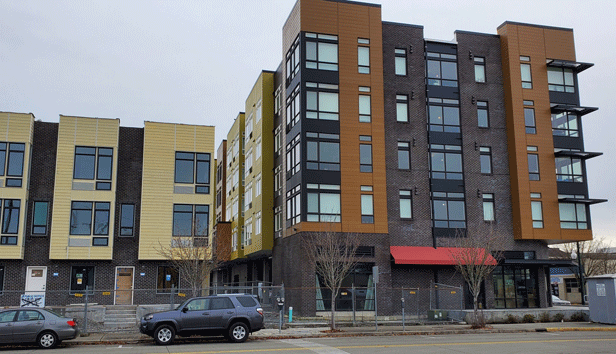
Westman Mill is a mixed-use commercial and residential building in downtown Olympia that was the historic location of sawmills. As part of the site’s redevelopment, the Port of Olympia remediated soil and groundwater contamination. Photo credit: Joel Hecker, PIONEER Technologies Corporation.
Many properties in Washington are, or are suspected of being, environmentally contaminated. Commonly referred to as brownfields, these properties are often abandoned or underutilized. Depending on the severity of contamination, brownfields can present health and safety hazards, damage the surrounding environment, depress neighboring property values, and hamper community-based economic development efforts.
In contrast, redeveloping brownfields can boost local economies, particularly in downtown areas and others slated for economic development. With this in mind, how can local governments encourage brownfield cleanup and redevelopment?
This blog will share strategies and funding opportunities that can help your agency revitalize brownfields in your communities.
Why Are Brownfields Hard to Redevelop?
The U.S. Environmental Protection Agency’s (EPA) Brownfields Program defines brownfields as a property where reuse may be complicated by the presence or potential presence of a hazardous substance, pollutant, or contaminant. The risks and cost associated with addressing contamination can be a significant barrier to redevelopment.
Most contaminated site cleanups in Washington are governed by two laws:
- The federal Comprehensive Environmental Response Compensation and Liability Act (CERCLA), commonly known as Superfund. Contamination on Superfund sites is very complex, and cleanup is directly regulated by the EPA.
- The state-based Model Toxics Control Act (MTCA). MTCA sites are more common than Superfund sites, and cleanup is regulated by the Washington State Department of Ecology (Ecology).
Liability under these laws is far-reaching. Any or all of the following parties could be required to pay for all or part of a site’s cleanup cost:
- Current site owners or operators.
- A person who owned or operated the site at the time of disposal or release of a hazardous substance.
- A person who brought or caused a hazardous substance to be at the site.
As a result, redeveloping a property with a history of land uses involving petroleum, solvents, or other contaminants involves potential costs for soil or groundwater cleanup—costs that must be paid out before any construction can take place.
Additionally, since contamination can move within the soil or groundwater, banks typically require an environmental site assessment (ESA) before approving a loan to purchase or develop a property that lies within the vicinity of such historical land uses.
Because they could potentially become at least partially liable for significant cleanup costs, owners of such properties are often reluctant to conduct an ESA to identify whether there is actual contamination present—and to what extent. Unfortunately, the unknown risk associated with such properties also reduces the resale value, so property owners often take no action to improve these sites. For more information see Ecology’s publication, Contaminated Property Considerations: Focus on Real Estate Transactions.
Brownfields Clean-Up Can Spur Downtown Redevelopment
There are many examples of brownfield cleanup leading to redevelopment of that site (as well as surrounding properties). Two of the most well-known examples are Tacoma’s Thea Foss Waterway and Spokane’s Riverfront Park, the latter of which won a Phoenix Award for Brownfield Excellence at the 2022 National Brownfield Conference.
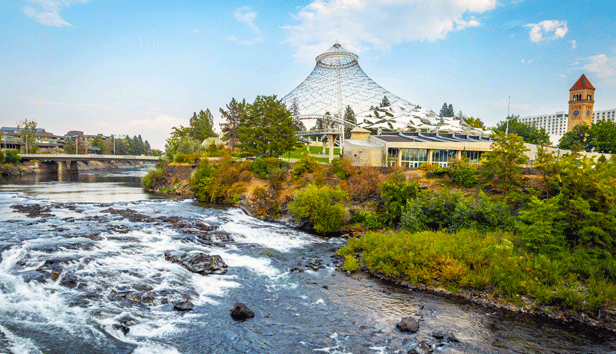
Spokane's Riverfront Park.
During construction of the Riverfront Park in the 1970’s, many of the historically industrial areas were simply covered with fill and not assessed for contaminants (current environmental laws were not in place).
When park redevelopment was approved by local voters, the City of Spokane used $600,000 of EPA funding toward cleaning up soil contamination. With extensive involvement from the public and the Spokane Tribe, new park features were added and improved connections were made across the Spokane River to downtown Spokane. The publicly financed redevelopment effort immediately spurred private development proposals downtown, including three large mixed-use projects.
How Can Local Governments Help Brownfield Redevelopment?
While the two examples described above are large urban sites, brownfield redevelopment also occurs on smaller sites.
Ecology maintains a master list of known contamination cleanup sites across the state, including those that have been remediated, those with leaking underground storage tanks, or those that have received brownfields funding. Local governments can use this list to identify and prioritize key properties for potential redevelopment, consistent with local comprehensive plan goals.
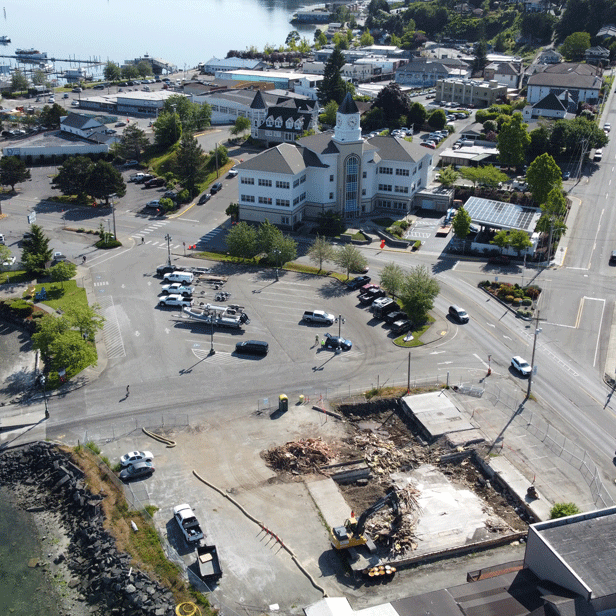
The Port of Bremerton is remediating soil and groundwater contamination to allow future redevelopment of this former gas station site (demolished) along the waterfront in downtown Port Orchard. Photo credit: Joel Hecker.
Potentially contaminated sites owned by a local government may be eligible for independent remedial action grants (IRAG), which reimburse cleanup costs completed under Ecology’s Voluntary Cleanup Program. The IRAG program expedites cleanups and can decrease costs, allowing the redevelopment of these properties for a public purpose.
Supporting the redevelopment of privately owned sites
For privately-owned sites, local governments should work closely with property owners to plan redevelopment that helps achieve both the owner’s goals and the community’s economic development vision.
The local government can support the owner throughout the cleanup process, including assessing and characterizing the contamination, analyzing remediation alternatives, developing a cleanup and redevelopment plan, and carrying out that plan. To help with these steps, a local government and site owner can jointly apply for an EPA Targeted Brownfields Assessment grant or the Technical Assistance to Brownfields Communities program (provided by the Center for Creative Land Recycling).
Local government staff can facilitate coordination among interested parties—including a property owner’s design and development team, state regulators, and public stakeholders—to reach cost-effective, mutually beneficial outcomes. For example, choosing a remediation alternative depends in part on the type of redevelopment that is planned (e.g., marginally contaminated soil may be cleaned and reused onsite rather than hauled away for disposal and new soil trucked in).
Acquiring sites for redevelopment
In some cases, a brownfield may not have a clear owner, such as properties under bankruptcy or foreclosure. In that case, the local government may propose to purchase the property in order to move forward with cleanup and redevelopment, as the MTCA authorizes Ecology to enter into a consent decree with a prospective purchaser.
Put simply, a consent decree is a negotiated settlement agreement in which the prospective purchaser, such as a local government, agrees on a cleanup plan with Ecology that resolves the purchaser’s potential liability. If an agreement is reached, funding for cleanup is frequently provided through Ecology.
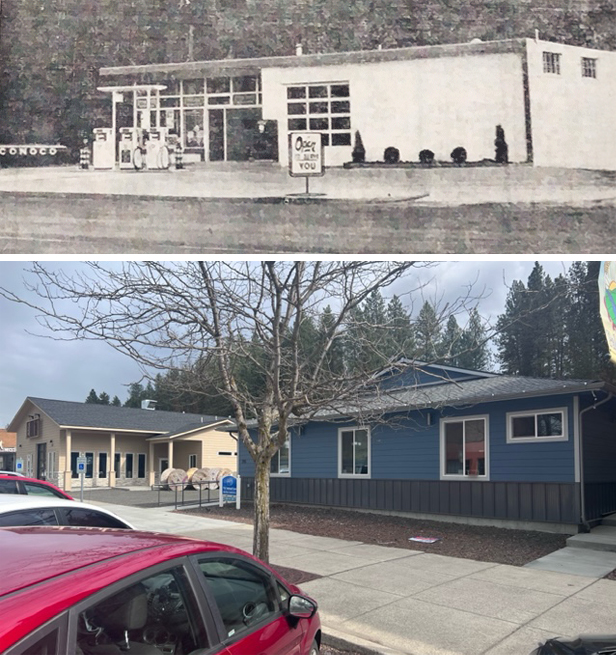
Contamination from a former gas station (seen on opening day in the top photo) and agricultural supply business in downtown Palouse, WA, has been cleaned up and the site redeveloped as a vet clinic and brewery (bottom photo). Photo credit: The Palouse Republic and Ecology.
Successful examples of this approach include a downtown site in Palouse and a portion of the Port of Bellingham’s Georgia-Pacific West property on Bellingham’s waterfront. The Bellingham site has been redeveloped as Mercy Millworks Housing, which also received funding through Ecology’s Affordable Housing Cleanup Grant Program.
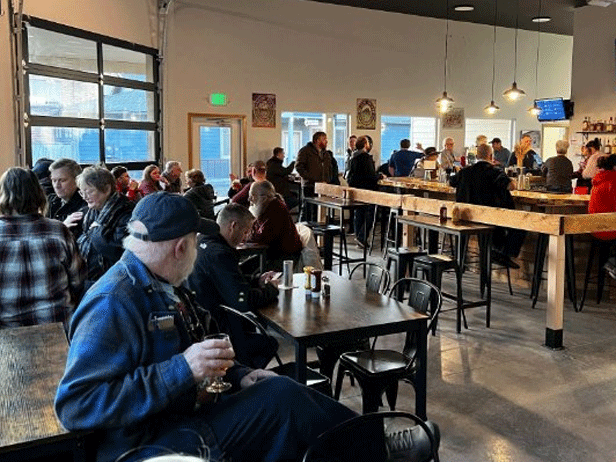
Busy brewery on former brownfields site in Palouse. Photo credit: Ecology.
Finding Funding and Technical Support
Ecology’s Brownfields webpage summarizes numerous funding and assistance opportunities available for brownfields redevelopment from the EPA, Ecology, and Washington State Department of Commerce.
Some brownfields consultants will help a local government or property owner apply for grants or loans, often with little or no upfront cost, because they can eventually receive payment through these grants or loans.
Consultants may also help local governments identify historically liable parties and retrieve reimbursement of cleanup costs from them. Again, there may be little or no upfront cost to the local government because the consultant can be paid from the reimbursement costs recovered. (Ecology offers guidance for hiring an environmental consultant to assist with brownfield cleanup and redevelopment.)
Olympia worked with a consultant to retrieve a portion of cleanup costs during construction of its city hall, a catalyst project for revitalization of its downtown. This was part of the city’s Brownfield Initiative, which also was awarded a $600,000 EPA Brownfield Assessment Grant. This grant allowed the city to assess over 20 contaminated sites, leading to their cleanup and redevelopment.
Portland, Oregon’s brownfields program also accessed significant federal brownfields funding to further cleanup and redevelop over 80 properties.
Conclusion
Common in most communities, brownfields are abandoned or underutilized properties that may have environmental contamination due to their former use, such as a gas station, dry cleaner, industrial facility, or agricultural land.
Negative perceptions of brownfields along with potential environmental liability concerns create challenges to redevelopment efforts in downtown and other key economic development areas.
Local governments can play a lead role in seeking funding and other assistance to promote brownfield cleanup and redevelopment, and such initiatives can help put vacant properties back into use and revitalize the surrounding areas.
To learn more about brownfields cleanup and redevelopment, plan to attend a state or national brownfields conference.
MRSC is a private nonprofit organization serving local governments in Washington State. Eligible government agencies in Washington State may use our free, one-on-one Ask MRSC service to get answers to legal, policy, or financial questions.

About Leonard Bauer
Leonard Bauer has over 35 years of public service experience in planning and community development.
He worked for MRSC from 2024 through fall of 2026 as a planning consultant. Prior to that he was the community planning and development director for Olympia for 10 years. He also served the Cities of Sumner and Tumwater, a regional council of governments in Eugene, OR, and the Washington State Growth Management Services Office at the Department of Commerce.
Leonard is writing as a guest author. The views expressed in guest columns represent the opinions of the author and do not necessarily reflect those of MRSC.


