
The Importance of Housing to Downtown Revitalization
June 5, 2024
by
Steve Butler
Category:
Housing
,
Downtown Revitalization Series
Photo credit: Steve Butler
Many downtowns were hit hard during the COVID-19 pandemic and are trying to get back to pre-pandemic activity levels. Most downtown workers have not yet resumed working fulltime in their offices, with a common opinion being that hybrid work is here to stay.
To counter this situation, local governments and downtown associations are employing several different strategies to revitalize their central business districts, such as emphasizing existing cultural amenities, creating attractive public spaces, and staging fun events and activities. Encouraging people to live downtown is another crucial element, however, and local governments can play a significant role in promoting downtown housing as part of their strategy to make downtowns an inviting place to live, work, and play.
The Importance of Housing
Even before the pandemic, several cities were seeing a major increase in people living downtown. This trend has many benefits, including an increased demand by local residents for retail, commercial (including restaurants), and other service businesses.
Having more downtown residents also helps mitigate the ‘after 5 p.m. ghost town’ effect, where employees leave their places of employment at the end of their workday and the downtown empties out. Both the International Downtown Association and the National League of Cities promote the importance of housing as a key element to making downtowns vital and lively.
What can local government do to encourage downtown housing? A good place to start is by including strong polices in your community’s long-range plans. For example, Bothell’s Downtown Subarea Plan encourages new housing in its central business district as well as within one-half mile of its downtown.
The next step is a review of your local zoning and other development standards to ensure they allow and encourage the development of new housing in your downtown; if they do not, revise them. Also, make sure that your local policies and codes encourage retention of the existing downtown residential stock, because it is almost always less expensive to preserve and retain existing housing than constructing new units. The City of Olympia has zoning code provisions that explicitly encourage the retention of existing and creation of new housing in its downtown.
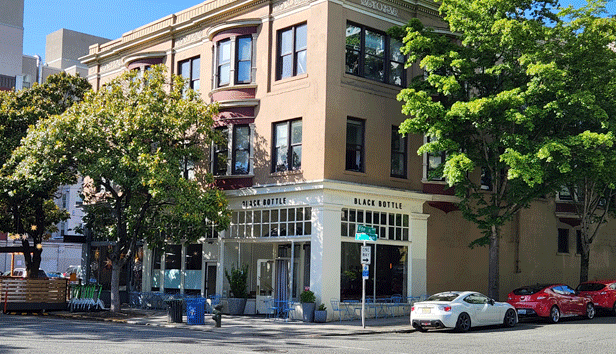
Photo credit: Steve Butler
Encouraging the adaptive reuse of historic downtown buildings for residential use is another important step to consider, both from a housing supply perspective and a ‘maintaining the historic and cultural character of your downtown’ perspective. Some observers would add that such adaptive reuse of historic buildings is also very climate-friendly, with no carbon-related demolition and new construction impacts.
Finally, remember the importance of having a project review process that makes it easy for developers to build what is compatible with your community’s vision of the future.
Trends in Housing-Related Laws
Addressing the affordable housing crisis by increasing housing supply has been a major focus of the Washington State Legislature over the past few legislative sessions.
As Growth Management Act (GMA)-planning cities and counties update their comprehensive plans, a relatively new state law (E2SHB 1220) included several new affordable housing-related issues these entities need to cover as part of their new housing elements. The Washington State Department of Commerce’s Updating GMA Housing Elements webpage contains a lot of useful information for those local governments undertaking periodic updates.
ESHB 1042, which was signed into law in 2023, promotes the conversion of existing buildings to multi-family housing within areas zoned for commercial or mixed-use (which includes most downtown areas), subject to some specified conditions. The new statutory requirements need to be incorporated into a local government’s development regulations within six months after adoption of its periodic comprehensive plan update.
In addition, a more recently enacted state law (HB 1998) requires communities to allow co-living housing in mixed-use development and higher density residential zones. This form of housing provides separate sleeping units with shared kitchen facilities, and many consider co-living to be a good housing option for downtowns.
Three New Concepts Being Considered
Given the strong desire to revitalize and enliven downtowns in our current post-pandemic era, three approaches are being considered by some cities, both locally and throughout the nation:
- Office-to-residential conversions:
- Hotel/motel-to-residential conversions; and
- Ground-floor retail-to-residential conversions.
Offices to housing
As the office real estate market continues to grapple with increasing vacancy rates, several cities and office building owners are looking at what it would take to convert vacant office space into new housing.
It should be noted that this approach won’t create a large amount of new housing since the total percentage of office buildings physically capable of being converted into housing in the U.S. is estimated to be only 11%. Additionally, these types of conversions are both financially and logistically difficult.
Seattle’s Office of Planning and Community Development recently held a contest that asked architects to analyze the potential for conversion of several existing office buildings and to identify needed steps to make such conversions feasible. The results of this contest reinforce the notion that local governments would need to revise existing development standards and provide financial incentives in order to encourage office-to-residential conversions by the private sector. These findings are reinforced by a study that looked at the opportunities and constraints for office-to-residential conversions in San Francisco.
Hotels to housing
Another option being is the conversion of underutilized hotels and motels into affordable housing. In most cases, the converted units are likely to be studio apartments with separate bathrooms and kitchenettes, although converted suite-style hotels could provide larger units with full kitchens and one or two separate bedrooms.
This trend picked up steam during the pandemic when there was a need to house vulnerable populations and the hospitality market went into a tailspin. There are several examples in Washington State where this type of conversion has been used to provide temporary housing for unhoused individuals, but former hotels/motel rooms can also be used as permanent affordable housing. For example, conversion of the former Ridpath Hotel in Spokane to micro-apartments was planned long before the COVID-19 pandemic.
Retail space to housing
Another, more controversial approach to encouraging additional housing in downtown is facilitating the conversion of vacant retail space to housing. The controversy arises because the new housing will not generate the same street-level pedestrian activity as a block of active retail businesses. Unlike retail patrons, residents do not usually enter and leave their residences multiple times during the day and also prefer to keep their front window curtains closed for privacy reasons. Accordingly, the drop in street-level pedestrian activity will have a greater impact in a commercial area that was primarily pedestrian-oriented and less so on adjacent streets.
With that said, having an active residential use on a downtown street is preferable to ground-floor retail space remaining vacant for a long time. The additional downtown residents will provide the same benefits as other residents with their patronage of nearby shops and stores (along with the added retail tax revenues). The City of Covington has adopted some thoughtful development standards related to ground-floor residential uses.
Conclusion
Housing is a key component in helping communities revitalize their downtowns. There are many factors that contribute to the success of a central business district, but promoting the retention of existing housing and the development of new residential construction are near the top of the list for most downtown revitalization efforts.
There are some new options mentioned in this blog that may be worth considering. Having strong policies, clear regulations, and an easy-to-use development review process, however, are all critical steps if a local government wants to encourage housing in their downtown.
MRSC is a private nonprofit organization serving local governments in Washington State. Eligible government agencies in Washington State may use our free, one-on-one Ask MRSC service to get answers to legal, policy, or financial questions.


