
Building Belonging: Urban Strategies to Combat America's Loneliness Crisis
February 25, 2026
by
Alicia Bones
Category:
Design
,
Inclusive Communities
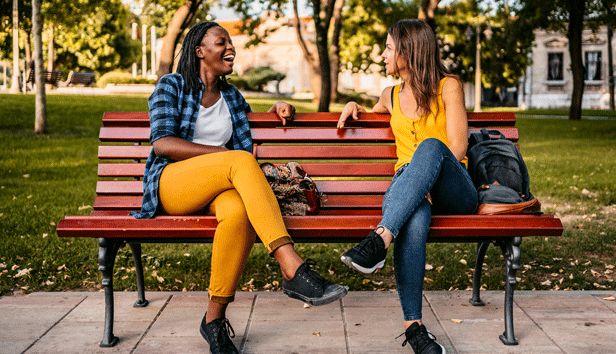
There is a loneliness epidemic in the United States. A 2025 American Psychological Association survey found that over half of U.S. adults felt isolated (54%), left out (50%), or lonely (50%). Nearly 70% said they received less emotional support than they needed, up from 65% the prior year.
According to former U.S. Surgeon General, Vivek H. Murthy, loneliness is not just a mental health problem that increases the likelihood of anxiety and depression, but also poses many hazards to physical health, including increased dementia and cardiovascular disease risk.
Local leaders and planners never intend to create policies that increase loneliness, but if social connectivity is not overtly considered, it may be overlooked.
"I think loneliness hasn't really been on the planning agenda, and maybe it's even strange to think that it could [be],” said Tom Brennecke, a researcher exploring how lonely people experience their cities. “But once you start to engage with loneliness you understand that actually it has a lot to do with the way people go about their everyday lives, so therefore also with [urban design].”
This is where the term “happy city” comes in.
"For me, a Happy City allows people to rest, connect and express, whether it's in peaceful spaces that allow them to be immersed in nature, to gather in community celebrations, or access learning opportunities where they can thrive,” said happiness expert Aliénor Salmon.
This blog discusses ways urban design may make residents lonelier and lists strategies that can boost urban social ties.
What Can Fix Urban Loneliness
What promotes disconnection in cities, and how can local leaders promote community members’ happiness? The following list summarizes a few key considerations.
Social community design in the built environment
Public spaces that discourage lingering—areas without visual interest, sufficient seating, or a shared purpose—strip away the infrastructure that simplifies interacting with neighbors.
"As you're walking alongside a blank wall, people don't feel like they want to walk there. The same applies to parks—it's about what people can see within them and whether there are places to sit and activities to do. It's a bit of a fine balance,” said Houssam Elokda, Managing Principal of the design firm Happy Cities.
Encouraging urban community-building involves promoting the comfort and ease of community members in public spaces. Factors like neighborhoods walkability, easy access to “third places,” green spaces, and public transit improve connection and decrease feelings of loneliness.
In terms of public outdoor spaces, Elokda recommends framing these areas with trees or buildings to create “a sense of enclosure or refuge.” He also encourages adding something for people to focus on, like a mural, and consider creating seating that supports individuals striking up conversations.
Sociable housing policy
Perhaps counterintuitively, crowded living conditions often produce social withdrawal. Specifically, crowded or rundown housing discourages socializing, and individuals living in high-rise buildings report higher levels of loneliness, reports Social Connection Guidelines, a cross-disciplinary organization that aims to create public health guidelines for social connection.
In response, planners should consider how to build these multi-unit buildings from a “social wellbeing lens,” argues the design firm Happy Cities and Hey Neighbour Collective (a British Columbia collective that brings together housing providers, nonprofits, researchers, and local governments). The group suggests that existing recommendations are “generally not enough to realize the full social potential of shared spaces."
The group worked with six jurisdictions in Metro Vancouver to implement shared space policies in multi-unit housing that supported neighborly connection and sense of belonging.
The key takeaways of this policy included:
- Location – Put shared spaces where community members naturally walk by, with good natural light, so neighbors encounter each other. Group these amenities together to multiply opportunities for interaction.
- Invitation – Design spaces that naturally encourage people to slow down and engage with one another, letting the physical environment itself spark casual interactions between neighbors.
- Activation – Design a variety of common spaces with activities and things to see and do, creating a center for the community.
- Inclusion – Shared spaces should accommodate varying physical needs, life stages, and cultural backgrounds.
- Transition – Pair comfortable private homes with shared spaces, and think carefully about how spaces shift from communal to private.
- Evolution – Foster belonging by caring for shared spaces, and let those spaces adapt over time as the community's needs change.
"By developing evidence-based policy and programming, cities can encourage the design of housing with shared spaces that facilitate positive neighbourly social connections, inclusion, and resilience,” the group wrote in their findings after the pilot program.
Designing inclusive public spaces
Public spaces that diminish loneliness don't have to be for chatting with neighbors. Social well-being can also come through being "alone, together," where community members use spaces for their own purposes without necessarily making specific connections with others using the space.
"There are different ways of being part of a community without having to constantly have active social contact. We saw that people often felt less lonely if they were connected to nature or to a space. You can feel this connectedness even to the community of people who use the same space, without necessarily having to chat with them," said Utrecht University Assistant Professor Luzia Heu.
For public spaces to serve everyone, they must be designed with the range of human experience in mind. Planner Megan Oliver notes that standard urban design practices often forget those with autism, ADHD, sensory processing disorders, and other conditions. In response, planners can create spaces by focusing on navigation, sensory awareness, and tools like sensory maps that chart stimulation intensity across areas. Oliver has seen momentum in her own community, from sensory-safe park events to playgrounds designed to avoid overstimulating children with neurodiverse needs.
Both of these strategies increase the likelihood that all community members will want to use public spaces.
Fighting Loneliness through Planning
When local leaders focus on social well-being in their policies, urban design can create the conditions that make connection among neighbors more likely. When cities prioritize walkable neighborhoods, welcoming public spaces, and housing that encourages interaction, community members have more opportunities to feel part of a community, even if just by sharing the same space.
MRSC is a private nonprofit organization serving local governments in Washington State. Eligible government agencies in Washington State may use our free, one-on-one Ask MRSC service to get answers to legal, policy, or financial questions.


