
2025 Housing-Related Legislative Outcomes
July 23, 2025
by
Steve Butler
Category:
Comprehensive Planning-Growth Management
,
Development Regulations and Zoning
,
Housing
,
New Legislation and Regulations
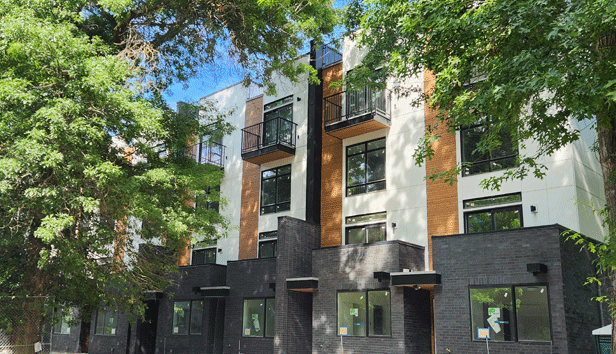
There have been several significant changes to Washington state law related to housing over the prior legislative sessions (2022–2024), especially those dealing with middle housing, accessory dwelling units (ADUs), and housing elements. This year’s housing-related bills appear to be more focused on addressing some very specific issues related to past changes to state law.
This blog summarizes five recently enacted bills related to encouraging the production of more housing and the preservation of existing affordable housing in Washington State.
Expanding Middle Housing in UGAs and LAMIRDs: SB 5471
SB 5471 provides a fully planning county with the option to allow middle housing on a single-family lot within both urban growth areas (UGAs) and limited areas of more intensive rural development (often referred to as LAMIRDs), with a maximum of four residential units that may be allowed per lot. If this option is exercised, those counties must require that middle housing in UGAs be served by water and sewer services and that middle housing in LAMIRDs must be served by existing sewer service.
This new state law also mandates that local standards for middle housing may not be more restrictive than those required for detached single-family residences, along with a requirement that the local development permit and environmental review processes be the same for both middle housing and single-family housing development proposals.
Allowing Self-Certification of Detached ADUs: HB 1353
HB 1353 allows, but does not require, cities planning under the Growth Management Act to establish and administer programs in which registered architects can “self-certify” that the development of a detached accessory dwelling unit (DADU) complies with applicable building code requirements.
Two points of clarification are that a self-certification program may only be used for:
- Detached ADU (but not attached ADU) projects; and
- Building code/building permit standards and processes, with any established local processes and procedures not related to the Washington State Building Code still needing to be followed. (For example, the cities of Ellensburg and Kirkland review ADU applications to ensure they meet the applicable zoning and other non-building code development regulations.)
Cities operating a new DADU self-certification program must also adopt rules that conform to the new state law, which includes an audit requirement that cities identify architects who fail an audit. Cities will also need to submit a report about their DADU self-certification programs to the Washington Department of Commerce (Commerce) by July 31, 2028.
Commerce’s Housing Planning website is a good source of information, which includes separate webpages on ADUs and Planning for Middle Housing.
Easing Conversion of Non-Residential Buildings in Residential Zones: HB 1757
In 2023, a bill was signed into law with the intent of making it easier to convert existing non-residential buildings to residential use in commercial and mixed-use zones (for more information, see 2023 Planning Legislation Impacting Local Governments).
This year, HB 1757 expands RCW 35A.21.440 to include existing buildings in residential zones. The affected code cities need to amend their zoning development regulations to conform with the statutory requirements by June 30, 2026.
Key provisions include the following:
- A city may not require a change of use permit for a proposed conversion of an existing building to residential use.
- Unchanged portions of an existing building that have been previously used for residential purposes are exempt from current Washington State Energy Code requirements.
- When any other existing building is converted to new dwelling units, the changed portions of the new units must meet state energy code requirements unless specific criteria can be met by the applicant — see the bill’s revisions included in RCW 35A.21.440(2)(g).
Extending Notice of Sale of a Manufactured Home Community: SB 5298
Existing manufactured/mobile home communities (MHCs) typically serve as a source of affordable housing for cities, towns, and counties but often come under pressure to be purchased and/or redeveloped for market rate housing.
SB 5298 adds additional notice of sale requirements when an owner either intends to sell an MHC or consider a purchase offer of it. In addition to providing each tenant, Commerce, and the Washington State Housing Finance Commission the notice, the owner is now required to also provide notice to the local government within whose jurisdiction some or all of the MHC exists, as well as to the officers of any known qualified tenant organization and to any relevant housing authority.
Encouraging More Multi-Family Affordable Housing in Urban Centers Through MFTE Changes: HB 1494
HB 1494 updates and expands the Multi-Family Tax Exemption (MTFE) program to encourage more multi-family affordable housing development in urban centers around the state. Major aspects of this bill impact rules applying to developer tax exemptions individuals/households, and jurisdictional procedures, including the following:
- A city may now offer a 20-year property tax exemption in areas within one mile of high-capacity transit, if it has a population of at least 15,000 people and a mandatory inclusionary zoning requirement.
- The counties of Clark, Kitsap, and Snohomish are now authorized to voluntarily provide 12-year property tax exemptions for projects located within a half mile of a planned or actual transit corridor where bus service is scheduled at least 10 times per day. The existing MFTE requirements for King and Pierce counties remain in place.
- Low- or moderate-income households can continue to claim low- or moderate-income status under MFTE unless and/or until the household income exceeds 150% of established income threshold.
- Owner-occupied projects must have a deed restriction or covenant ensuring affordability for 12-year exemptions.
- Cities and counties are now authorized to imposing a sliding scale penalty under certain conditions, instead of only being limited to just canceling the exemption.
Conclusion
Increasing the overall housing supply, and affordable housing in particular, remains a significant issue in Washington State, and will continue to be the focus of most local governments in the months and years ahead.
The author would like to thank Noal Leonetti, Public Policy Intern, MRSC, for his assistance with this blog.
MRSC is a private nonprofit organization serving local governments in Washington State. Eligible government agencies in Washington State may use our free, one-on-one Ask MRSC service to get answers to legal, policy, or financial questions.


