
Does Your Code Take E-Bikes and E-Scooters Into Account?
June 24, 2025
by
Leah LaCivita
Category:
Cycling and Walking
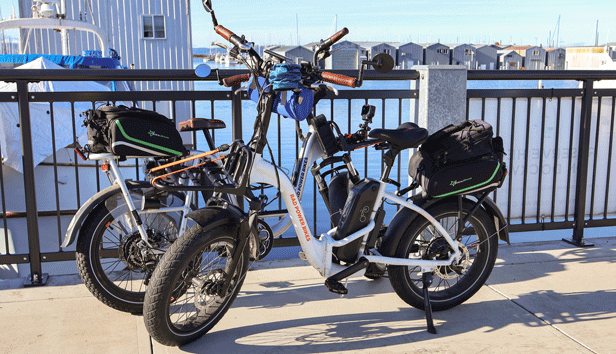
Ah, summer in Washington State: wildflower hikes, cold lake swims, and, more recently, gliding around on an electric-powered bike or scooter (e-bike; e-scooter). Whether it is due to environmental considerations, a desire for exercise, or to simply get somewhere faster, many people turn to e-bikes and e-scooters.
Public access to e-bikes/e-scooters has been enabled by shared micromobility companies like Lime or Bird, which began offering rentable options as early as 2017. The National Association of City Transportation Officials (NACTO) reported people took 133 million trips on shared micromobility devices in the U.S. in 2023, a 20% increase from 2022.
Even if your local government not does contract with a company to offer an e-bike/e-scooter share program, odds are that individuals in your community have purchased their own devices (after all, over 1 million e-bikes were sold in 2023 in the U.S) and will be using them on your streets.
Despite their growing popularity, e-bikes/e-scooters do generate criticism, typically around haphazardly parked devices clogging sidewalks and the risks associated with devices that are heavier and faster than their traditional counterparts, making them more hazardous in the event of a collision. This blog looks at state laws regarding electric-assisted bikes and scooters, and how local governments have crafted their own policies to suit local needs.
Regulatory Background
Washington State law addresses e-scooters and e-bikes separately, regulating where these may be ridden, whether riders are required to wear helmets, and what authority localities have in regulating these devices locally.
E-scooters (referred to as ‘motorized foot scooters’) are addressed in RCW 46.04.336, RCW 46.20.500, and RCW 46.61.715.
- RCW 46.04.336 defines a motorized foot scooter as a device with handlebars and a floorboard, powered by an electric motor or internal combustion engine, with a maximum speed of 20 miles per hour (mph).
- RCW 46.20.500 allows them to be used on a “roadway or bicycle lane.”
- RCW 46.61.715 authorizes local government to regulate the use of e-scooters, including those in shared programs, and to adopt/assess penalties for moving/parking violations involving them. The statute also authorizes local governments to levy “reasonable taxes and fees” on e-scooter share companies, and it requires these companies carry commercial general liability and automobile liability insurance.
RCW 46.04.071 defines ‘bicycle’ to include human-powered bicycles and e-bikes identified in RCW 46.04.169. The latter statute outlines three classes of e-bikes based on the highest speed a rider can achieve:
- Class 1: motor-assisted up to 20 miles per hour.
- Class 2: fully motored (no pedaling) but motor stops when the bicycle reaches 20 mph.
- Class 3: motor-assisted while pedaling up to 28 mph. Riders on class 3 e-bikes or e-scooters must be at least 16 years old (RCW 46.20.500).
RCW 46.61.710 covers operation of both e-bikes and e-scooters, including where they can be ridden, as broadly outlined in the table below.
| Device | Where it can be operated |
| Class 1 e-bike | Formal bike lanes, shared-use trails |
| Class 2 e-bike | Formal bike lanes, shared-use trails |
| Class 3 e-bike |
|
| E-scooter |
|
This statute also prohibits all classes of e-bikes and e-scooters from being used on trails designated as non-motorized or that have a natural surface.
Notably, the state restrictions listed above do not preempt local preference. Localities are authorized to regulate the use of e-scooters — RCW 46.61.715(1) — and all classes of e-bikes — RCW 46.61.710(7) and (8) — including setting age restrictions, access to trails/sidewalks/parking, or use of helmets.
What to Consider
Many cities, towns, and counties throughout the state have adopted local codes that address the use of e-bikes/e-scooters. Some have adopted state restrictions, while others have implemented customized regulations. The most common areas of concern include parking, sidewalk and/or trail riding, and use of helmets.
Where can e-bikes/e-scooters be parked?
E-bikes/e-scooters are heavy and hard to maneuver. If one is left in the wrong area, for example, blocking access to critical infrastructure, it can be difficult for community members to remedy a problem. Instead, several local governments have opted for dedicated parking zones for electric-assisted devices, which is especially helpful in areas where many are often left, such as transit plazas, stadiums, convention centers, or other major attractions.
In Seattle, bikes, e-bikes, and e-scooters can be parked in the ‘furniture zone’ (curb/landscape strip next to a sidewalk) or at any city bike rack. Additionally, the city’s Free-Floating Shared Micromobility Permit Requirements (2025) specifies that the city may designate no parking zones for shared e-bikes/e-scooters, which the vendor (Lime) is required to implement using geofencing technology. Several of these zones (as well as zones specifically marked for parking shared e-bikes/e-scooters) have been implemented along the popular Alki waterfront trail.
Most policies addressing rentable micromobility devices will also include how they must be parked (i.e., upright, not obstructing flow) and specify that vendors must relocate non-compliant devices within a set time period. In Seattle, e-bikes/e-scooters (as well as traditional bicycles) cannot block driveways, crosswalks, loading zones, accessible parking spaces, bus stops, or street corners. The city also encourages community members to report e-bike/e-scooter parking problems using the Find It, Fix It mobile app.)
Localities should also consider adopting procedures for removing vehicles locked to public property that have been deemed to be abandoned or an obstruction. Here are examples:
- Bellingham Municipal Code Sec. 11.48.150 — Allows for impoundment of bicycles constituting an obstruction.
- Lake Stevens Municipal Code Sec. 7.36.120 — Allows for impoundment of bicycles, scooters, or “wheeled recreational device” left unclaimed for 60 days.
Where can e-bikes/e-scooters be used?
The rapid growth of micromobility companies, which sometimes deployed their fleets on city streets without first consulting with the local regulatory body, had many policymakers scrambling to update local codes.
While state law specifically prohibits class 3 e-bikes and e-scooters from using sidewalks (RCW 46.61.710), it does not address sidewalk use by class 1 and 2 e-bikes. Some local jurisdictions may have an ordinance banning bicycles from using sidewalks, which would extend to electric-assist bikes. If a local government does not have such a policy but would like to keep all classes of e-bikes off sidewalks, existing policies used should be reviewed and updated.
Some local governments mirror regulations adopted in RCW 46.61.710:
- Tacoma Municipal Code Ch 11.06 — Prohibits class 3 e-bikes from sidewalks and/or multipurpose trails.
- Seattle Municipal Code Sec 11.44.120 — Prohibits class 3 e-bikes and e-scooters from operating on sidewalks (unless no alternative is available).
- Wenatchee Ch. 7.32 — Restricts e-scooters from all sidewalks (and bicycles from using sidewalks in the downtown business area).
Other local governments group e-bikes/e-scooters with similar devices and develop regulations targeting the group:
- Bremerton Municipal Code Ch. 10.13 — Motorized Wheeled Transportation Devices. Prohibits their use in parks, public places, multipurpose trails, and streets with a posted speed limit of 25 mph. E-bikes/e- scooters are allowed on sidewalks only if operated under manual power.
- Spokane Valley Municipal Code Ch 9.20 — Motorized Personal Transportation Devices. Prohibits their use in parks, sidewalks, multipurpose trails, and streets with posted speed limit of 25 mph (except in the designated bike lane).
- Vancouver Municipal Code Sec. 8.06 — Skateboards, Roller Skates, Coasters, In-Line Skates, Motorized Foot Scooters, and Similar Devices. No device may be ridden in a public plaza or city/county-owned or leased parking structure, and specifically prohibits e-scooter use on sidewalks, bike lanes, or city-owned multipurpose trails.
Electric-assisted devices are frequently prohibited from local public parks (and the trails available in them), including in Everett and Pierce County parks. Others have allowed their use but with restrictions. For example, Bellingham updated its codes in 2021, allowing e-bike/e-scooter use in public parks and on city-owned multipurpose trails — see Bellingham Municipal Code (BMC) Sec. 8.040.060 — and setting a 15-mph speed limit on park roads for all non-motorized and motorized vehicles (see BMC Sec. 8.04.050).
Geofencing and shared micromobility programs
Other than outright restrictions, local governments can also work with shared micromobility companies to restrict or manage e-bikes/e-scooters in certain areas using geofencing. Geofencing uses the Global Positioning System (GPS) to create a virtual geographic boundary to, for example, restrict e-bike or e-scooter access, set a reduced speed limit within the boundary, or designate it as a parking area.
Under Spokane’s WheelShare program, shared e-bikes/e-scooters may access multipurpose trails in the city, such as those through Riverfront Park or the Centennial Trail, but only at reduced speed limits. The GPS recognizes when a device is being operated in an area with a designated speed limit and automatically adjusts the speed. Seattle employs this technology to both identify low-speed zones and approved parking areas.
Note: Privately owned e-bikes and e-scooters will not respond to this technology.
Should riders wear helmets?
Washington State law does not require it, but many local governments have laws requiring riders to wear helmets, including Aberdeen, Washougal, Lakewood, Port Orchard, Lynnwood, and Snoqualmie, to name a few. Some may encourage such usage, but do not require it; for example, see Tacoma Municipal Code Sec. 11.30.010.
Shared micromobility companies recommend use of helmets, and occasionally offer free ones through local partners (for example, Seattle), but they do not supply them as part of the rental experience.
Conclusion
While state-based regulations regarding electric-assist bicycles and scooters are available for local agencies to consider, there may be good reasons to develop more tailored local codes, especially for those communities in which shared micromobility companies operate.
For information on regulating shared micromobility programs, see the following:
- NACTO: Shared Micromobility Permitting, Process, and Participation (2022)
- New Urban Mobility Alliance: Micromobility Policy Atlas — A digital database of policies and regulatory frameworks from around the world.
MRSC is a private nonprofit organization serving local governments in Washington State. Eligible government agencies in Washington State may use our free, one-on-one Ask MRSC service to get answers to legal, policy, or financial questions.


