
Nurse Navigator Programs Help Address 911 Overuse
May 19, 2025
by
Leah LaCivita
Category:
Emergency Medical Services
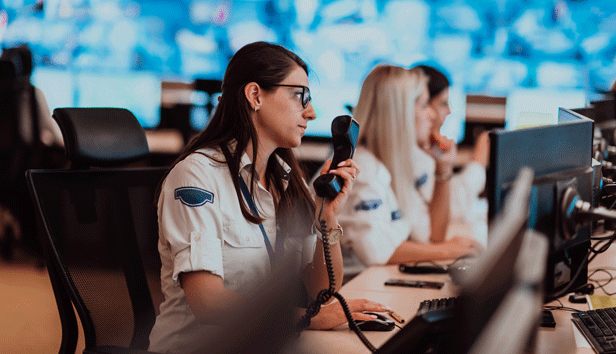
911 is probably the most well-known phone number in the country. Launched in 1968 as a means for requesting emergency assistance, use of the service has grown exponentially since the 60s. Loud bangs, a loose pet, or an abandoned vehicle can all elicit 911 calls.
At 240 million calls annually, 911 dispatchers must quickly calculate how to triage calls to get to the right service, be it the police, ambulance dispatch, or another option (if available), such as mobile crisis response. But when the system is overwhelmed with requests involving non-life-threatening medical conditions, such as for lift assists, nausea, or routine medical conditions, it diverts resources away from true emergencies.
Some 911 systems have implemented a nurse navigator program to better manage low-acuity calls — those non-emergency situations in which the caller’s medical issue does not require ambulance transportation and treatment at an emergency room. This blog will look at a few of those programs.
Why Nurse Navigators Are Needed
According to the National 911 Annual Report, over 5.4 million 911 calls were made in Washington State to over 110 Public Safety Answering Points (PSAP, or 911 call centers) in 2021. It is estimated that upwards of 25% of these calls involve low-acuity medical needs. This is the case for Clark Regional Emergency Services Agency (CRESA), a PSAP that serves Clark County, receives over 58,000 calls annually, 14,000 of which would be considered non-emergencies.
Emergency resources are both limited and costly to maintain. When non-emergency use of emergency resources occurs in excess, these systems may be unable to quickly respond to life-threatening emergencies, or such a response may be delayed.
Firefighters have told researchers that the increasing number of low acuity calls they have to attend to leaves them feeling frustrated and discouraged, and this may ultimately desensitize them to the needs of community members. Some local government have developed community paramedicine programs and Community Assistance Response (CARES) teams to provide more comprehensive support to frequent users of 911, but what about diverting calls at the source?
This is where nurse navigators come in. Nurse navigators manage non-emergency 911 calls and work with individuals as long as needed. The ultimate goal is to help callers find the care they need, but also to give them a full menu of options in addition to expensive ambulance rides and emergency room visits. Seattle Fire Department, which has had a navigator program in place since 2022, notes 40% percent of calls transferred to nurse navigators result in the caller being redirected away from emergency response to other resources, such as urgent care or a primary care facilities.
How It Works
The 911 Nurse Navigation program was developed in 2018 by Global Medical Response (GMR), a company that provides emergency medical and ambulance services worldwide. GMR and its US-based affiliate, American Medical Response (AMR), has partnered with Seattle, Snohomish County, Clark County, Spokane, and Yakima County to develop local nurse navigator programs.
Regardless of location, the nurse navigation program works in a similar manner: When a call comes into a PSAP, dispatchers ask the caller a series of questions to determine if they need immediate services or if they can be routed to a nurse navigator. To reach a nurse navigator, the call is sent to GMR/AMR’s Texas-based national call center, which is staffed by licensed nurses who also offer bilingual support. Depending on the caller’s needs, a navigator may help by arranging transportation, setting up appointments at a primary care facility, scheduling a telehealth visit, sending them to an urgent care facility, or simply providing advice to help a caller self-manage their condition.
A caller is not required to have insurance to use the nurse navigator service and could still ask the navigator to arrange for ambulance transport to an emergency room. However, after time some callers have begun to trust the service enough to be redirected to alternative care. Rocco Roncarati, regional director for AMR’s operations in Southwest Washington, indicated this had happened for Clark County's program in a 2024 interview with Oregon Public Broadcasting:
We have callers that call often who know the program. We’re seeing less of, “I don’t wanna [sic] talk to a nurse, I just wanna [sic] go to the hospital,” and more of callers really reaching out just to get access to health care.
Program Development
Any local government may contract with GMR/AMR for 911 Nurse Navigation, but those agencies that already contract with them for ambulance services have dispatch data to pull from in terms of understanding how local emergency services are being used, by whom, and for what. In analyzing the data for Yakima County, GMR/AMR offered the nurse navigation system as one of several options for strengthening the local healthcare network.
“The [nurse navigator] program works best,” a GMR spokesperson told me, “where there is a heavy dependence on 911 for lower priority calls and a robust network of established community care options such as urgent care centers, walk-in clinics, and related resources.”
According to Michelle Bresee, EMS Analyst, for the Vancouver Fire Department (VFD) establishing a program takes upwards of a year. “If you count inquiry and discussion time, it took us 10 months to get [Clark County 911 Nurse Navigation] up and running,” Bresee told me. During this time Vancouver:
- Worked in consultation with the local medical program director’s office to develop protocols for which calls would be sent to nurse navigators;
- Developed a system-wide workflow (in coordination with the county PSAP) for sending calls to the navigators; and
- Developed partnerships with local health care providers — health centers, urgent care facilities, dental care facilities, and behavioral health services — to expand options for non-emergency care referrals.
Public education is also a critical component for introducing the concept of nurse navigation and its role in local emergency services. For Clark County, this included press releases, media interviews, and campaigns on multiple social media platforms. Snohomish County developed a social media campaign and handouts for distribution at, among other places, prevention-related, county-based classes.
Funding
The Snohomish County nurse navigation program, a partnership between Snohomish County 911 and the Snohomish County Fire Chiefs Association received initial support from the county-based nonprofit North Sound Accountable Community of Health (NSACH). NASCH covered program costs (about $365,000) for the first year (2024) as well as providing a one-time starter fee of $60,000.
According to Bresee, Clark County’s program is funded by a “fee-for-service reimbursement of patient charges to AMR,” which is similar to Seattle. Spokane uses a previously approved EMS fee increase for program support.
Conclusion
Given the high costs and fragmented nature of the national healthcare system, it is understandable why people turn to a dependable service like 911 to handle all their medical needs. It should also be noted that a 911 call which meets the definition of low- acuity medical need will still seem like an emergency to the caller.
The effort to build out systems to respond to low-acuity calls has resulted in services like 911 Nurse Navigation, mobile health units, crisis response, and community paramedicine, which many communities, like Seattle and Snohomish County, employ in tandem. Together, these services can help provide enhanced (and ongoing) care for individuals with complex medical needs while also freeing up emergencies services for life-threatening situations.
MRSC is a private nonprofit organization serving local governments in Washington State. Eligible government agencies in Washington State may use our free, one-on-one Ask MRSC service to get answers to legal, policy, or financial questions.


