
Shared Spaces – Tips to Balance Use of Public Facilities
November 18, 2024
by
Steve Gross
Category:
Parks and Recreation Facilities
,
Inclusive Communities
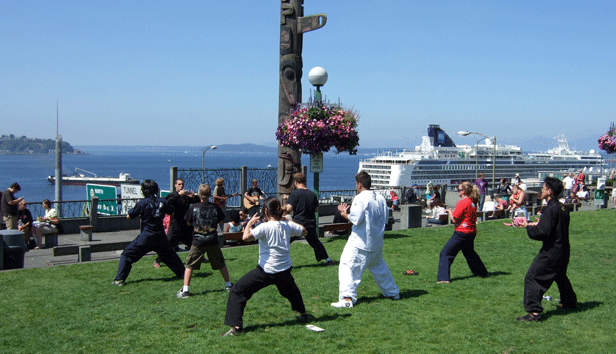
It is the nature of publicly owned facilities that members of the public will need or want to be in, on, and around them. Access to council or commission chambers and customer service lobbies is necessary for the public to access government services. Other facilities — such as parks, recreation fields, and trails — only exist for the public to use them.
This blog will explore how some agencies find a balance between providing equitable access to facilities and providing a safe and respectful environment for all users.
So, What’s the Problem?
The problem is that in many cases, no matter what one person or group wants to do at a public facility, there may be another person or group that is mortally offended by the same thing. Read my colleague Jill Dvorkin’s blog Pickleball: Made with Love in Washington for a good example of this.
As a government lawyer, I often looked at the challenge for agencies through the lens of public nuisance law. In Washington State, RCW 7.48.120 defines a nuisance as an unlawful act. (This statute has not been amended since 1881: If it ain’t broke, don’t fix it.) But there is also a broader common-law definition from the 1952 Washington Supreme Court case, Riblet v. Spokane-Portland Cement Company, which says a nuisance is an act by one person that unreasonably interferes with the rights of others.
Focus on Behaviors That Unreasonably Affect Others
Defining what is unreasonable also requires a hard look at changing societal and cultural expectations. I used to get “shushed” regularly at the public library (it didn’t take). Nowadays, my library director friends tell me that while they may have “quiet zones,” the new normal is that libraries are not stuffy mausoleums of knowledge — especially in the kids’ area (I remain skeptical, but it seems to be working for everyone else).
Whether a behavior is “unreasonable” depends on the purpose of the facility and the range of expected users. What is reasonable in one context may be unreasonable in others. At the pool, no one is surprised at seeing people in bathing suits and barefoot, but “we” may not expect such attire (or lack thereof) at our commission meetings or at the senior center billiards tournament.
Also, an individual using a facility may make other users uncomfortable. A runner fresh off a 10k practice may be a bit sweaty (and, despite billions of dollars of advertising, deodorants can only do so much). Unhoused people may carry some (or all) of their belongings with them. Some folks may want to sit quietly and sketch birds at a local park while others want to bring everyone they know for a barbeque and tub-thumpin’ 90’s dance party.
From what I can see, local governments work hard at being inclusive while trying to juggle all these competing interests. I asked folks from a variety of public agencies to send me examples of their codes of conduct for public facilities and saw some common themes throughout: After carving out exceptions for constitutionally protected activities, most agencies prohibit loud and ongoing noise, using a facility for a purpose for which it was not designed (bathing in a public restroom, for example), consuming alcohol or illegal substances, entering non-public areas of the facility, and blocking users from moving through or around a facility.
For transit facilities, the rules include not just buildings, but buses. In addition to the common themes, transit agencies incorporate the “unlawful transit conduct” rules in RCW 9.91.025.
As I said earlier, all these policies carve out exceptions for constitutionally protected activities. But the line between those activities and unreasonably interfering with either agency staff’s work or other users’ right to use the same facility is a shifting one. We’ve written about these issues several times: Rights and Limits on Filming in Public Facilities; Camping Revisited: U.S. Supreme Court Changes the Landscape of Penalizing Public Sleeping; Not What You Were Expecting To Hear: More Strategies for Handling Hate Speech During Public Comment; and Supporting/Opposing Ballot Measures and Candidates.
My takeaway from reading these examples is that your agency policy should first clearly define what unreasonably disturbing conduct is, including, if possible, actual scenarios. Then your policy must have a good process for determining whether that conduct may still be permitted because it is constitutionally protected. Finally, your agency will need to decide how it will enforce this policy.
Enforcement
Key to enforcing a conduct policy is a set of clear definitions and an equitable enforcement mechanism. The examples listed at the end of this blog contain definitions, so I will cover enforcement. Any enforcement mechanism must provide “due process” to the person who is accused of violating a code of conduct policy. At a minimum, this due process must:
- Establish who gets to make the initial determination that a rule is being violated,
- Clearly explain what rule is being violated,
- Give the person the opportunity to defend their conduct, and
- Provide a fair appeal process.
The penalties for violating conduct rules should also be proportionate to the offense: A lifetime ban for spilling coffee on the gym floor probably would be considered extreme.
Enforcement is often done by a combination of facility staff and the local police department. Remember that your agency is a property owner and as such can (within limits) exclude people from a property under penalty of criminal trespass.
One of the sample policies this blog links to includes rules of conduct for the Bellingham Public Library. Under this policy the library staff member in charge is authorized to make the initial determination that a person who visited the library and displayed disruptive behavior should be excluded, and for how long. Using that determination, the police department issues a trespass warning to the individual. The policy also provides for an appeal to the library’s board of trustees. Similarly, your agency’s enforcement process does not have to be onerous, but it should be clear.
Conclusion
As I said a thousand or so words ago, public facilities are meant to be used by the public. Establishing equitable rules can help ensure those facilities are used by all who wish to do so. Clear policies also give your agency something to fall back on when someone comes in and says, “Can’t you do something about ‘x’?”
Take a look at our examples of what your peers are doing, consult your attorney, and update (or draft) away.
- Bellingham Public Library: Rules of Conduct (4.101)
- Ellensburg Public Library & Hal Holmes Community Center: Rules of Conduct (2020)
- Cowlitz County Code Ch. 10.05: Code of Conduct and Trespass from County Facilities
- Grant County Transit Authority: Rider Guidelines (2021)
- Jefferson County Code Ch. 8.85: Code of Conduct and Trespass from County Facilities
- Kettle Falls Municipal Code Ch. 12.16: Regulations Applicable to Parks and Recreational Facilities
- Port of Bellingham: Public Space - Use Policies and Procedures (2023)
- Port of Everett: Marina Rules & Regulations (2022)
- Richland Policy No. 0285: Public Use of City Facilities (2021)
- Spokane Transit Authority: Rules of Conduct for Transit Vehicles, Facilities and Properties (2021)
Author’s Note: Thanks to my colleagues Lisa Pool, Harry Boesche, Jill Dvorkin, and Sarah Doar; many of the specific examples are drawn from their recent answers to questions from our customers and from previous blogs.
MRSC is a private nonprofit organization serving local governments in Washington State. Eligible government agencies in Washington State may use our free, one-on-one Ask MRSC service to get answers to legal, policy, or financial questions.

About Steve Gross
Steve Gross was a Legal Consultant from 2020 until the end of 2024. Prior to that, Steve worked in municipal law and government for 20+ years as an Assistant City Attorney for Lynnwood, Seattle, Tacoma, and Auburn, and as the City Attorney for Port Townsend and Auburn. He also has been a legal policy advisor for the Pierce County Council and has worked in contract administration.


