
Written on the Subway Walls: Is Graffiti Free Speech or Property Damage?
September 29, 2025
by
Harry Boesche
Category:
Nuisance Abatement and Enforcement
,
Property Nuisances
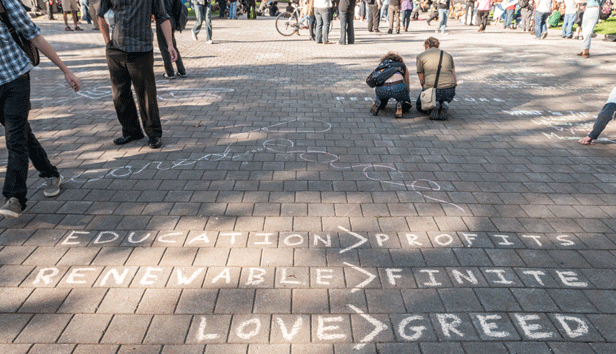
The First Amendment protects writings, drawings, and paintings as well as spoken words. Local governments nonetheless frequently wish to regulate these activities if inscribed onto public properties because—unlike spoken words—such activity can physically damage property. But local governments must balance their interest in protecting property with First Amendment free speech protection.
This blog examines these competing interests and how notable First Amendment cases impact local government regulation.
Three Factors that Define the Extent of Local Government Regulation
Three important variables affect the First Amendment protection given to written messages or images on public property (and the government’s corresponding ability to regulate them).
What does the message or image convey?
The First Amendment does not protect all types of speech, so the nature of a message or image is important in evaluating its First Amendment protection and whether a local government can prohibit it.
The U.S. Supreme Court held in Chaplinsky v. New Hampshire (1942) that governments can restrict speech that is “of such slight social value as a step to truth” that its benefits are outweighed by “the social interest in order and morality.” Applying this principle, gang tags or purely obscene graffiti that defaces public property typically gets little to no First Amendment protection. But other forms of speech—even if unpleasant or controversial—may be protected and harder for local governments to regulate.
For instance, the First Amendment strongly protects “political speech.” While not universally defined, the Washington State Court of Appeals, Division 1 in City of Seattle v. Buford-Johnson (2021) declared that political speech includes commentary, criticism, and “even political hyperbole toward and about public servants.”
More recently, the United States Court of Appeals for the Ninth Circuit (9th Circuit) in Tucson v. City of Seattle (2024) ruled that protected political speech includes writings that embody “anti-police slogans” and protests “the treatment of people of color by police.”
In State v. Arlene’s Flowers, Inc. (2019), the Washington Supreme Court declared that the First Amendment even protects “hate speech” (vile or offensive language that falls short of fighting words or true threats of violence directed toward an individual).
Local governments seeking to regulate in this area should note that laws enacted or enforced to target protected forms of speech are more likely to draw First Amendment challenges and court scrutiny.
Where is the message/image located?
Writings and drawings on “public forum” properties get the highest First Amendment protection and are the hardest for local governments to regulate. Public forums include properties with long histories and traditions of public speech (e.g., public streets, sidewalks, and parks), as well as other public properties that are compatible with free speech activities.
Courts consider a property’s layout and its normal and traditional use to determine this compatibility, and whether the public could reasonably expect speech protection at the location. When these criteria are applied, messages or drawings on an open public sidewalk, public square, or park plaza are more likely to receive free speech protection than those applied to highway signs, in public bathroom stalls, or on fenced-in utility infrastructure, since those sites lack the features and history of free speech public forums.
Since not all public property is a free speech forum, it is important for localities to establish boundaries around properties they wish to protect from writings and drawings. Attempts to restrict imagery or written speech will fail unless clear boundaries separate a regulated property/area from adjacent/surrounding property considered to be a speech-protected public forum. Such boundaries can include signs, fencing, or other features to clearly indicate that the property or area is separate from the public speech forum.
In Gerritsen v. Los Angeles (1993), the city sought to regulate free speech in two designated areas in a public park (admittedly a public free speech forum). The 9th Circuit struck down the city’s regulations because the walkways and sidewalks within the regulated areas were “no different from others in the park,” making the regulated areas essentially indistinguishable from the rest of the park.
For the same reason, a public forum doesn’t lose its speech protection just because it borders other property lacking public forum characteristics. Two cases illustrate this point: Bledsoe v. Ferry County and Tucson v. Seattle.
In Bledsoe v. Ferry County (2020), authorities charged Bledsoe with malicious mischief for writing chalk messages critical of local officials on a public sidewalk leading to a county building. Bledsoe sued and alleged that the charges violated her free speech rights, and the United States District Court for the Eastern District of Washington had to decide whether the involved stretch of sidewalk was a public forum for free speech. The county argued that it wasn’t since it abutted a non-public forum (a building the county used for official business rather than public expression). The court disagreed and declared that the sidewalk’s history and use made it a public speech forum, and that it retained that character despite its proximity to the county building.
Similarly, the 9th Circuit in Tucson v. Seattle (2024) ruled that an eco-block wall surrounding a police station was a free speech public forum based on its location and physical characteristics. The court noted that the wall “was placed in a public right of way, on top of and abutting a sidewalk,” making it a “vertical extension of the sidewalk that was freely open to public access.” The court also noted that the wall had “no signs erected stating that writing was banned,” giving the public a reasonable expectation that the wall was an expressive forum.
Is the message/imagery “permanent?”
The content and location of messages/imagery are important to determine First Amendment protection, but courts also consider the materials used to create them.
Court decisions like Bledsoe, Tucson, and Mackinney v. Nielsen (9th Cir., 1995) have sided with individual First Amendment rights when temporary materials like chalk or charcoal were used to write on public property. In contrast, messages in spray paint or other more permanent and destructive materials will more likely tip the scales in the government’s favor and interest in preserving public property.
Other Considerations
In looking at whether to regulate messages/imagery in public places, local governments should avoid regulating the content and should instead put into place and consistently enforce content-neutral regulations.
Avoid regulating speech content
Regulations that limit or prohibit certain content in messages or imagery are very difficult to impose. Governments must narrowly tailor such regulations to meet compelling government interests.
While important, local government interests in aesthetics and traffic safety are not sufficiently compelling to justify prohibitions against speech content (see Collier v. City of Tacoma, Washington Supreme Court, 1993). In Askins v. U.S. Dep’t of Homeland Sec. (2018), the 9th Circuit declared ominously: “It is rare that a regulation restricting speech because of its content will ever be permissible.”
But local governments can regulate the time, place, and manner of speech. Accordingly, laws focusing on dangerous conduct associated with writing messages/creating imagery on public property are less likely to draw First Amendment scrutiny than those targeting the message’s or image’s content. For example, local laws that generally prohibit walking or sitting in roadways or climbing over highway overpasses (for any reason) are less likely to receive First Amendment challenges than laws specifically prohibiting political protest activities in roadways or painting political messages on highway signs.
Enforce speech neutral regulations evenly
Even if local regulations are written to avoid specifically targeting speech content, they can still draw First Amendment challenges if those regulations are enforced unevenly.
Known as “as applied” First Amendment challenges, Tucson provides an example of uneven enforcement. In the case, police arrested and jailed Tucson and others under a Seattle property destruction ordinance for using charcoal to write messages critical of police on an eco-block wall surrounding a police station. The ordinance’s language didn’t prohibit any particular speech content, but the plaintiffs argued that authorities violated the First Amendment by selectively arresting and booking them based on the content of their writings, while others who chalked on sidewalks were not similarly charged.
While the Tucson case remains subject to further legal proceedings, it nonetheless shows the importance of even and consistent enforcement to avoid any “as applied” First Amendment challenges.
Conclusion
In balancing the need to keep neighborhoods clean and orderly, local governments looking to address imagery or messages in public spaces must carefully consider whether the nature, location, content, and perceived permanence of a message or image raises concerns about free speech. Given the complexity of First Amendment and free speech legalities, agencies should consult their legal advisors for guidance in addressing these issues.
Below are additional resources from MRSC broadly addressing First Amendment issues:
- The Right to Assemble: Responding to Protests, Spontaneous Gatherings, and Counterdemonstrations (2025)
- U.S. Supreme Court Changes Law on Government First Amendment Liability for Social Media Activities (2024)
- Social Media and Public Agencies: Strategies to Harness Communication Potential and Avoid Legal Challenges (2024)
- Rights and Limits on Filming in Public Facilities (2023)
- Speaking Versus Regulating—The Government Speech Doctrine (2022)
- Building and Property Nuisances—Graffiti Control
MRSC is a private nonprofit organization serving local governments in Washington State. Eligible government agencies in Washington State may use our free, one-on-one Ask MRSC service to get answers to legal, policy, or financial questions.

About Harry Boesche
Harry Boesche joined MRSC as a legal consultant in 2024. Prior to this, he was the Deputy City Attorney for the City of Auburn for 17 years.
His municipal law practice includes advising elected officials and appointed board and commission members on public records act and open government issues.


