
Save the Bees: How Local Governments Can Protect Pollinator Habitat
August 27, 2024
by
Katie Buckley
Category:
Guest Author
,
Environmental Laws and Regulations
,
Land Use Administration
,
New Legislation and Regulations
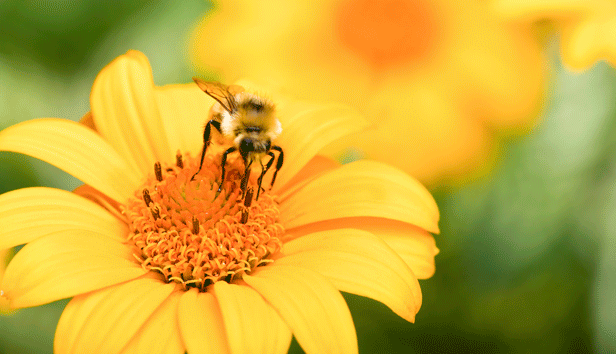
Pollinators are a critical component of our interconnected world, and their populations are under threat. They are important for not only ecosystem health, but also our food systems. Fortunately, unlike other threatened wildlife, pollinators can be supported in habitat patches of almost any size. Creating and conserving pollinator habitat can not only help pollinators, but also reduce maintenance costs, water and pesticide usage, and run off, while also increasing the attractiveness of the landscape and our own health.
This blog will look at why pollinators are so important to a healthy ecosystem and what state and local governments have been doing to protect and enhance pollinator habitat.
The Importance of Pollinators
Pollinators are critical to our food security. They are responsible for about one third of the human diet, helping to pollinate about 75% of crop species. They are also critical to ecosystem health, with 90% of flowering plants relying on them for reproduction. Here in Washington State, apples alone are worth $2 billion annually, and this fruit, like many others, relies on bee pollination.
Honeybees are also not the only pollinator, though they do receive a lot of attention thanks to their importance to agriculture. Washington is home to over 600 species of bees, as well as butterflies, moths, wasps, flies, beetles, and hummingbirds, which all pollinate different plants. Most pollinators specialize in what plants they pollinate, and when those plants are removed from the landscape, the pollinators will also go away.
In recognition of the importance of pollinators in a healthy ecosystem, the Washington State Legislature has, over the last few years, passed several pieces of legislation designed to protect and enhance pollinator habitat, including requiring that public works projects incorporate such habitat into the surrounding landscaping.
Pollinator Legislation
SB 5552 was passed in 2019, creating the Pollinator Health Task Force, the Washington State Department of Agriculture (WSDA) Pollinator Program, and added pollinators as a priority for state land managing agencies.
Passed in 2021, SB 5253 implemented the recommendations of the Pollinator Health Task Force. This bill touched on many pollinator related topics, though one section is of relevance to municipalities, specifically in regards to public works projects (see RCW 39.04.410).
If a public works project includes landscaping, at least 25 percent of the planted area must be pollinator habitat to the extent practicable. For purposes of this section, "pollinator habitat" means an area of land that is or may be developed as habitat beneficial for the feeding, nesting, and reproduction of all pollinators, including honeybees. The department of agriculture, in consultation with the conservation commission and the department of fish and wildlife, must develop a list of native forage plants that are pollen-rich or nectar-rich and beneficial for all pollinators, including honeybees.
The list of native forage plants has been developed and is posted on the WSDA’s Pollinator Habitat webpage. Additionally, see the Washington Department of Fish and Wildlife's (WDWF) webpage on creating pollinator habitats.
In 2024, two new pollinator related bills passed: SB 5972 and SB 5934. SB 5972 banned the use of neonicotinoid pesticides (linked to pollinator declines) except in agriculture or licensed applications. SB 5934 is meant to encourage the creation of pollinator habitat, including this section that applies to cities, code cities, and counties (RCW 35.63.300, RCW 35A.63.320, RCW 36.70.994):
- A city may encourage an applicant of a project permit or commercial building permit to include pollinator friendly plants in any landscaped area to the extent practicable by:
- Providing the list of native forage plants as developed by the department of agriculture in compliance with RCW 39.04.410 to applicants for project permits;
- Providing information regarding the benefits of pollinators and pollinator habitat; and
- Offering incentives, including expedited processing or reduced application fees, for permit applicants that include pollinator habitat as part of the permit application.
- A city may set restrictions related to beehives but may not adopt an ordinance banning beehives.
- For the purposes of this section:
- "Commercial building permit" has the same meaning as defined in RCW 19.27.015.
- "Pollinator habitat" means an area of land that is or may be developed as habitat beneficial for the feeding, nesting, and reproduction of all pollinators. "Pollinator habitat" does not include beehives, except for mason bee houses.
- "Project permit" has the same meaning as defined in RCW 36.70B.020.
In summary, cities and counties can encourage commercial developers to include the installation of pollinator habitat as part of their projects through the permitting process. Cities may also regulate beehives but cannot outright ban them.
Efforts Underway
Some municipalities are already meeting or exceeding SB 5253. Bee City USA is a popular initiative by the Xerces Society and multiple Washington cities are already affiliates, including Bellingham, Olympia, Puyallup, Sammamish, and Seattle.
The City of Vancouver is trying to naturalize areas of their parks and create more pollinator habitat with their volunteer program Naturespaces. Clark Public Utilities has started the Pollinator Project, which establishes pollinator habitat on utility-owned properties. The City of Spokane's SpokaneScape program encourages water-wise landscaping that incorporates mostly native plants, and also pollinator habitat. Heritage Gardens of the Columbia River Basin, a program of the Benton Conservation District, is now operating in Benton, Franklin, Yakima, Kittitas, Chelan, Grant, and Adams counties, and is a great resource for native plant landscaping in those areas.
If you’re looking for more examples outside of Washington, McCall, ID might be your first stop. McCall municipal code chapter 3.5.12 outlines landscape design guidelines for the city's business park zone, which encourage the use of native vegetation to retain the feel of the surrounding natural landscapes, provide wildlife habitat, and reduce water consumption.
More public works examples include the Chicago City Hall greenroof, habitat restoration and conservation on a large scale through the Midpeninsula Regional Open Space program (its not just about pollinators, but does include Mt. Umunhum “home of the hummingbirds”) in the California Bay Area, and the High Line in New York City.
Conclusion
Washingtonians are proving to be enthusiastic about pollinators. Pollinator festivals are being organized around the state, and the WSDA’s Washington Bee Atlas, dedicated to discovering and mapping all the bees species in our state, is growing incredibly quickly.
Thanks to SB 5934, public works landscaping will now need to have a pollinator habitat component, but encouraging pollinator habitat in other ways can help engage our communities, preserve our ecosystems, and yes, save the bees.
MRSC is a private nonprofit organization serving local governments in Washington State. Eligible government agencies in Washington State may use our free, one-on-one Ask MRSC service to get answers to legal, policy, or financial questions.

About Katie Buckley
Katie Buckley is the Pollinator Health Coordinator for the Washington State Department of Agriculture (WSDA), running both the Pollinator Health Task Force and WSDA Pollinator Program. She worked as a pest biologist for the WSDA before moving into her current position.
Katie has a background in entomology and obtained her B.S. from Purdue University, her M.S. from the University of Florida, and her Ph.D. from Washington State University. Her research was primarily on conserving pollinators and other beneficial insects
Katie is writing as a guest author. The views expressed in guest columns represent the opinions of the author and do not necessarily reflect those of MRSC.


