
2025 Legislation Affecting Local Government Planning
August 5, 2025
by
Leonard Bauer
Category:
Comprehensive Planning-Growth Management
,
Administration
,
Parking
,
Development Regulations and Zoning
,
Housing
,
Transportation and Land Use
,
New Legislation and Regulations
This blog summarizes nine bills related to county and city planning that were passed during the 2025 Washington State legislative session and signed into law by the governor. All bills took effect July 27, 2025.
Other bills that affect planning were summarized in recent MRSC blogs concerning sustainability, housing, residential land division, and child care facilities.
SB 5148: The Housing Accountability Act
SB 5148 provides cities, towns, and counties the option to request that the Washington Department of Commerce (Commerce) review and certify their comprehensive plan housing elements and development regulations for compliance with Growth Management Act (Chapter 36.70A RCW) and other statutory requirements. Commerce also must select up to 10 local governments each year and review and certify their housing elements and any associated housing development regulations.
If Commerce determines that a city or county housing element and/or development regulations do not comply with the requirements, the jurisdiction is provided several opportunities to revise them or appeal Commerce’s decision to the Growth Management Hearings Board. A city or county with a non-compliant housing element or development regulations may not deny applications to develop affordable or moderate-income housing.
SB 5184: The Parking Reform and Modernization Act
SB 5184 adds to previous legislation to further limit how much parking local governments can require for certain residential uses and commercial spaces. The bill reduces or eliminates parking requirements in cities and counties with a population of 30,000 or more.
SB 5184 sets the following limits on local government development regulations regarding parking:
- No more than 0.5 off-street stalls per multifamily unit.
- No more than 1 stall per single-family unit.
- No more than 2 stalls per 1,000 square feet of commercial space.
- No parking may be required for residences under 1,200 square feet, commercial spaces under 3,000 square feet, affordable housing, senior housing, childcare centers, ground level non-residential space in mixed-use buildings, or for buildings changing use.
More details on the provisions related to child care facilities appear in 2025 Legislation Promotes the Development of Childcare Facilities, a previous MRSC blog.
This bill also repeals RCW 36.70A.620, which had capped parking minimums for specific types of housing units within one-quarter mile of certain transit stops. (Note that this repeal supersedes amendments to RCW 36.70A.620 that were included in another 2025 bill, HB 1183, section 8.)
Cities and counties with a population between 30,000 and 50,000 must implement the requirements of SB 5184 by July 27, 2028, and cities and counties with a population of 50,000 or greater must do so by January 27, 2027.
HB 1491: Promoting Transit-Oriented Development
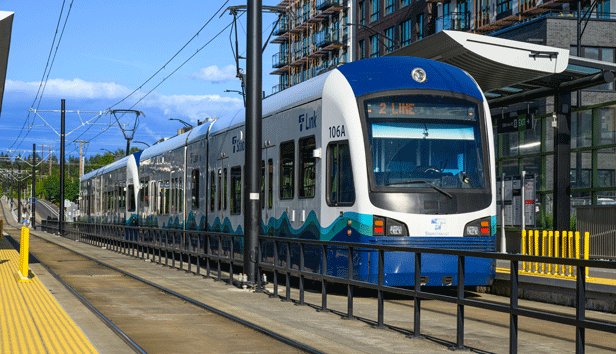
HB 1491 requires cities to designate “station areas” around certain public transit stops for higher-density development. It defines rail and bus station areas and amends the definition of a “major transit stop.” Commerce will develop a model code for station areas and can approve exceptions to the program.
The primary requirements of the bill include:
- For light rail, commuter rail or trolley station areas, cities must define a half-mile area around the station and allow development with a minimum 3.5 floor area ratio.
- For bus station areas (i.e., those on bus rapid transit routes) cities must define a quarter-mile station area around each station and allow development with a minimum 2.5 floor area ratio.
- Cities must offer a multifamily property tax exemption program in all station areas. Station areas are subject to mandatory affordable housing targets for low-income and workforce housing.
- Cities may not require off-street parking for mixed-use or residential development within a station area, except under certain circumstances.
- Buildings constructed within a station area must meet affordability standards for specified numbers of units for 50 years, with some exemptions.
There are also other provisions in the bill that cities should review carefully for potential applicability within their jurisdiction.
Station areas must be adopted by December 2029 by affected cities in King, Kitsap, Pierce, and Snohomish counties. Other cities subject to the bill must adopt station areas by no later than six months after their next periodic update in 2025, 2026, or 2027.
SB 5611: Allowing Binding Site Plans for Multifamily Development
A binding site plan has long been an alternative process for land division of properties zoned for commercial or industrial use, manufactured home or tiny home parks, and condominiums. SB 5611 broadens the definition of commercially zoned property to include properties zoned for multifamily housing. Cities, towns, and counties may adopt ordinances allowing multifamily zoned properties to be divided using a binding site plan.
SB 5558: Changing Periodic Update Deadlines
SB 5558 extends the deadline for the periodic update of comprehensive plans and development regulations from June 30 to Dec. 31, 2026, for Benton, Chelan, Cowlitz, Douglas, Franklin, Kittitas, Skamania, Spokane, Walla Walla, and Yakima counties and the cities located in these counties.
In addition, sections 2-4 of the bill affect all jurisdictions with periodic update deadlines in 2025 through 2027. These sections now require that local code updates related to design review (RCW 36.70A.630), middle housing (RCW 36.70A.635) and accessory dwelling units (ADUs: RCW 36.70A.680) be completed at the same time as comprehensive plan periodic update deadlines.
As a result of this bill:
- Periodic updates due Dec. 31, 2025, must also address middle housing, ADUs, and design review.
- The deadline for periodic updates due in 2026 is extended to Dec. 31, 2026, and updates to design review, middle housing, and ADU regulations are also due by that date.
- The periodic update deadline for 2027 jurisdictions remains June 30, 2027, and updates to design review, middle housing, and ADU regulations are due at that time.
HB 1935: Clarifying Permits Subject to Project Review Act
HB 1935 excludes building permits from the definition of ‘project permit’ in RCW 36.70B.020. The bill is intended to clarify questions about SB 5290, which was adopted in 2023 (see Impending Deadline of January 1 to Address SB 5290’s New Development Timelines for a more detailed explanation of that bill’s requirements).
HB 1039: Extending Urban Services to Tribal Lands
HB 1039 allows a city or town and a federally recognized Indian tribe to reach agreement by Dec. 31, 2028, to extend urban services such as water and sewer onto tribal lands that abut the city.
HB 1135: Growth Management Hearings Board’s Findings of Compliance
HB 1135 clarifies that the Growth Management Hearings Board (GMHB) may not issue a finding of compliance unless it finds that the county or city has amended the portion of its plan or code that the GMHB found noncompliant, and that the amendments are fully compliant with the Growth Management Act.
HB 1576: Requiring Property Owner’s Consent for Historic Landmark Designation
HB 1576 prevents a city from designating a property as a historic landmark if:
- The property is less than 40 years old; or
- The designation would restrict use, alteration, or demolition of the property and the owner’s consent was not obtained.
Properties may be nominated as a historic landmark without the property owner’s consent, but the owner’s consent must be obtained before designation.
The following are exempt from requirements in the bill:
- Properties within a historic district that were established through a local preservation ordinance, and
- Properties that are more than 125 years old.
Cities must amend ordinances to meet these requirements in residential and mixed-use zones by July 27, 2026, or the bill’s requirements supersede and invalidate any conflicting local codes.
Conclusion
This blog briefly summarizes some of the bills signed into law in 2025 that affect local government planning. The bills include a variety of deadlines and optional actions available to cities, towns, and counties. Please review the complete bills with your legal counsel to determine how they might affect your community.
MRSC is a private nonprofit organization serving local governments in Washington State. Eligible government agencies in Washington State may use our free, one-on-one Ask MRSC service to get answers to legal, policy, or financial questions.

About Leonard Bauer
Leonard Bauer has over 35 years of public service experience in planning and community development.
He worked for MRSC from 2024 through fall of 2026 as a planning consultant. Prior to that he was the community planning and development director for Olympia for 10 years. He also served the Cities of Sumner and Tumwater, a regional council of governments in Eugene, OR, and the Washington State Growth Management Services Office at the Department of Commerce.
Leonard is writing as a guest author. The views expressed in guest columns represent the opinions of the author and do not necessarily reflect those of MRSC.


