
Rolling Rules: How Washington Local Governments Influence Food Cart Operations
August 11, 2025
by
Leah LaCivita
Category:
Licensing and Regulation
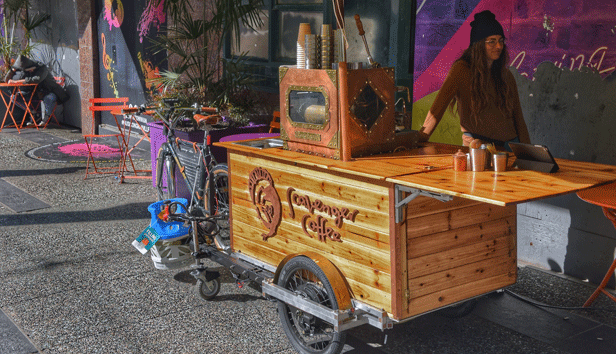
Across the state, food carts (also called pushcarts) are a staple of modern life, offering everything from coffee to fresh fruit smoothies, and the famous Seattle Dog. Lower startup costs and less dependency on a specific location make mobile food vending an appealing option for many entrepreneurs. Behind the scenes, food cart vendors must navigate a complex web of health, zoning, and business regulations, which this blog will attempt to unravel.
What Is a Food Cart?
When most people envision a food cart, what comes to mind is classic image of a cart outside a museum or sports arena selling hot dogs and pretzels, but today’s version is equally more likely to serve churros or elote.
Defining what a food cart is from a regulatory point of view can be challenging. To help operators determine what type ‘mobile food unit’ they have, the Washington State Department of Labor and Industries (L&I) asks the following questions on its Food Trucks & Trailers webpage:
- Will you sell food or other items from the truck/trailer at temporary sites?
- Is the truck/trailer licensed as a vehicle?
- Do people work inside?
- Do customers stand on the outside?
- Does it have at least one of the following: electrical system 120v or greater, water or drain system, or a propane gas piping system?
- Is the truck/trailer no more than 8.5 feet wide?
A ‘no’ response to any question means the unit is not a food truck, and if employees work outside, the unit is a food cart or food delivery truck.
How Are Food Carts Regulated?
While food trucks must obtain permits from L&I and county health departments in order to serve food to the public, food carts only need an inspection/permit from the county health department in which they intend to operate.
The type of food sold matters (and in what condition). Pursuant to RCW 36.71.090, a vendor may sell “farm produce or edibles raised, gathered or produced” without a license. While this law is aimed at farmers and gardeners, anyone selling fresh whole produce falls under the rule. However, once a vendor slices tomatoes or adds them to a dish (for example), they enter the realm of Time/Temperature Control for Safety (TCS), triggering stricter health regulations.
Food that is TCS sensitive has a higher risk of causing foodborne illnesses if improperly prepared or stored. Some examples of TCS food are raw, cooked, or partially cooked meat and eggs, cooked starches (e.g., rice, potato); mixtures that include cut tomatoes or garlic in oil, and cut fruit and vegetables high in acidity.
There are additional state regulations to consider. The Washington State Retail Food Code (WAC 246-215) addresses ‘mobile food units’ in Part 9, Subpart A and ‘temporary food establishments’ in Subpart B, requiring that food served from either be prepared, portioned, stored, or packaged at an approved commissary kitchen or another facility (such as a permitted restaurant). The mobile food unit (including both food carts and trucks) must return to an approved facility (commissary, restaurant) each day for cleaning, restocking supplies, and other servicing activities.
The role of the county health department
To ensure food carts follow food safety standards, county health departments have established many requirements, including:
- Cart must include freshwater and wastewater tanks (Whatcom County Guidelines for Pushcarts).
- Carts must have separate containers for soiled and clean food service utensils (Grays Harbor County Mobile Food Unit Guide).
- Carts must discard uneaten TCS-sensitive foods at the end of each day (Snohomish County Mobile Unit Requirements).
- Carts may only serve limited items (Thurston County Street Vending Guide or Tacoma-Pierce County Health Department Mobile Unit Requirements.
- Carts must have a bathroom use agreement with a local facility to allow food cart staff access to a bathroom (Benton Franklin Health District Mobile Location Agreement).
- Carts using liquid propane, charcoal, wood, or oil frying equipment must seek approval of such equipment by a local fire department (King County Mobile Food Unit Plan Review and Permitting Guide).
Some health departments may also offer permit exemptions for vendors selling non-TCS food (e.g., King County), such as packaged pre-made snacks or frozen concoctions, jerky, baked goods, dry goods (beans, grains, tea, herbs), or items produced as part of a cottage food operation.
The role of cities and towns
While county health departments are entrusted with ensuring food safety standards are met, cities and towns can also regulate aspects of food cart operations, such as where carts may be located and the hours in which they may operate. This is often accomplished through broad regulations on mobile vending.
Common restrictions include requiring operators get permits and/or licenses, prohibiting carts from blocking public access (sidewalks, driveways) or causing a traffic hazard (intersections, streets). Other less common food cart regulations are as follows:
- Restricting size of cart — see Othello Municipal Code Ch. 4.14.040(g).
- Prohibiting signage/advertisement placement anywhere other than on the cart — see Edmonds Municipal Code Sec. 4.12.055(D)
- Restricting ‘hawking’ or other loud noises — see Quincy Municipal Code Sec. 5.12.060(I)
- Creating special zoning areas for food cart operations — see Seattle Department of Transportation’s Director’s Rule 01-2023: Vending in the Public Square or Federal Way’s Mobile Food or Retail Vendor Supplemental Checklist
- Allowing carts to operate on agency-owned property or in the public right-of way — see Pasco Municipal Code Sec. 5.7.090.
- Requiring cart operators follow local regulations related to use of plastic bags, non-compostable food service containers, and single-use plastic utensils — see Edmonds Municipal Code Sec. 4.12.055(C)
Violations
Last year saw a rise in unpermitted food carts in several counties, including Clark, King, and Snohomish, prompting health departments to warn community members about the dangers of foodborne illnesses and reminding them to seek out vendors displaying the required permits. To make it easier for King County diners, in 2025, the health department expanded the use of its popular food safety rating system for traditional dine-in restaurants (a colorful sign with a face to indicate rating) to include licensed mobile vendors.
Depending on the violation, a food cart vendor can be shut down by the health department or by a city/town. Unpermitted food carts may be asked to leave or be removed from the location (e.g., if violating local zoning codes), fined (e.g., if blocking public access), or shut down entirely if it is proven that the food served caused foodborne illness in customers.
Most local governments will opt for educating unlicensed food cart operators before applying punishments, especially since food carts are a low-barrier, low-cost way to enter into the food industry.
Conclusion
Almost a decade ago, the City of Portland (OR) asked researchers to survey its burgeoning mobile food scene. They found that many food cart vendors sought out this approach because of a desire for independence, flexibility, and the ability to interact directly with customers in a way that traditional restaurants did not offer. Researchers also found that food carts were often a family-run business, which sometimes acted as a steppingstone to more formal business ventures.
Taking in this information, the city launched a food cart pods program, bunching several mobile vendors together into one location that offered amenities like bathrooms, seating, stages for entertainment, etc. to attract diners. The result? Multiple pods across the city offer a variety of cuisines and a bustling communal foodie scene that attracts regional and national attention. Washington local governments can also find ways to balance public health, safety, and local planning needs while encouraging mobile food entrepreneurship.
MRSC is a private nonprofit organization serving local governments in Washington State. Eligible government agencies in Washington State may use our free, one-on-one Ask MRSC service to get answers to legal, policy, or financial questions.


