Dangerous Waste Management Program Guidance and Compliance Tips
February 12, 2026
by
Julie Nicoll
,
Stacy Fox
Category:
Guest Author
,
Environmental Laws and Regulations
,
Hazardous Materials and Substances
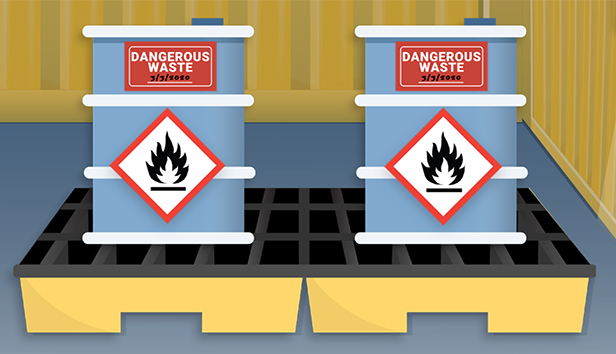
Image adapted from Ecology's Check your Central Accumulation Areas.
As discussed in Part 1 of this blog series, “dangerous waste” can be generated by any government agency, from cities and counties to transit authorities, hospital districts, and port districts.
Wastes such as paints, used solvents, cleaners, and chemical products that are no longer useable, count towards an agency’s generator category. These wastes are commonly found in agency fleet maintenance shops. Unique wastes streams generated by law enforcement and fire protection districts include ammunition (lead waste) and fluorinated firefighting foam.
Dangerous waste compliance programs are often overlooked until a facility is inspected by the Washington State Department of Ecology (Ecology). This blog, Part 2 of the series, will explore the basics of a dangerous waste management program, including waste designation, preparing for an inspection, and compliance tips.
Waste Designation
Not only are generators required by law to track the amount of dangerous waste they generate, the amount of waste an agency generates monthly determines which Washington State Dangerous Waste Regulations apply to the site.
In order for an agency to determine how much dangerous waste it generates, the agency must properly designate its waste. Waste designation is the process of determining if a regulated “dangerous waste” has been generated or not.
Waste designation typically requires an understanding of the chemical characteristics of the waste. Ecology’s waste designation checklist is a helpful tool to get started. It includes references to the Dangerous Waste Regulations, WAC 173-303, as well as questions to guide the designation process, such as:
- Is this a solid waste?
- Is the waste exempt for recycling?
- Is the waste excluded?
- Is the waste a universal waste (batteries, mercury-containing lights, and equipment)?
- Does the waste exhibit the characteristics of reactivity, toxicity, ignitability, or corrosivity?
For more information on waste designation, see Ecology’s publication and video.
After an agency completes the waste designation process, the appropriate generator category (small, medium, large) can be determined. For more information on generator categories, see Part 1 of this series.
The more dangerous waste an agency generates, the more onerous the regulations are. Accordingly, it is beneficial for an agency to minimize the amount of dangerous waste it generates monthly.
Dangerous Waste Management Program
A comprehensive dangerous waste management program includes the following:
- An inventory of dangerous waste generated
- Compliance with various on-site management requirements:
- Labeling of waste drums/containers (Ecology offers free waste labels)
- Management of waste containers – see Ecology’s video on dangerous waste containers (WAC 173-303-630)
- Management of empty containers (see Dangerous Waste Pharmaceuticals Guide and Focus on: Dangerous Waste Pharmaceutical Containers, which are applicable to health care facilities).
- Waste accumulation and storage (see compliance poster)
- Weekly site inspections (see Ecology’s sample inspection form)
- Staff training
- Compliance with the U.S. Department of Transportation’s regulations and training requirements for “offering” waste for transport (labels and placards).
- Disposal options, including landfill, treatment, recycling, and incineration (see Ecology’s list of waste service providers)
- Reporting requirements (see Part 1 of the blog series)
- Recordkeeping (see Ecology’s weekly inspection checklist and records retention requirements in WAC 173-303-210)
- Regular self-audits
An essential component of a dangerous waste program is preparing your site for an Ecology inspection. Performing a self-audit utilizing Ecology’s checklist is a good starting point. To have a better understanding of what to expect during an inspection, see Ecology’s inspection guidance.
As discussed in Part 1 of the blog series, the new eManifest system allows Ecology to access every generator’s waste records. Ecology can review these records to assess compliance, determine if additional information is required, and evaluate whether an inspection is warranted.
Compliance Tips
Government agencies may also lease property to office, retail, and industrial tenants, who may generate dangerous waste.
As a property owner and property manager, it is critical to understand the potential liability associated with the generation and storage of dangerous waste on leased property. The property owner may be potentially responsible for abandoned waste or contamination on the property, even if caused by a tenant.
Ecology’s guidance for property owners discusses how to manage these risks to people and the environment. Several Washington ports have developed comprehensive tenant auditing programs to manage these risks. For example, see the Environmental Compliance Assessment Program at the Port of Bellingham and Port of Seattle.
Conclusion
Waste generators have an ongoing responsibility to ensure compliance with the Dangerous Waste Regulations. Since these regulations are subject to change, it is important to stay informed. You can do this by subscribing to Ecology’s “Shoptalk” newsletter for updated information on dangerous waste and pollution prevention training, best practices, rulemaking, and reporting deadlines. For example, Shoptalk Fall 2024 covers dangerous waste designation basics and the recent reporting changes mentioned in Part 1 of this series.
Ecology’s website also summarizes the penalties assessed for non-compliance. As we all know, the potential for financial penalties gets everyone’s attention!
We hope this blog series encourages agencies to proactively evaluate their dangerous waste compliance programs.
MRSC is a private nonprofit organization serving local governments in Washington State. Eligible government agencies in Washington State may use our free, one-on-one Ask MRSC service to get answers to legal, policy, or financial questions.