
The Connection Between Downtown Safety and Revitalization
March 5, 2025
by
Abby Newbold
Category:
Guest Author
,
Public Safety and Welfare
,
Design
,
Downtown Revitalization Series
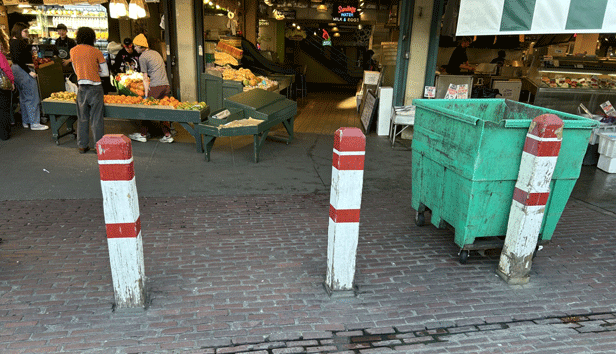
Photo courtesy of the author.
Downtowns have changed, as the typical use of downtown space has shifted due to the lasting impacts of the COVID-19 pandemic. Many office workers work remotely, and retail sales have shifted more to online activity. In some cases, downtown areas are struggling to manage the impacts of homelessness or illicit activities.
Both passive and active strategies by local governments may boost activity, respond to challenges, and invite more people to downtown areas. This toolbox of strategies may be helpful for cities looking to address downtown safety.
Passive Strategies
Passive strategies rely on the idea of “eyes on the street,” bolstered by pedestrian users in urban spaces. Jane Jacobs in Death and Life of Great American Cities (1964) hypothesized that the more people in downtown areas engage with available space, the more likely people will feel a sense of safety.
Public space and activities
Public space includes municipally owned parks and plazas as well as space used by the public but leased to private businesses, such as pedestrianized parking spaces or sidewalk seating. These areas provide places for public activities, leisure, and events, and such uses can contribute to a sense of safety. Washougal is working on a project to develop outdoor recreation facilities, in part to draw more community members to their town center and boost redevelopment efforts.
Programming or events that invite greater foot traffic can also contribute to a sense of safety. Creative reuse programming, like the Seattle-based Punk Rock Flea Market (run by an independent nonprofit) or the Bothell Lot EFG temporary community space, are examples of non-permanent events or spaces to activate downtown areas. For more ideas and local examples, see The Importance of Public Space to Downtown Revitalization.
Urban design elements
Downtown area design may contribute to both physical and public safety. The Getting Smart on Safety (2024) report from the Futures Institute identified specific strategies, like redesigning traffic flows and greening streets, to promote pedestrian safety.
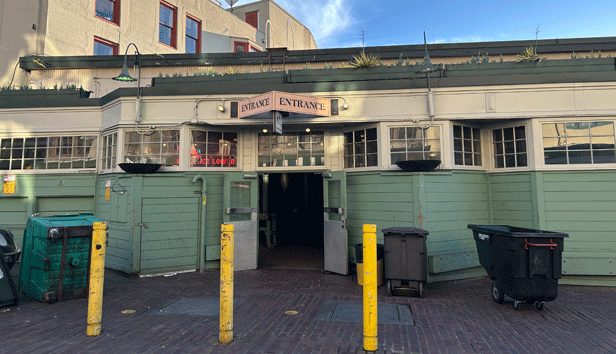
Bollards contribute to an inviting space and safety for pedestrians at Pike Place Market in Downtown Seattle. Photo courtesy of the author.
Strategies to improve the pedestrian experience and protect walkers, like bollards or sidewalk planters, can provide inviting spaces for people, contributing to the idea of “eyes on the street.” For example, Dayton’s Main Street Action Plan (2021) highlights non-vehicle user safety.
Crime Prevention through Environmental Design (CPTED) design principles build on connectivity, community culture, and natural surveillance to improve safety in urban areas. CPTED strategies include installing adequate street lighting and landscaping, using windows, front porches, and balconies to provide ‘eyes’ on the street, and other elements.
For example, Federal Way incorporates CPTED principles and references the approach in its community design guidelines at Municipal Code Ch. 19.115. The cities of Covington and Everett also use CPTED principles.
Diversity of land uses
Compared to an empty sidewalk, the presence of people can also contribute to a sense of safety. In prime pedestrian areas like downtowns or main streets, a single-use first floor structure, such as an office building with no additional ground floor uses, does not readily invite pedestrian activity.
Allowing multiple land uses in downtown areas and combining residential, commercial, retail, entertainment, entertainment, education, and civic or cultural amenities encourages more continuous activity over a 24-hour period. Some examples of jurisdictions promoting a diversity of land uses in their downtown core include:
- Marysville: Downtown Master Plan (2021) — Includes recommendations for an “active ground floor” to create safer spaces, particularly for pedestrian use of downtown areas.
- Pasco: Downtown Master Plan (2022) — Encourages ‘substantial private sector development and investments’ by calling for updates to the downtown zoning map to reflect future land use goals.
- Spokane: Pavement to People - A Downtown Housing Incentive — Approved with the passage of Ord. C36357.
Active Strategies
Active strategies fostering a sense of safety typically involve personnel, such as employees from local governments or partner organizations, conducting activities in a downtown area.
Maintenance and beautification
Maintaining a clean environment and staying vigilant about maintenance and clean up can help create a more welcoming environment. Aberdeen's Downtown Beautification Project annually installs plants and flowers in partnership with members of the community.
Services like graffiti removal and landscaping can be offered by the local government (such as Olympia’s Downtown Clean Team, which maintains downtown areas), or these services may be provided by a downtown association or organized with volunteers.
“Feet on the Street” teams — Monitors, security personnel, and ambassadors
Public or private security personnel in downtown and main street areas may be part of a strategy for improving safety and security through deterrence and response. Approaches may include police (or other security presence) foot patrols or security cameras.
As part of Bellingham's Downtown Safety and Community Support Services program, police conduct bicycle patrols in downtown areas. The city also partners with the Downtown Bellingham Association to offer private security personnel for businesses and private property.
Downtown safety strategies may also include non-police monitors, ambassadors, or even information offices to provide resources and services for community members. In their multi-pronged approach to safety, Bellingham’s services include an ambassadors program, and the city contracted out to have teams monitor city-owned parking facilities. Trained in de-escalation techniques, these same teams can also connect people with social services if they encounter someone in crisis.
Services available through the Downtown Tacoma Partnership includes the safety team, which addresses nuisance behaviors and can provide on-call security escorts, and the clean team, which keeps city streets clean and removes graffiti.
Additional responders
Additional responders may include specific crews like behavioral health outreach teams, which respond to non-violent calls and often work in partnership with local law enforcement. Responder services may be geared toward those experiencing challenging mental health conditions, homelessness, and/or substance abuse. For example, in late 2024 Spokane enacted the Crisis Outreach, Response and Engagement (CORE) program to promote downtown safety, address community concerns, and respond to the needs of individuals experiencing crisis through a coordinated effort between the Spokane police, local fire departments, and outreach specialists.
Jurisdictions may also engage with external partners like nonprofits or religious institutions to provide services and support. For more examples of this approach, see Police, Mental Health Professionals Partner to Improve 911 Response.
Implementation – A Comprehensive Way
Multiple entities, in addition to local government staff focused on downtown areas, can adopt these strategies for public safety. One option may be parking and business improvement area (PBIAs) or, simply, business improvement area (BIA).
PBIA/BIA are organizations in which members (local businesses) pay a small fee into a communal fund and the proceeds of this fund can be used to cover additional services for the district. Some examples include:
- Olympia Downtown Alliance (see Downtown Guide Program and Downtown Maintenance Program)
- Seattle Business Improvement Areas
- Downtown Tacoma Partnership
Another program is the Washington State Main Street Program (Main Street), which offers technical and financial assistance to Main Street Communities — independent nonprofit organizations dedicated solely to downtown revitalization.
To participate in the program, organizations must have committed the necessary time and training to develop community, financial, and human resources support, and must have implemented the Main Street Approach. One Main Street organization, the Mount Vernon Downtown Association, undertook a street lighting project to increase safety for sidewalk users during winter months.
Creating downtown area plans can be another tool for local governments to utilize these strategies for safety. A downtown area plan can enable coordination between local government agencies, encourage public-private collaboration, and offer a vision for future actions. The Spokane Downtown Plan (2021) mentions public safety throughout the document as a community concern. For example, strategies PS1 and PS2 contain multiple action items aimed at improving public safety.
For more on downtown plans, see How Downtown Plans Can Create a Framework for Revitalization Efforts, Part 1 and Part 2.
Conclusion
Increasing downtown safety is an important goal for any jurisdiction. Whether through public space and safe design; diverse land uses; maintenance and beautification; or monitors, security staff, and other responders, these strategies may help in improving public safety. No single approach will work alone: Utilizing multiple strategies concurrently can help improve a sense of safety and support revitalization efforts in downtown areas.
MRSC is a private nonprofit organization serving local governments in Washington State. Eligible government agencies in Washington State may use our free, one-on-one Ask MRSC service to get answers to legal, policy, or financial questions.


