
Managing Election-Related Issues
August 14, 2024
by
MRSC Insight
Category:
Elections and Voting
Editor's note: Starting January 1, 2026, RCW 42.17A.555 has been re-numbered as RCW 29B.45.010. We have updated this post accordingly.
Challenges can arise for a local government during an election season, including those involving candidates to ballot drop boxes, and temporary signage. This blog reviews several scenarios.
Challenges Involving Candidates
What if, after the primary election, a candidate moves from the jurisdiction and is no longer qualified to hold the office?
To qualify for local elective office, a candidate must be a registered voter of the municipality and reside in the jurisdiction they seek to represent (see RCW 42.12.010 and RCW 29A.08.010).
Sometimes a candidate will move from the jurisdiction and no longer qualify for the office they are seeking. However, their name remains on the ballot and the person continues to seek election. What can be done? A judge is authorized to correct an election error, prevent a “wrongful act” with respect to an election, or require the performance of an election-related duty, if an affidavit is filed by an elector (see RCW 29A.68.011). However, local governments are prohibited from expending any public funds in pre-election litigation as this would likely be considered indirectly assisting an opposing candidate. See RCW 29B.45.010 (formerly RCW 42.17A.555).
What if the winner of the primary election withdraws or dies prior to the general election?
According to AGO 1999 No. 5, a deceased candidate’s name remains on the ballot and the votes cast for them are counted. In the event the deceased candidate receives the most votes, a vacancy is declared for the position and the vacancy is filled according to the process applicable to that office. The answer is the same in the event a candidate withdraws from the race — If the candidate who withdrew wins the most votes, then a vacancy occurs and must be filled accordingly. The runner-up candidate to a candidate who has died or who withdrew is not declared the winner but could be considered for filling the vacancy. For more information, see our page Vacancies in Local Elected Offices.
Keeping Election Workers Safe
In March of this year, RCW 9A.46.020 was amended to provide more protection for “election officials,” which includes:
any staff member of the office of the secretary of state or staff member of a county auditor's office, regardless of whether the member is employed on a temporary or part-time basis, whose duties relate to voter registration or the processing of votes as provided in Title 29A RCW.
The law now makes it a Class C felony to harass an election official, and those experiencing harassment may now apply for the Address Confidentiality Program under state law in chapter 40.24 RCW. Elections officials and their staff should consider reporting such harassment to local law enforcement.
Ensuring Secure Access to Ballot Collection
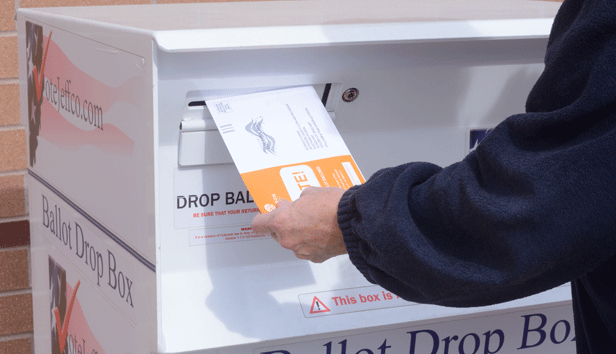
Voters can return ballots through the mail, via a voting center, or through an official ballot drop box. RCW 29A.40.170 requires county auditors to establish at least 1 ballot drop box per 15,000 registered voters in the county and at least 1 drop box in “each city, town, and census-designated place in the county with a post office.” There are additional provisions in this statute about drop box security, including preventing ballots from overflowing so voters may drop their ballots, security when removing ballots, and locking the boxes at 8:00 p.m. on the day of the election.
According to data maintained by the Washington Secretary of State (SOS), 56% of all voters in the 2023 general election returned their ballot via a drop box. Given the large number of voters returning ballots through a drop box, local governments can help maintain easy access to these facilities by limiting certain activities within the area. RCW 29A.84.510 provides that during the 18-day voting period, no "electioneering" is permitted within 25 feet of a ballot drop box. ‘Electioneering’ includes campaigning, signature collection, or any activity that impedes the voting process.
The 2020 election saw a trend in which individuals not affiliated with or authorized by a political party stationed themselves near ballot drop boxes to ‘observe’ people depositing their ballots. This activity can be one that “impedes” the voting process if too close to the drop boxes. WAC 434-250-100(6) offers this clarification:
The 2020 election saw a trend in which individuals not affiliated with or authorized by a political party stationed themselves near ballot drop boxes to ‘observe’ people depositing their ballots. This activity can be one that “impedes” the voting process if too close to the drop boxes. WAC 434-250-100(6) offers this clarification:
Within twenty-five feet of a ballot deposit site that is not located within a voting center, no person may electioneer, circulate campaign material, solicit petition signatures, or interfere with or impede the voting process. Whenever it is necessary to maintain order around a ballot deposit site, the county auditor may contact a law enforcement agency for assistance.
Campaign signs also fall within the definition of “electioneering” and should be removed if placed within a 25-foot radius of a ballot drop box or voting center.
Finally, any person who knowingly misrepresents an unofficial ballot collection site or device as an official ballot drop box can be charged with a gross misdemeanor crime. (see RCW 29A.84.610).
Regulating Non-Commercial Temporary Signs
Speaking of campaign signs, local governments can regulate where temporary non-commercial signs are placed — within the public right-of-way. For a detailed discussion, see Regulating Signs During Election Season.
More Resources
For more about local election-related issues, here are several resources offering a deeper dive on various topics:
- Supporting/Opposing Ballot Measures and Candidates
- Election Season Tips and Reminders
- Use of Public Facilities in Election Campaigns
Also note that election security measures are covered on the Elections Administration webpage and in our 2022 two-part blog series, Elections Integrity and Security.
MRSC is a private nonprofit organization serving local governments in Washington State. Eligible government agencies in Washington State may use our free, one-on-one Ask MRSC service to get answers to legal, policy, or financial questions.


