
Adopting SEPA Exemptions May Help Implement Your Comprehensive Plan
June 18, 2025
by
Leonard Bauer
Category:
Comprehensive Planning-Growth Management
,
Environmental Laws and Regulations
,
Housing
,
New Legislation and Regulations
Editor's note: This blog has been updated to show that the City of Kent adopted a citywide infill housing development exemption in 2024.
Since 1971, the State Environmental Policy Act (SEPA) has required local governments and state agencies to identify, evaluate, and mitigate (where possible) the probable environmental impacts of proposed actions. Since the adoption of the Growth Management Act (GMA) in 1990, however, many have argued that the intensive analysis and public process to adopt local government comprehensive plans has effectively made SEPA redundant for actions that implement those plans.
For some actions, the state legislature has agreed. They have authorized a number of SEPA exemptions local governments can use to streamline actions that carry out local comprehensive plans, such as permitting affordable housing or new downtown businesses. Some SEPA exemptions are categorical and are defined in state law or rules (see WAC 197-11-720).
Other exemptions are optional and only take effect when specifically adopted by the local government, usually for certain portions of a jurisdiction (i.e., subareas) after a public process to consider area-wide impacts.
This blog describes some of the SEPA exemptions that are optional for local governments and shares examples of how cities, towns, and counties are using them as powerful tools to carry out their comprehensive plans.
Why Adopt SEPA Exemptions?
There are many implementation actions called for in local comprehensive plans, such as constructing new housing and growing small businesses. Why should local elected officials take the time to consider SEPA exemption tools when these other actions are their priorities? The short answer is that SEPA exemptions can help local priorities happen more quickly. They can do this by:
- Speeding up the local approval process timeline by eliminating the extra steps required by the SEPA process; and
- Reducing the likelihood of someone appealing a project or program (since a SEPA appeal would no longer be possible for an exempt SEPA action).
Construction projects are dependent on private and nonprofit developers. It is much more likely for developers to access financing and construct these projects if there is little risk of a lengthy permitting process or legal appeal. The SEPA exemptions discussed below remove the requirement for environmental review of individual construction projects. Instead, potential environmental impacts and mitigation are analyzed cumulatively over a large area as part of a broad public process that results in a locally adopted comprehensive plan or subarea plan. Once this occurs, a local SEPA exemption can be adopted that reduces permitting time and removes risk of appeal, incentivizing developers and financers to build the projects prioritized in the local plan.
SEPA exemption tools can be important economic development tools for a city, town, or county while also maintaining environmental protections and promoting a transparent public process.
Increasing Categorical Exemptions for Construction Projects
WAC 197-11-800 defines numerous sizes and types of governmental actions that are not subject to SEPA review, known as categorical exemptions. Subsection (1) describes a process for local governments to adopt flexible thresholds to categorically exempt minor construction projects. These exemptions then apply to all projects no larger than the listed exemption level. (Note there are some exceptions listed in WAC 197-11-305 and 197-11-800(1)(a), such as projects on lands wholly or partly covered by water.)
Cities, towns, and counties should consider increasing the exemption levels to encourage the types of construction projects that would help reach their comprehensive plan goals. As shown in the table below, a city, town, or county can exempt the following types of construction up to these maximum exemption levels:
| Project Types | Fully Planning GMA Counties | All Other Counties | ||
|---|---|---|---|---|
| Incorporated UGA | Unincorporated UGA | Other unincorporated areas | Incorporated and unincorporated areas | |
| Single family residential | 30 units | 30 units | 20 units | 20 units |
| Single family residential with less than 1,500 sf total | 100 units | 30 units | 20 units | 20 units |
| Multifamily residential | 200 units | 60 units | 25 units | 25 units |
| Barn, loafing shed, farm equipment storage, produce storage or packing structure | 40,000 sf | 40,000 sf | 40,000 sf | 40,000 sf |
| Office, school, commercial, recreational, service, storage building, parking facilities | 30,000 sf and 90 parking spaces | 30,000 sf and 90 parking spaces | 12,000 sf and 40 parking spaces | 12,000 sf and 40 parking spaces |
| Barn, loafing shed, farm equipment storage, produce storage or packing structure | 40,000 sf | 40,000 sf | 40,000 sf | 40,000 sf |
| Fill or excavation | 1,000 cubic yards | 1,000 cubic yards | 1,000 cubic yards | 1,000 cubic yards |
Source: WAC 197-11-800(1)
Some Washington cities, towns, and counties have taken advantage of this flexibility to customize their categorical exemptions. Bellevue and Friday Harbor increased exemption levels to the maximum allowed. Pierce County is currently considering updates to their categorical exemptions code to raise thresholds to the maximum allowed for residential development projects.
Other jurisdictions have increased exemption thresholds to a level that is lower than the maximum allowed, including Airway Heights, Battle Ground, Federal Way, Richland, Stanwood, and Tumwater.
Some local governments have increased categorical exemption levels for some areas while providing exemptions in other areas using one of the exemptions for subareas described below. For example, Bremerton, Redmond, and Spokane increased categorical exemption thresholds for most areas and adopted planned actions for certain subareas under RCW 43.21C.440.
Covington and Snohomish County have increased categorical exemption thresholds in some areas and defined different exemptions for specific infill development areas under RCW 43.21C.229.
Exemptions for Subareas
Some SEPA exemptions tools can apply to all (or most) development within a defined neighborhood or subarea of a city, town, or county. These area-wide SEPA tools include exemptions for planned actions, infill and housing development, and urban centers with major transit stops.
Planned actions
The planned action review process in RCW 43.21C.440 authorizes local governments planning under the GMA to prepare an environmental impact statement (EIS) as part of a subarea planning process.
The EIS is a thorough analysis of potential environmental impacts and the development of mitigation measures for the subarea. Based on the EIS, a local government can adopt a planned action ordinance defining the amount of future development. Development proposals that are then consistent with the EIS and planned action ordinance do not require additional SEPA review, streamlining the process.
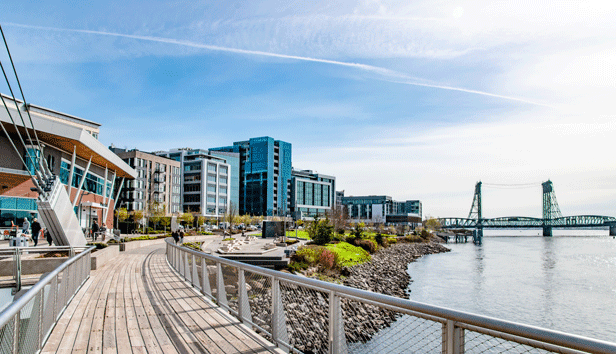
Cities, towns, and counties have had the authority to adopt planned actions since 1995, and many have done so. When combined with other local actions, planned action ordinances have successfully spurred the significant redevelopment of several subareas such as Everett’s southwest industrial area, Tacoma’s downtown and Thea Foss Waterway, and Vancouver’s city center, including the Esther Short Park and Columbia River waterfront.

Tacoma's Thea Foss Waterway.
A few more recent examples are Bremerton’s Harrison Heights planned action, Fife’s city center plan, Kirkland’s NE 85th street station, Mason County’s Belfair subarea plan, Olympia’s Capital Mall Triangle subarea plan, and Spokane South Logan TOD planned action as outlined in its municipal code.
Some cities have found it helpful to update their planned action ordinances over time, often as part of later comprehensive plan updates. A few examples are Federal Way’s city center planned action; Lake Stevens’ center subarea plan (and the planned action in Ord. 1027) and 20th Street Corridor subarea plan (and Ord. 1075); and Redmond’s Overlake SEPA planned action.
Infill and housing development
The state legislature adopted this exemption “to accommodate infill and housing development and thereby realize the goals and policies of comprehensive plans.” See RCW 43.21C229(1).
A county or city planning under the GMA can exempt residential and mixed-use development, and commercial development up to 65,000 square feet (excluding retail), if such development is consistent with the environmental analysis conducted for its comprehensive plan. (In 2025 the legislature passed SB 1491, which amended RCW 43.21C.229 to add categorically exempt residential and mixed-use development in station areas defined in the statute.
Covington, Olympia, and Port Angeles have used this tool to advance comprehensive plan goals for housing affordability and downtown revitalization. Kent's ordinance no. 4508 (2024) adopts the infill housing development exemption citywide.
Urban centers or major transit stops
Pursuant to RCW 43.21C.420, cities eligible for this exemption can adopt an optional element of their comprehensive plan for subareas that are designated as mixed use or urban centers, or located within one-half mile of a major transit stop and zoned for at least 15 dwelling units per acre. The process to adopt the subarea plan and an accompanying EIS is prescribed in RCW 43.21C.420(4).
Once adopted, development projects within the subarea that are consistent with the plan and that set aside 10% of their dwelling units for low-income housing are exempt from appeals if applied for by July 1, 2029.
Chewelah and Tukwila used this tool to envision future redevelopment in Chewelah’s downtown and Tukwila’s Southcenter subarea. Lakewood and Port Orchard have also adopted subarea plans using this SEPA tool in conjunction with a planned action to ensure the exemption for development projects extends beyond the July 1, 2029 deadline.
Other Considerations
One major challenge for area-wide SEPA exemption tools is the significant up-front cost for the required subarea planning and environmental analysis. Many jurisdictions have taken advantage of grants available intermittently from the Washington State Department of Commerce for this purpose. Another funding option is provided in RCW 43.21C.428, which authorizes fees to be charged to subsequent development projects to reimburse the local government for its up-front costs under the planned action and infill housing development tools.
Local governments adopting any of the SEPA exemption tools discussed in this blog should also ensure that adequate notice of new development project applications continues to be provided to the public and other governmental agencies. In particular, tribal nations typically rely on notices of SEPA determinations to become aware of development projects in their areas. Counties and cities/towns should consider alternative methods of providing adequate notice to interested parties.
Conclusion
Local governments can adopt one or more optional SEPA tools to promote development that implements their comprehensive plans. Development projects are more likely to be financed and constructed if they are exempted from the risk of additional time and appeals. Environmental analysis is conducted up front, usually at an area-wide scale, so cumulative impacts can be more thoroughly considered.
Cities, towns, and counties should strongly consider adopting one or more of the tools described in this blog to help meet their communities' development goals.
MRSC is a private nonprofit organization serving local governments in Washington State. Eligible government agencies in Washington State may use our free, one-on-one Ask MRSC service to get answers to legal, policy, or financial questions.

About Leonard Bauer
Leonard Bauer has over 35 years of public service experience in planning and community development.
He worked for MRSC from 2024 through fall of 2026 as a planning consultant. Prior to that he was the community planning and development director for Olympia for 10 years. He also served the Cities of Sumner and Tumwater, a regional council of governments in Eugene, OR, and the Washington State Growth Management Services Office at the Department of Commerce.
Leonard is writing as a guest author. The views expressed in guest columns represent the opinions of the author and do not necessarily reflect those of MRSC.


